Sign in

In these MP villages, Ravan is no demon king, but a healer and protector

Mandsaur and Ravan village in Vidisha worship Ravan as a healer and protector, without whose blessings no festive or special occasion is complete.

Updated on: Sep 30, 2017, 14:51:29 IST
Hindustan Times, Mandsaur | By , Mandsaur
Share
Share via
  • facebook
  • twitter
  • linkedin
  • whatsapp
Copy link
  • copy link

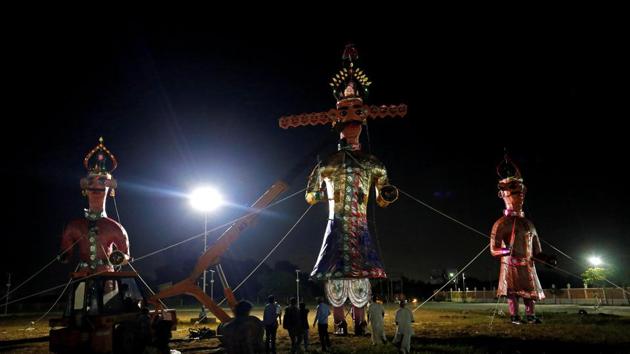
Dussehra is celebrated as the occasion when Hindu god Rama slays the ten-headed ‘demon’ king Ravan, who is widely seen as the chief villain in the Hindu epic Ramayana, that glorifies Rama.

Workers install effigies of Ravan during the Hindu festival of Dussehra in Ahmedabad. (REUTERS)

But, two places in Madhya Pradesh deem Ravan their “healer” and “protector”.

In Mandsaur, which is believed to be the hometown of Ravan’s wife, people consider him as their “son-in-law”.

As per a belief of the region, those afflicted with various ailments tie a red thread on the left leg of the 35-feet high statue of Ravan in the town’s Khanpur area, believing it would cure them.

“Ravan is revered and worshipped here and people have faith that if they tie a thread around his leg here in Khanpur, they would be cured of ailments. People, especially those who are suffering from fevers, come here to get healed,” says Dheerender Singh, resident.

On Saturday morning, people in Mandsaur, especially womenfolk and members of the Namdeo community, started thronging Khanpur to offer prayers before the statue of Ravan .

“People here have immense respect for Ravan and come to worship him, especially on Dussehra,” says another resident, Mohini Bai.

And in Vidisha district’s Ravan village, where his effigy is never burnt, he is worshipped as “the bestower of good luck and protector”, without whose blessings no festive or special occasion is complete.

No marriage is solemnised without first sending a wedding card to Ravan at his temple here. Two-wheelers and other vehicles in this village have Jai Lankesh compulsorily written over them. They believe it prevents accidents.

This village, called Ravan, is located in the Nateran tehsil of Vidisha district, nearly 40 km from district headquarter, where for centuries, Ravan has been worshipped by Kanyakubja Brahmins, a Brahmin sub-sect, to which Ravan belonged.

Inside the Ravan temple, there is a big 10-feet idol of Ravan —in lying position. The local legend is that an unforeseen calamity would strike the village if anyone tries to put the idol in upright position.
  • Neeraj Santoshi
    ABOUT THE AUTHOR
    Neeraj Santoshi

    Neeraj Santoshi is the Chief of Bureau for Hindustan Times in Uttarakhand, where he leads the state reporting team while covering government, politics, environment, wildlife, Uttarakhand High Court, and issues shaping the Himalayan region. With more than two decades in journalism across conflict zones, he has covered politically sensitive regions and environmentally fragile landscapes, and focused on stories that combine public interest with in-depth storytelling. An alumnus of Pune University with a Master’s in Communication Studies, he has reported extensively from Jammu & Kashmir (2003-2010), Madhya Pradesh (2010 to 2018 ) and Uttarakhand (Since 2018), covering subjects ranging from insurgency, elections and governance to wildlife conservation, mining, climate change, agriculture, human rights and social justice. He has covered politics and legislative assemblies of both Jammu & Kashmir and Madhya Pradesh over more than a decade. Before taking over as Chief of Bureau in Uttarakhand, he served as Special Correspondent with Hindustan Times in Madhya Pradesh and earlier reported for both Hindustan Times and The Indian Express in Jammu & Kashmir, where he covered state politics, environment and insurgency-related developments. Over the years, his stories have focused on environmental degradation, wildlife, illegal mining, governance and the changing social fabric of Himalayan states and Central India. He is particularly interested in long-form explanatory journalism, and stories that explore the intersection of ecology, conservation, governance and society. Outside the newsroom, Neeraj enjoys reading widely on neuroscience, consciousness studies, Artificial Intelligence and quantum physics, with a special interest in Kashmiri Tantric Shaivist traditions. He is also passionate about wildlife, mountaineering and the Himalayas, interests that continue to inform his reporting and deepen his understanding of the region he covers.Read More