
 E-Paper



A meditation on the Indian cow
Imagine creating space for these bovines, like it has been done for the deer of Miyajima in Japan, so even strays can be happy and healthy

 Prefer HTon Google


On a sunny winter day, a few years ago, I was sitting in the verandah of a small house in a village on the outskirts of Delhi. I heard the iron gate creak. I looked up and saw a cow resting her head on the gate and peering inside. I was a bit startled. The lady of the house smiled, went inside and brought out a rolled roti. She fed the cow and patted her affectionately. The cow shook her head and went away. I was told the cow is a regular visitor who arrives at the same time every day, eats a roti, and leaves.
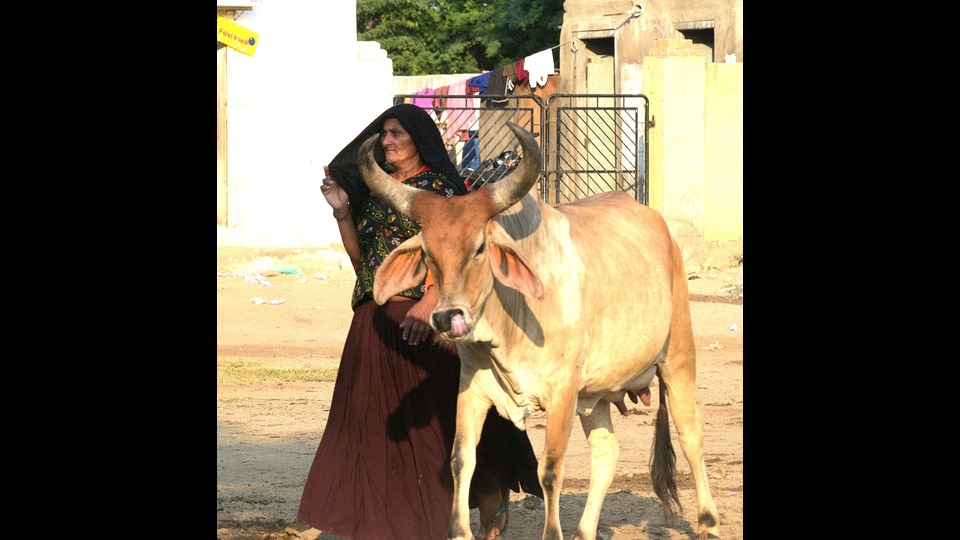
A friend from Australia made an interesting observation. She lived in a service apartment in Delhi and was fascinated to see women from the neighbouring village leave vegetable and fruit peels and leftovers outside their doors. Stray cows came along and ate it. She observed that this was an environmentally friendly way of disposing organic waste.

It is true that cows and humans in many parts of India have a symbiotic relationship. Small open-water tanks used to be built outside the walls of homes in rural north India. They were filled with water every day so stray animals, mostly cows, could quench their thirst in the hot summer months.
On Holi and some other festivals, cow dung cakes are an integral part of the bonfire. Years ago, while making a mural, I experimented with different materials. Sadly, the mural developed multiple cracks after it dried. My domestic help suggested that I use cow dung. She told me that, in her village, everyone made sanjhis on the walls. Sanjhi is a folk art done by women during Navratri in parts of north India that uses clay and cow dung to make images of goddess Sanjhi, a form of Durga. My helper even got me some dung. It wasn’t easy to handle but it worked. There were very few cracks. She also said the dung would ensure that insects didn’t destroy the mural. That was a bit too much for me and I ensured it was disinfected with neela thotha or copper sulphate. The mural still exists.
Cows have been an integral part of religious events and rituals in many homes in the country. In many places, they are treated like family members and are fed the first roti of the day. They are the first to be offered special food during religious festivals like Diwali and on auspicious occasions like weddings. Whether pooris and other high calorie foods are good for bovine health is a topic for another day. But it’s true that Indian cows have been fed human food for centuries and they are perhaps accustomed to it by now.

Frequently mentioned in the religious texts of Indic religions, cows are integral to our mythology: Kamdhenu, the wish-fulfilling cow, emerged from the Samudra Manthan (churning of the ocean); Nandini used her divine powers to raise an army to defeat the king who sought to forcibly take her from Sage Vashistha.
The story of Nandini is unusual considering cows – at least Indian ones – are gentle and friendly animals. So, an innocent woman is called “Allah Miyan ki gai (God’s cow)”. A sentence that’s heard quite often during marriage proposals is: “Ladki toh gai hai; bilkul gai (Our daughter is as innocent as a cow)”.
The statement is objectionable at many levels, but then few can claim that our society is just to girls. Also, it’s a bit of a stretch but, perhaps, Eric Arthur Blair aka George Orwell’s depiction of cows as representing common, easily-exploited folk in Animal Farm’s revolutionary society, owes something to his birthplace of Motihari in Bihar!

Cows don’t exhale oxygen, as an officer of the law claimed, and cow dung doesn’t contain gold particles, as a politician claimed. But they are intelligent and affectionate animals. My grandfather kept a cow; he had to part with her when he grew older because he could no longer care for her. None of his city bred children wanted to look after the cow. I remember him joking that his cow was the only one who eagerly waited for him to get home from work. She always did announce his arrival with a full-volume moo just as he entered the lane. As a child, I helped him bathe the calf while he bathed the cow. I wanted to take the bachiya(calf) back home with me and had to be convinced that it needed to be with its mother, just as I needed to be with mine.
On a recent visit to Miyajima (Deer Island) near Hiroshima, Japan, I was fascinated by its famous free-roaming sika deer, which are considered messengers of the gods. The animals are free, and humans are instructed on how to behave with them.
In Shepperton, near Melbourne, I saw artistically painted fibreglass cows scattered around town. There are cows for all kinds of occasions, events, and businesses. A tennis cow stands in front of the lawn tennis centre, a police cow, complete with cap and uniform, dawdles outside the police station. There’s even a Mooalyn Monroe cow. New cows are regularly introduced to the herd with a cluster of them grazing in a local park. All of them are part of “MOOOVING ART”, a collection of about 100 near-life-size model cows in different themes. A “cow doctor” repairs them when they get damaged. The art project that has been going on for about 10 years promotes the local dairy industry.

As we know, cows are a contentious issue in India. But for a moment, let’s forget the religious and political aspects and imagine real cows, instead of fibreglass ones. Imagine children bathing them, patting their calves, feeding them. Imagine content cows and kids sensitised about animals, who surely have equal rights on our beautiful planet. Imagine spaces created for cows (especially in urban areas), where they can be fed, and where tourists and others can learn about their cultural significance. Anything but the sorry spectacle of them eating polythene bags on the streets of Delhi.
Really, instead of the hate-filled headlines about violence that we have become accustomed to, it would be nice to hear of “cow vigilantes” who actually feed, care and look after these gentle animals and ensure they are healthy and happy.
Prerna Jain is an artist and photographer based in New Delhi. An extensive collection of her work can be found at her website www.prernasphotographs.com and at facebook.com/prernasphotographs. She is the author of My Feathered Friends and Stories Usual, Yet Unusual.


