
 E-Paper



Book Box: Why Salman Rushdie?
Sample Salman Rushdie — sign up for his Substack newsletter, 'Salman's Sea of Stories', read his essays and revisit his award-winning novels to find out what the fuss is all about.

 Prefer HTon Google


“I’ve read all these. Don’t you have any new ones?”
My mother was complaining to the lending library man, in Jamshedpur’s Bistupur market. She was on her weekly trip to replenish her reading, and she’d run through the kiosk’s endless supply of Mills and Boon romances. Thus it was, that scraping the bottom of the barrel that day, library “uncle” dug deeper and offered my mother an unfamiliar yellow jacketed paperback.
And that, dear Reader, was my first brush with Rushdie. I was a 12-year-old, and the said yellow jacket had caused my mother to metamorphose into being moony over a book called Shame, swooning over its satire and wowed by its wordplay. She never went back to Mills and Boon again.
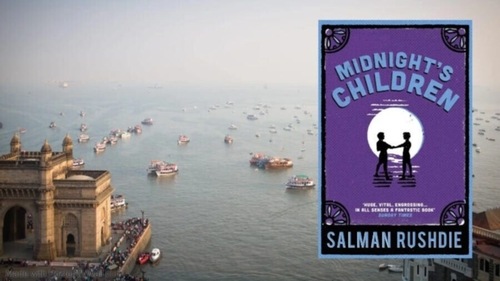
Years later, when I moved to Mumbai to begin work at ANZ Grindlays Bank, I would walk the streets of Bombay by day, and read dazzling descriptions of those streets by night, in Midnight's Children. I was a “paying guest” in the neighbourhood where protagonist Saleem Sinai and Rushdie grew up - on Warden Road in Breach Candy, walking past Scandal Point, searching for its second-hand library. This Booker and “Booker of Bookers” winning book, with its tantalising mix of fact and fiction became a puzzle to ponder over - like Commander Sabarmati — could he possibly be the Commander Nanavati from the infamous Nanavati Murders? And then there was the lush language — the very first time I’d seen words like badmas and bhelpuri make it to a book.
Every reader has their own Rushdie story and I’d love to hear yours — do write in, to the address below.
At my book club, there are Rushdie lovers and Rushdie haters — yet there are some Rushdie books we all root for. But before moving on to these, here are a few fun links.
Start with a word game — played first at a dinner party where Rushdie was a guest. What Robert- Ludlum-like title would you give a Shakespearian play, was a question a dinner party guest asked. Fast as a flash, came the renowned Rushdiean reply — The Rialto Connection for The Merchant of Venice. There’s more and Christopher Hitchens and Rushdie reminiscence about the dinner party here.
Sign up for Rushdie’s weekly newsletter — it’s paid, but well worth it, with an enthralling mix of reflections, short stories, serial fiction and content from the Journalism as Literature class he teaches at NYU. Even though Rushdie lies critically injured in a New York hospital right now, hopefully, he will get back to normal life soon. In the meantime, there is a wealth of archival content you immediately get access to.
And now for the books.
Book1 of 3: A Writer's Memoir
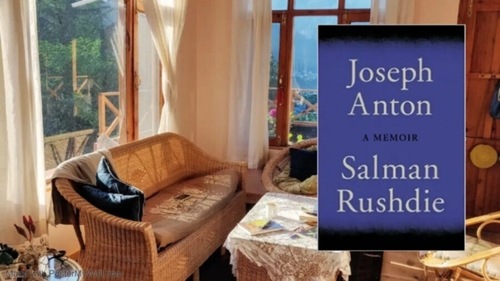
Salman Rushdie spent years in hiding, after a fatwa was pronounced on his life. In Joseph Anton, he gives a detailed account of those years. At 600 pages, it is a marvel of a book, light and chatty, even gossipy, fabulously fluent and thought-provoking. Rushdie used Joseph Conrad and Anton Chekhov to construct his pseudonym and he writes about himself in the third person. “Throughout the writing of the book he had kept a note to himself pinned to the wall above his desk.” “To write a book is to make a Faustian contract in reverse,” it said. “To gain immortality, or at least posterity, you lose, or at least ruin, your actual daily life,” he says in the book.
Book 2 of 3: Essays
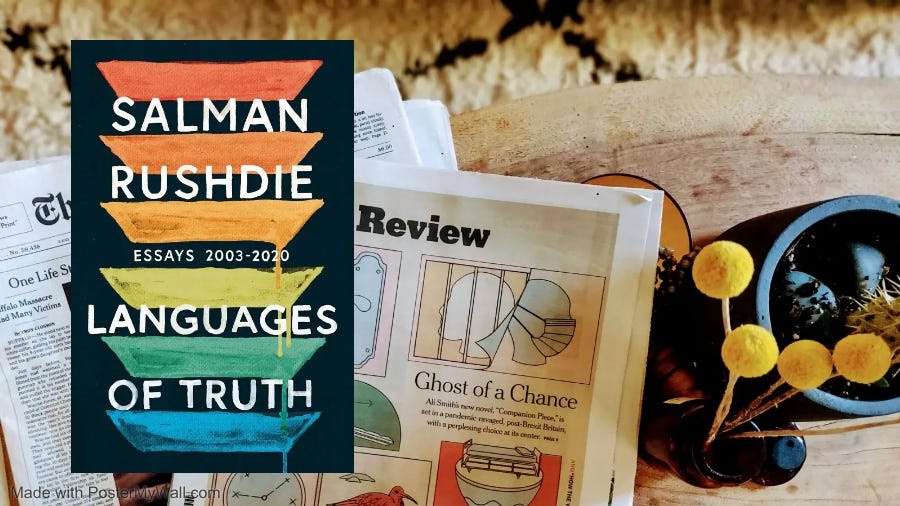
“Great art-or let's just say, more modestly, original art - is never created in the safe middle ground but always at the edge. Originality is dangerous. It challenges, questions, overturns assumptions, unsettles moral codes, disrespects sacred cows or other such entities” says Rushdie in this collection of essays on art and literature. He analyses fairy tales, writes tributes to artists like Bhupen Kakkar and Amrita Shergil and gives compelling explanations for why we need imagination. Languages of Truth is a collection of essays that cries to be read and re-read and will be an amazing addition to your library.
Book 3 of 3: A Children’s Book
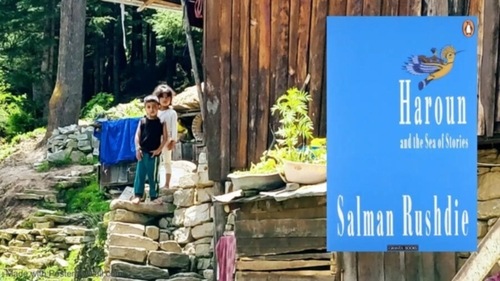
This marvellous children’s classic is just perfect to read aloud to your children. Haroun and the Sea of Stories is full of allegory and bi-lingual word play — In the magical land of Kahani, there are two parts, one is the land of Gup where free speech is practised and the other is Land of Chup where speech is not allowed. There’s Princess Batcheat and Prince Bol and a little boy called Haroun who sets out on an adventure to restore the sea of stories, fighting foes, including Khattam Shud, modelled on Iran’s Ayatollah Khomeini.
And finally, listen to Rushdie talk about 3 objects that tell the story of his life in this Penguin podcast.
As we send our collective good wishes to this brilliant writer, who is now recovering from multiple stab wounds, we’d love to know your favourite Rushdie moments? Do write in, with comments and recommendations.
Next week, we bring you stories of women, to celebrate Women’s Equality Day on August 26.
Until then, Happy Reading!
Sonya Dutta Choudhury is a Mumbai-based journalist and the founder of Sonya’s Book Box, a bespoke book service. Each week, she brings you specially curated books to give you an immersive understanding of people and places. If you have any reading recommendations or suggestions, write to her at sonyasbookbox@gmail.com
The views expressed are personal


