
 E-Paper



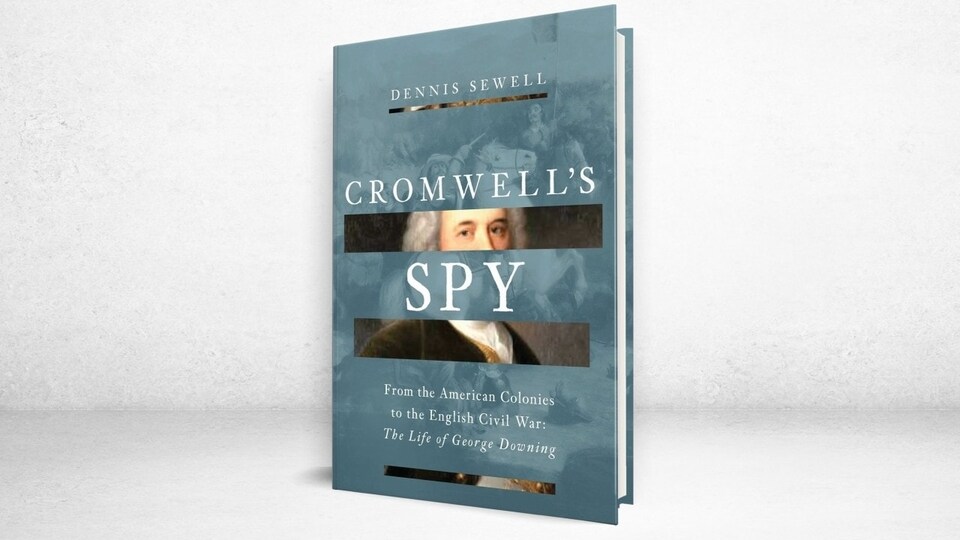
‘Cromwell’s Spy’ Review: A Schemer in the Shadows
Spying was George Downing’s true calling. He especially loved word-substitution ciphers—and turning on allies when it suited him.


 Prefer HTon Google


London’s Downing Street—best known for its most famous resident—shares its name with a quieter street in New York City’s Greenwich Village. Both commemorate the same man. Not a bad legacy, considering George Downing is summarized by his biographer thus: “Liar, blackmailer, seducer and thief, this double-dealing shapeshifter would betray both friends and principles without a moment’s misgiving.”
Born in Dublin in 1623, Downing spent his childhood in London before emigrating to New England with his family as part of the Puritan migration. (John Winthrop, the founding governor of the Massachusetts Bay Colony, was his uncle.) A member of Harvard’s first graduating class in 1642, Downing initially served as a preacher aboard a Caribbean trading vessel. Returning to England, where Royalists and Parliamentarians were at war, Downing was appointed chaplain to Col. John Okey’s regiment in Parliament’s New Model Army. Later he served as chaplain and secretary to Arthur Hesilrige, a member of parliament and a close friend of Downing’s father. Downing’s abilities would catch Oliver Cromwell’s attention, leading to his appointment as scoutmaster general—the head of Parliament’s intelligence operations.
As Dennis Sewell shows us in “Cromwell’s Spy—From the American Colonies to the English Civil War: The Life of George Downing,” spying proved Downing’s true calling. Mr. Sewell, a contributing editor at the Spectator and a former reporter for the BBC, provides us with fascinating glimpses into the “shadowy world” of 17th-century espionage, from disguises and surveillance techniques to Downing’s favorite: word-substitution ciphers. Using that scheme, names and terms associated with a mission were allocated code words, explains Mr. Sewell, allowing the spy “to adopt a cover identity and, like an actor, remain in character as he crafted his reports”—a “grain merchant,” for instance, might refer to cavalry as “wheat” or artillery as “barley.” Transcribing coded letters as examples, Mr. Sewell expertly explains their meanings and shows he’s a bit of a codebreaker himself.
The book’s narrative is accessible and brisk, delivered in easy prose and a light, journalistic style with sprightly turns of phrase; Downing learned from his father, Mr. Sewell tells us, “to have an eye to the main chance, and the importance of being shameless.” There are occasional historiographical nods, to Samuel Eliot Morrison and C.H. Firth, for instance, but mostly this is a book unencumbered by visible scholarship. Downing himself sometimes recedes from view, reflecting limited surviving documentation—not altogether surprising for one who spent his life hiding from view. Even basic aspects of his domestic life remain obscure. Though he married into the powerful Howard family, we know little of his wife, Frances. (Not even her portrait survives.)
Mr. Sewell outlines broad contexts and settings, such as 17th-century Scotland, where secret-agent Downing helped secure the surrender of Edinburgh Castle in 1650. We learn about Britain’s many religious denominations, including fringe groups such as the Ranters and the Fifth Monarchists, and about the turncoats, who were “ten a penny” in Downing’s time. There’s Edward Wogan, “an astonishingly daring Irishman” who fought for the Roundheads before he flipped sides; Gen. George Monck, a “battle-etched veteran” and “a collaborator in many a murky scheme,” who had “an invaluable lesson for young Downing: one can swap sides and yet prosper.”
Mr. Sewell presents Cromwell and Downing as men of similar attitudes. Downing was “adept at switching between the material and the spiritual,” a realist willing to wink at disagreements and who favored “subtlety, sophistication and restraint.” While historians often portray Cromwell as “a hypocrite or a double-dealer,” here he’s a dexterous politician, a pragmatic and adaptable leader who “could ride two horses at once, while advancing three agendas.”
If Downing was a vicious man, he suited his times. Violent death was everywhere, on and off the battlefield. In 1649 Charles I was publicly beheaded. Arthur Aston, the commander of Royalist troops, “was beaten to death with his own wooden leg,” Mr. Sewell tells us. The Marquis of Montrose, fleeing after the Battle of Carbisdale (1650), was “hunted down, captured and taken to Edinburgh, where he was hanged . . . at the Mercat Cross,” his head later impaled “on a spike above the Edinburgh Tolbooth, where it remained, come rain, wind and snow, for many months.”
After being elected to the First Protectorate Parliament, Downing continued his espionage activities. Stationed in The Hague in 1658, he quietly pursued Royalist exiles at their local bookshop. However, by the time political tides turned and Charles II was restored to power in 1660, Downing had also turned. The facts of his “dramatic defection” are contested; Mr. Sewell offers three competing accounts, but the outcome is clear: Spy Downing soon enthusiastically aided the Royalists to capture the regicides—among them his own former friends Hugh Peter and John Cook. Both men would suffer horrific executions of unimaginable brutality.
As teller of the Exchequer, Downing later contributed to financial reforms in Britain’s Treasury, promoting Dutch-style credit practices, against the opposition of Edward Hyde, Earl of Clarendon. Downing’s Dutch connections also facilitated the transformation of New Netherland into the British province of New York in 1664.
Downing’s posthumous reputation (he died in 1684) will likely always rest on his deceitfulness. Samuel Pepys knew him; the British diarist thought him “a perfidious rogue.” Of the “‘dog’ Downing,” John Adams, the former U.S. president and a fellow New Englander, recorded, tongue-in-cheek, in 1818: “Far from boasting of thee as my countryman, I should wish that thou hadst been hanged, drawn and quartered. . . . But no! This is too cruel for my nature. I rather wish that you should have been obliged to fly and repent among the rocks and caves of the mountains of New England.”
Mr. Sewell grants that the English Civil War “had a way of making double-dealers out of even the most honest men and women.” But Downing still stands apart, a reminder of how brutal human nature can be during polarized times. His hands, Mr. Sewell concludes, will be “forever stained with blood.”
Mr. Spencer is a professor of history at Brock University and the editor in chief of “The Bloomsbury Encyclopedia of the American Enlightenment.”


