
 E-Paper



Review: Manto & Chughtai: The Essential Stories
Short stories by Manto and Chughtai that explore the Partition, sex, and sexuality continue to be relevant


Saadat Hasan Manto, a master of modern Urdu literature, made a mark with his radical writings, journalistic and otherwise, long before he witnessed the Partition of India. He died seven years after the event, aged just 43, leaving a novel, several collections of short stories and a few film scripts. Decades after his death, his humane stories about the struggles of the common people remain relevant. His short story, Toba Tek Singh, a dark satire on the ridiculousness of exchanging Hindu and Muslim lunatics after Partition, reads like a commentary on the times we live in.
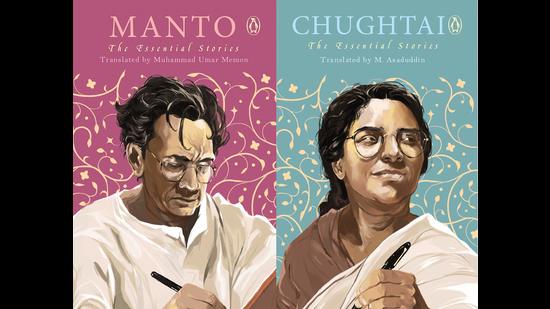
Manto: The Essential Stories is a collection of six short stories. Arranged under the subheads Partition, and Sex and Sexuality, these pieces are sharp, brutal and timeless. His “feminist” writings expose the institutionalised exploitation of women and are a show of solidarity with them. In his Partition stories, women are a metaphor for the rape of humanity. His male characters are often empathetic to the plight of women even though they are seldom catalysts for change.
Manto wrote unabashedly about sex and sexuality, and was charged with obscenity in Pakistan, his home after Partition. His women are not shy of displaying sexual urges and somehow make the men look small and petty. In Frozen, Kalwant Kaur kills her lover Eshar Singh when he fails to arouse her and admits to cheating on her. In one of his short stories, not included in this collection, a male character is raped by a woman. In Sharda, Nazir treats a sex-worker and her child with affection even as his patriarchal views about the role of women remain unchanged.
Manto exposed the absurdity of the unending cycle of violence inflicted on women by both Hindus and Muslims to seek revenge against each other’s communities. In Open It! a strikingly beautiful 15-year-old is gang raped not only by the enemy, but by her “own” too.
“The doctor glanced at the body lying on the stretcher. He felt the pulse and, pointing at the window, told Sirajuddin, ‘Open it!’ Sakina’s body stirred ever so faintly on the stretcher. With lifeless hands, she slowly undid the knot of her waistband and lowered her shalwar. “She’s alive! My daughter is alive!” Old Sirajuddin screamed with unbounded joy. The doctor broke into a cold sweat.
Readers are treated to several hitherto unknown details about Manto in a chapter called My Friend, My Enemy written by Ismat Chughtai, whose stories of Partition and sexuality are also a part of this book. Both Chughtai and Manto were controversial Urdu writers of the 20th century. Both refused to conform to the whims of the mainstream, and were often in trouble for their writing.
Recalling her first meeting with Manto in Bombay, Chughtai describes him as a man who was not dictated by conventional concepts of good and evil. She once asked him if he believed in love and he surprised her with a “no”. He admitted he had loved his son, who died as a toddler, and that he liked taking care of him. Reluctantly, he also spoke of a shepherd girl in Kashmir whom he loved. “I would hold my breath and wait for the moment when she would lift her hand and I would have a glimpse of her elbow.”
She recalled meeting him once with a broom in hand, sweeping the floor. His wife told Chughtai, “…I just said cooking and household chores are not for men. At this he flared up,… took a broom and began sweeping.” When Manto’s first daughter was born, Chughtai saw him “wringing nappies and hanging them on the clothesline to dry”.
He did not patronise women in real life or in his literature. In Manto’s world, men and women were equals. He treated prostitutes with dignity and saw them as legitimate sex workers, even as many believe he projected women as titillating “sex objects”.
The two writers fell out when Manto decided to move to Pakistan on an impulse. Chughtai believed he was being a coward. A few years later, disenchanted with Pakistan, he asked her to call him back “by any means”. She ignored his letters, and then she received the news that he had been sent to a mental asylum. Finally, she learnt of his premature death.
Chugtai’s stories too are just as relevant now as they were when she first wrote them. She is best known for her most controversial story, Lihaaf (1942), which deals with lesbianism. She was tried on charges of obscenity for this story but she continued to fearlessly explore female sexuality in her writings and to expose society’s double standards.
Her stories of the zenana (the female quarters) are moving. The Wedding Suit is about a widow trying desperately to marry off her not-so-young daughter while Touch-Me-Not is about the fears of a beautiful Begum who may lose her kingdom if she is unable to have a child. Chughtai’s genius is revealed in this line from The Wedding Suit: “The thought of a man did not come to her as a longing, but as an answer for her need for food and clothing.”
Kafir and Gainda play out against the backdrop of caste-class politics. In the former, a girl, “Musalmanti”, and boy, “Kafir”, who grew up as neighbours want to solemnise their relationship but worry about the girl’s nose being chopped off. (“If I become a Hindu, my nose won’t be safe even if I get one made of rubber”).
Manto and Chughtai’s works have been rendered into English by M Asaduddin and Muhammad Umar Memon respectively, both men with impeccable credentials. A whole new world is now ready to embrace the rich legacy of Manto and Chughtai. It’s a world that both are probably mocking from up above.
Lamat R Hasan is an independent journalist. She lives in New Delhi.


