
 E-Paper



Review: Who Me, Poor? by Gayatri Jayaraman
A new book states that some young seemingly affluent Indians are actually struggling to survive


Right at the start, let’s accept that there is no equality. Instead, there’s yawning poverty that, like the fearsome water in Samuel Taylor Coleridge’s The Rime of the Ancient Mariner, threatens to engulf many. Now that the blinders are off and you’ve got that out of the way, there can be some real talk.

There’s no need to close your eyes to the lives withering away on the pavements. There’s no reason any more to blame the poor for being poor. There’s no avoiding looking at the disheveled faces gliding from car to car at road crossings. There’s no denying that beyond the gadgets and the glamourous jobs that we crave, exist lives that have so few possessions, they can be counted on 10 fingers.
This poverty is real.
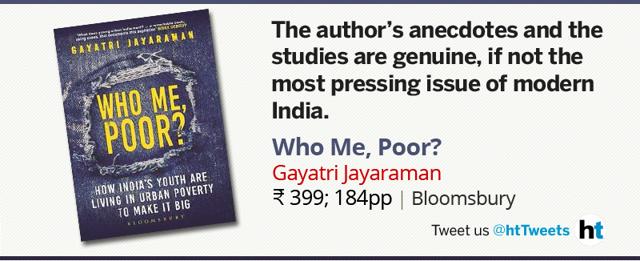
But so is Gayatri Jayaraman’s conception of the ‘urban poor’. What began as a Buzzfeed article last year that boldly claimed, and was widely mocked, for saying ostensibly affluent young Indians were going hungry because they were eager to invest in the Brand ‘I’ has now been transmuted into a book of essays. With nearly the same content as Jayaraman’s original article, ‘Who me, poor?’ explains young upper middle class Indians don’t have it all despite their Instagram feeds featuring five-star menus and trips to Goa.
A lot like Pink Floyd’s two lost souls swimming in a fish bowl year after year, the millennial and the generation after have been entrapped in a heightened definition of individualism. The trend of the time is to be unique. As irony would have it, corporates will ask you to do something out-of-the-box to prove yourself while doing everything to control that ebullience. Startups, of course, will only accept you if you demonstrate that you can think spectacularly outside the box. Those who opt for the security of a nine-to-five job, that seats them at identical desks and yet expects them to brim with creativity, are left weary of their crisp suits. They lose their sense of the self. They’ve been drafted into the herd. What’s more, they are expected to be their own shepherds.
The startup, a fresher option of the day, will allow fulfilment of bohemian fantasies but there’s the danger that it might leave its staff stranded before their careers take off.
So much for jumping out of the fish bowl.
But there’s a commonality between both categories of employees. They are excessively active on social media and have internalised the idea that first impressions are important and that networking is necessary. All employees have been told, again, and again, of the need to say and do the right things to be noticed. This leads introverts to grapple with the terrible idea that his or her staunch work ethic might not be enough to get ahead within a company. These pressures, Jayaraman says, are what the ‘urban poor’ are struggling to cope with. Add to this, these young people are broke because they’d rather build their image online, go out with friends, and wear branded clothes than pay their rent on time. It’s the curse of the post-2008 Wall Street crash combined with strides in technology, and advertising that insists on defining the individual in 140 characters.
Jayaraman’s arguments are plausible but they don’t acknowledge those who are born into a cycle of government-defined poverty, who go hungry and live on throwaways because they have no resources. The author’s anecdotes and studies are genuine, if not the most pressing issue of modern India.
To a certain degree, Jayaraman’s ‘victims’ are beyond sympathy. They definitely aren’t the urban poor. Why? Because the educated casualties of this century’s spiral still have potent options - self-realization and will - that can get them out of their holes.
Read more: I ate only white food on Tuesdays
They only have to look outside their ornamental French windows and recognize the deadlier evils of the world.


