E-Paper



Intel’s Move Toward Nationalization Won’t Work—at Least for the Long Haul
Federal support could get the troubled chip maker over some hurdles, but risks great harm to the U.S. tech sector.


 Prefer HTon Google


Intel definitely needs help. But government support always comes with strings attached, and those strings in this case could ultimately trip up the Silicon Valley pioneer—and the broader U.S. chip industry.
The Trump administration is discussing options with Intel that could involve the federal government taking a financial stake in the troubled chip maker. The idea came up during President Trump’s meeting with Intel Chief Executive Officer Lip-Bu Tan on Monday and the discussions are still in an early stage, The Wall Street Journal reported.
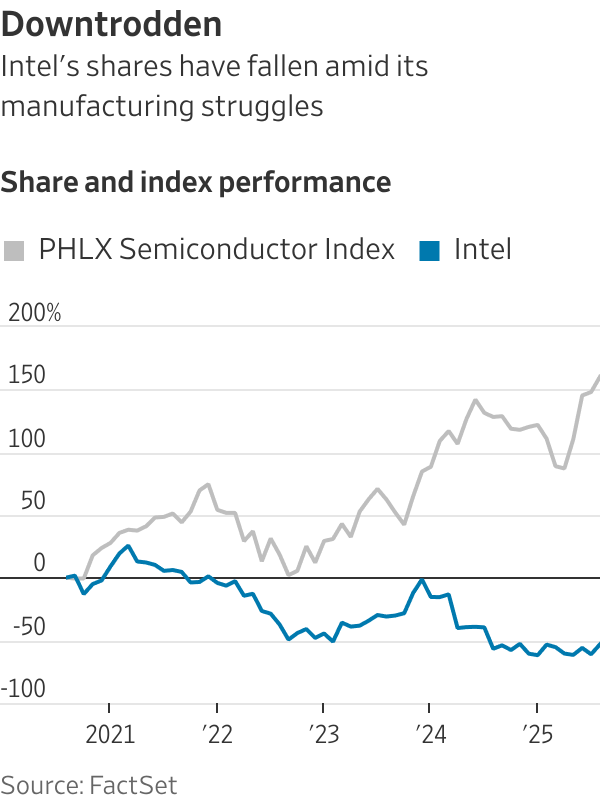
That marks a fast turnaround, given Trump was calling for Tan to be fired just days ago. The news was encouraging for Intel’s beleaguered investors, who have watched the chip industry’s once undisputed leader lose more than half its market cap in less than two years. The stock jumped 7% Thursday on the initial reports of the talks and gained more ground early Friday morning.
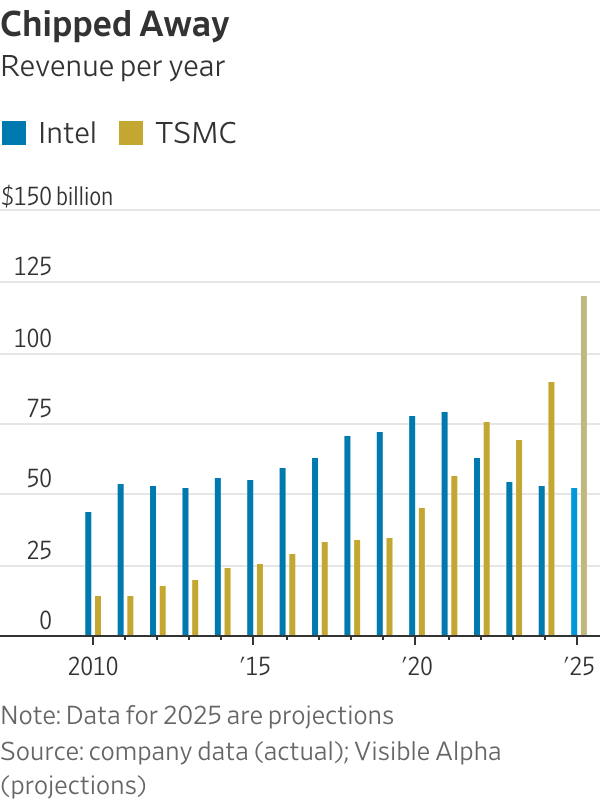
But investors should still be wary. Intel’s problems are such that even a big check from Uncle Sam won’t fully solve them. The company has burned a total of nearly $40 billion in cash over the past three years trying to regain its manufacturing lead from Taiwan Semiconductor Manufacturing Co., or TSMC. Intel has also been granted up to about $8 billion so far in direct funding through the Chips Act.
But that hasn’t been enough. Intel’s most state-of-the-art production process called 18A was supposed to close the gap with TSMC. But the company admitted on its second-quarter earnings call last month that 18A will be used mostly for its own products—meaning few outside chip designers have found the technology compelling enough to sign on as customers of Intel’s contract manufacturing service. Wall Street expects another $7 billion in negative free cash flow for Intel this year, according to estimates from Visible Alpha.
Tan told investors in the same call that he won’t commit major capital spending to Intel’s next process—called 14A—without commitments from external customers. That was widely seen as Tan drawing a line in the sand—a line by which he would determine whether to keep Intel in the business of manufacturing chips.
But Intel pulling out of that business would be detrimental to the government’s efforts to shore up domestic chip making for national-security and supply-chain stability reasons.
Most of the world’s most cutting-edge chips are manufactured in Taiwan—a growing flashpoint for tensions between the U.S. and China. Major U.S. companies including Apple and Nvidia rely on those chips for their products and would face severe economic hardship if a war choked off their supply. For all its problems, Intel is the only U.S.-based company capable of manufacturing cutting-edge chips.
So the government’s interest in Intel as a national-security matter is real. But taking a stake in the company could have vast unintended consequences, especially given Trump’s recent propensity for trying to exert direct influence over private business decisions. His call for Tan’s ouster was only one such example in the past week. He also demanded—and got—Nvidia and Advanced Micro Devices to agree to fork over 15% of the revenues they make selling AI chips into China.
Even partial government ownership of Intel could put that unwelcome trend into overdrive. It would add to the levers Trump—or any future president—can pull to manipulate how private companies behave, something governments tend to be bad at.
The government might for instance pressure chip designers like Nvidia, AMD or Qualcomm to manufacture with Intel, perhaps as a condition for getting export licenses for China.
And that could easily go wrong. If companies are forced to use Intel’s factories before they can make chips with production yields that match TSMC’s, it could result in inferior products and wastage by Intel because so much silicon has to be thrown out to make a working chip. More broadly, if chip designers are using Intel fabs even though they aren’t the most advanced or efficient, the entire U.S. chip industry could lose competitiveness. That would undermine the ultimate goal of government intervention in the industry, which is to maintain American technological supremacy.
President Joe Biden attended the 2022 groundbreaking of an Intel semiconductor facility in Ohio.
The rubicon of state intervention in chips is already crossed. The administration already has significant leverage over Intel thanks to government factory-expansion grants that place limits on how it can restructure its chip design and manufacturing arms without government consent.
But the Federal government must take care not to go too far, lest it undermine the market model that made America’s technology sector the envy of the world.
Write to Dan Gallagher at dan.gallagher@wsj.com and Asa Fitch at asa.fitch@wsj.com