E-Paper



Major auto industry events and shifts that defined 2025
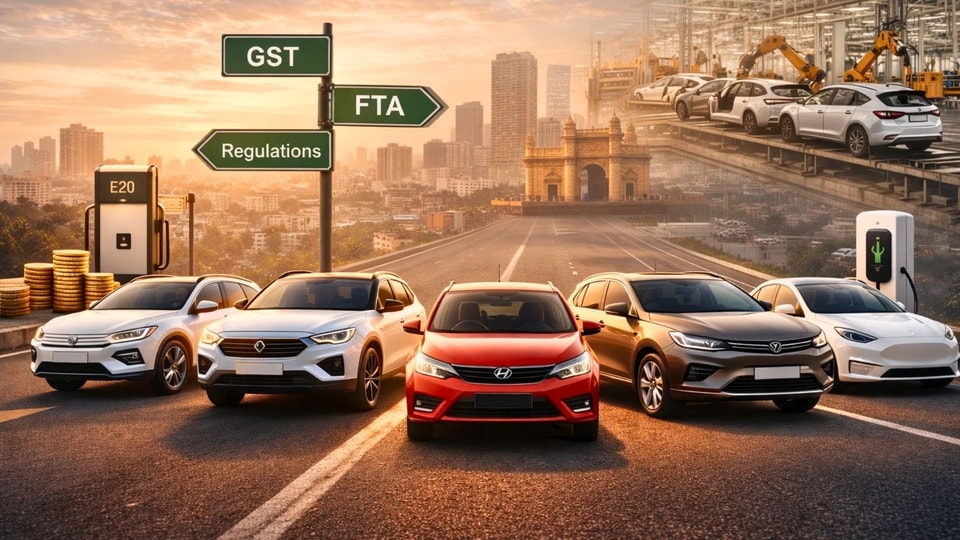
From GST changes to fuel rules and EV policy, 2025 showed how government decisions reshaped India’s car market more than launches.

 Prefer HTon Google


India’s car market in 2025 was shaped less by flashy launches and more by decisions made far from showroom floors. Government policy, tax restructuring, fuel mandates and regulatory shifts played an outsized role in influencing what buyers paid, what manufacturers prioritised and how the market eventually recovered after a slow start.
Policy decisions quietly reshaped the market
The year began with the Union Budget in February, which delivered two signals at once. Import duties on motorcycles below 1,600cc were reduced across CBUs, SKDs and CKDs, slightly easing access for global brands. More importantly for the long term, customs duties were removed on lithium-ion battery cells, battery management systems and key EV manufacturing inputs, reinforcing the government’s intent to strengthen domestic EV production.
February also saw relaxed import norms for vintage cars, expanding licence-free imports to vehicles older than 50 years. While high cumulative taxes keep these imports niche, the move was seen as a practical update rather than a symbolic one.
Fuel policy followed in April, when E20 petrol replaced E10 nationwide. Although newer vehicles were recalibrated for the higher ethanol blend, real-world efficiency losses turned out to be higher than early projections, particularly for older BS4 vehicles. Concerns around compatibility and long-term impact remained unresolved through the year.
(Also Read: India emerges as the biggest source of cars sold in South Africa)
April also marked a shift on the manufacturing front, with Renault taking full ownership of its Chennai plant after Nissan exited the joint venture. With complete operational control and a new design centre inaugurated in the city, Renault underlined India’s growing importance beyond just assembly.
Trade, tax reform and regulation changed buying economics
Trade policy entered the picture in July with the signing of the India-UK Free Trade Agreement. Over the next five years, duties on UK-built luxury cars and motorcycles will fall sharply under a quota system, opening the door to meaningful price corrections for premium brands. In return, Indian-made EVs are set to gain duty-free access to the UK market later in the decade.
September brought the most decisive intervention of the year with GST reforms. Lower tax rates for compact cars and two-wheelers, along with the removal of the cess-based structure for larger vehicles, allowed manufacturers to reset pricing. Many brands went beyond the mandated reductions, using the timing to stimulate demand ahead of the festive season.
Regulation tightened elsewhere. Draft CAFE 3 norms proposed stricter fleet-wide efficiency targets, pushing manufacturers to rethink product mixes and rely more heavily on hybrids and EVs to balance emissions. At the ownership level, Delhi’s enforcement against older vehicles and stricter PUC rules increased compliance pressure, even as some measures faced public resistance and rollbacks.
(Also Read: Tata Motors to lead India’s EV sales in 2025; MG close behind, Mahindra third)
New arrivals, old nameplates and a late recovery
While policy dominated the narrative, the year still delivered notable milestones. Several long-running nameplates marked major anniversaries, reinforcing their continued relevance. Models such as the Hyundai Creta, Toyota Innova, Maruti Swift, Alto and Mahindra Bolero crossed significant age and sales landmarks, highlighting the staying power of familiar brands.
Electric mobility gained visibility with the arrival of Tesla’s Model Y in July, supported by a high-speed charging network, followed later in the year by VinFast’s entry with two electric SUVs and broader manufacturing plans.
The midsize SUV segment also became increasingly crowded, with multiple launches and confirmations underlining its strategic importance heading into 2026.
After a slow first nine months, the market finally found momentum post-GST. Festive-season demand helped reverse earlier declines, pulling the industry into an estimated 4.5-5 percent growth for the year. In the end, 2025 stood out as a reminder that in India’s car market, policy decisions often matter as much as the products themselves.