
 E-Paper



Basmati farmers worried, US sanctions on Iran loom over exports from Punjab
Basmati rice exporters of Punjab are a worried lot. The aromatic basmati variety 1509 has already arrived at the mandi in Amritsar, Tarn Taran and Gurdaspur districts, but with US trade sanctions on Iran, India’s basmati exporters may lose orders worth many billion dollars.


Basmati rice exporters of Punjab are a worried lot. The aromatic basmati variety 1509 has already arrived at the mandi in Amritsar, Tarn Taran and Gurdaspur districts, but with US trade sanctions on Iran, India’s basmati exporters may lose orders worth many billion dollars. If exports are stopped to the cash rich middle-eastern country, farmers of Punjab and Haryana will face a direct hit.
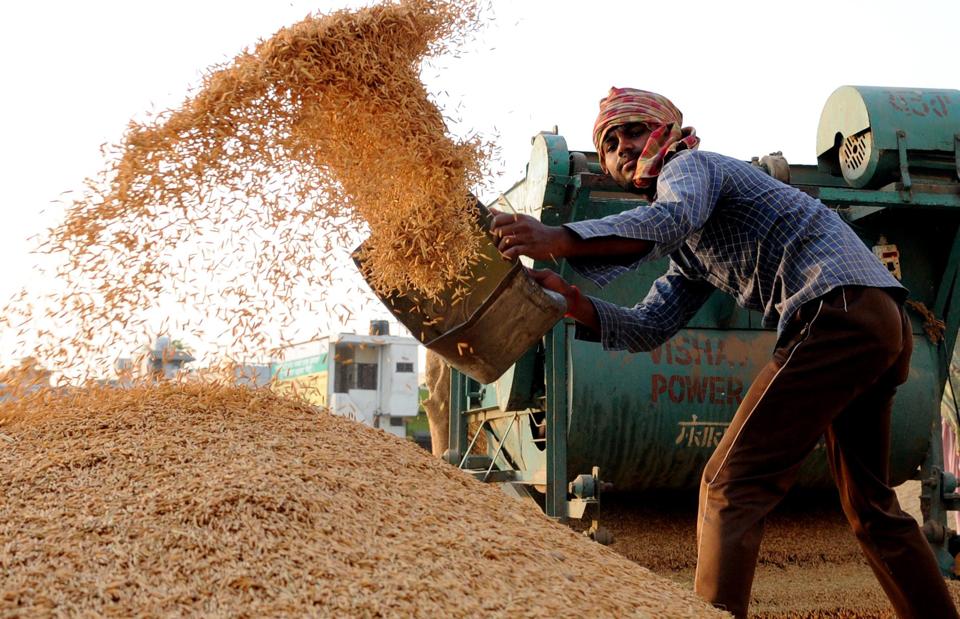
Of the total of 15 lakh acres under basmati cultivation this season, the 1509 variety is sown over 40% of the area (6 lakh acres) and rest–1121 variety– is expected to ripen in November.
The rice that forms the bulk of Iran’s staple diet is 1509 and 1121 varieties, both famous for their long grain and aroma. In Punjab, they are grown in districts of Amritsar, Tarn Taran, Gurdaspur, Hoshiarpur, Muktsar and Fazilka. In Haryana the aromatic variety is grown largely in Travadi belt in Karnal and adjoining districts.
Additional chief secretary (agriculture) Visawjeet Khanna said that the state government and basmati exporters are working out a solution. “Our foremost challenge was to diversify to basmati from the water-guzzling coarse grain paddy, which we have done successfully,” he said.
Basmati exporters are also worried because huge payments of the previous year are pending from Iran.
Harmeet Singh a farmer from Qadian (Gurdaspur) said despite uncertainty over the sanctions issue, farmers opted for basmati to conserve ground water. “If promoted properly we can sell our crop at a good price,” he added.
A look at the numbers explains why farmers are concerned. Of the total 40 lakh tonne basmati (worth ₹30,000 crore) exported from India every year, 15 lakh tonne goes to Iran, with Punjab and Haryana collectively contributing to 75% grain for export, and Punjab contributing the larger share.
Keeping the issue of sanctions aside, in Punjab, by the joint efforts of state agriculture department, more farmers opted to grow basmati, increasing the area under the aromatic variety from last season’s 5.28 lakh hectare to 6.29 lakh hectare.
In 2017-18, the state’s grain ran into trouble when a large chunk was sent back from European countries, over traces over weedicide in the grain which was higher than permissible limits.
“Punjab is an important part of geo-tagged area for aromatic grain cultivation. We have the patent and we will not lose it. I am sure we will do better than the previous year–be it an increase in area under cultivation, better quality grain and higher yield,” said Khanna.
After the 2018-19 fiasco, basmati growers and state department took corrective steps to make the grain acceptable to importers and farmers too made a good profit selling the produce at ₹3,600 to 4,000 a quintal with each hectare yielding up to 50 quintals.
Director agriculture Sutantar Kumar Airi said the department was able to control usage of harmful pesticides and weedicides such as Acifet, trizofan, thiamithoksam, carbandazim, tricyclazole, buprofazin, carbofeuron, propiconazole and thiofinate methyl. “This will make difference to our crop,” he added.
Ashok Sethi, a basmati exporter, said arrivals have started in Amritsar in smaller quantities. He said the situation is tense regarding basmati exports. Iran and Bahrain buy 40% of the total basmati exported from India. Other countries such as Canada, Australia and Europe also buy from India.


