
 E-Paper



Chandigarh admn sets the ball rolling to save Sukhna
Tender floated for 2MLD sewage treatment plant near Kishangarh


In the wake of the Punjab and Haryana high court order for preservation of Sukhna Lake, the UT administration will construct a sewage treatment plant (STP) in Kishangarh village here to save the man-made water body.
The proposed 2 million litres daily (MLD) STP to be built using MBR (membrane bioreactor) technology will fill the lake near Kishangarh and will also solve the problem of sewage entering the Sukhna forest area.
MBR is the combination of a membrane process like microfiltration or ultrafiltration with a biological wastewater treatment process. When used with domestic wastewater, MBR processes can produce effluent of high quality enough to be discharged to coastal, surface or brackish waterways or to be reclaimed for urban irrigation.
Officials said the tender for construction of the STP at a cost of ₹20 crore has been floated, and the project is likely to be completed by the next eight months.
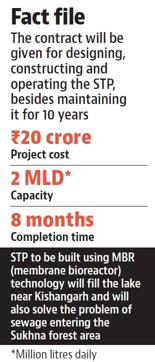
Confirming the development, a senior UT official said, “The contract will be given for designing, constructing and operating the STP, besides maintaining it for 10 years after six months of trail run and one year defect liability period.”
SOLVING THE PROBLEM
Around 2 million gallons daily (MGD) of sewage generated by Kishangarh village was daily discharged into a choe near the lake. “Last year, the National Green Tribunal (NGT) committee in Chandigarh, along with the officials of Chandigarh Pollution Control Committee (CPCC), had also visited the area and observed the level of pollution. After the NGT directions, the sewage from the village was being dumped in a sump (low space that collects often undesirable liquids such as sewage). After the STP is constructed, this sewage could be used to fill up the lake and also stop any flow to the lake or nearby choes,” said the official.
HANGING FIRE
While the proposal to set up the STP was mooted in 2017, the project could not take off. The UT administration had even submitted a proposal on constructing the STP before the high court during the hearing of the save Sukhna case in 2017.
The rain-fed Sukhna lake at the foothills of the Himalayas was created way back in 1958 by damming the Sukhna choe, a seasonal stream coming down from the Shivalik Hills.
In a series of directions related to preservation of the lake, the high court had last week directed the administration to ensure that the average capacity of the lake is increased by at least about 100-150 hectares by one-time large scale desilting (dredging) of the lake. The administration was also directed that the capacity once created should be maintained through regular dredging.
Apart from this, the authorities in Punjab, Haryana and Chandigarh were directed to lower the storage capacity of the check dams to ensure regular flow of water into the lake. The states of Punjab, Haryana and Chandigarh have also been directed that no waste water or sewage flows into the river from Kansal, Kaimbwala and Saketri villages.


