
 E-Paper



Chandigarh’s positivity rate shoots up to 9.6% in July as admn ramps up Covid testing
Till June, out of every 100 people being tested, only around five were being confirmed positive, which has now increased to more than seven

 Prefer HTon Google


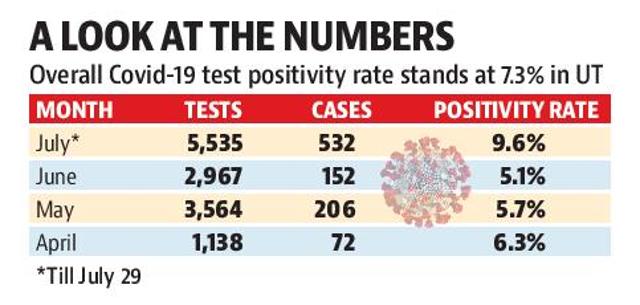
As the number of infections crossed the 500 mark in July with ramped up testing numbers in Chandigarh, the confirmation rate (also known as test positivity rate) has gone up to 7.3%, a surge of 1.3% from the onset of this month.
Till June, out of every 100 people being tested, only around five were being confirmed positive, which has now increased to more than seven. It is mainly due to the confirmation rate of July being a record high at 9.6% with two days still to go. This trend is being witnessed amid the UT conducting around 40% of the total tests in just July and 50% of the total cases have also surfaced in the same period.
Dr Rajesh Kumar, former head of the department of community medicine and school of public health at the PGIMER, says this shows the pandemic is on the upswing.
“Test, track, and treat is the only option. World Health Organisation suggests that test positivity rate should be below 5%. Thus, here the strategy should be to increase the testing numbers and surveillance for the symptomatic people. With more samples being tested, more people with the infection will be identified and sent to isolation and it will help in containing the outbreak,” he said.
“With increase in testing numbers, more people are testing positive, pushing up the confirmation rate,” said UT health secretary Arun Gupta. “We have a targeted approach towards testing and the numbers are gradually going up. The testing for all non-family contacts was not very much desired earlier, as mostly they were isolated with the provision that they will check for symptoms and report to the department. Now, we have decided to test all contacts.”
Dr G Dewan, director of the health and family welfare department, said: “ We have started door-to-door survey on the basis of mapping again. Moreover, we have started taking samples in all government hospitals. All patients reporting to flu clinics are tested and hospitalised if positive. Also, people are less afraid to come forward to get tested now, which has increased the testing numbers.”
Dr RS Bedi, former president of Indian Medical Association’s Chandigarh chapter, said testing more number of people, even if they are not from the high-risk category, makes sense and the upward trend should continue. “Testing should be open to all to detect the infection,” he said.
Meanwhile, the UT health department is planning to introduce rapid antigen testing to cover asymptomatic cases across government hospitals and further increase the testing numbers. At least 1,000 such testing kits are already being procured by the PGIMER to be used primarily for OPD patients to validate their usefulness.
“The order for around 2,000 antigen test kits will be placed and they are expected to come in the first week of August. This will increase the testing numbers, even though the authenticity of the tests is low,” a senior UT health official said.


