
 E-Paper



School buses to get right of way in Chandigarh
Buses to have seat belts for all students, autos can’t ferry more than four kids, court tells administration


In a slew of directions for ensuring safe travel of students in Chandigarh, the Punjab and Haryana high court on Friday made it mandatory for vehicles to give the “right of the way” to school buses, on the lines of ambulances.
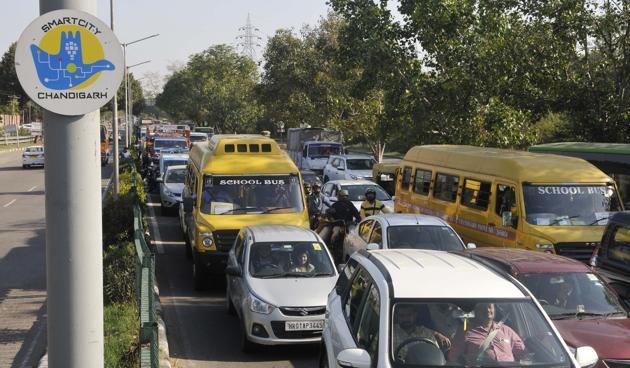
A special division bench comprising justice Rajiv Sharma and justice Amol Rattan Singh also banned ferrying of more than four schoolchildren in autos, observing that sometimes even 10 students are seen seated in the autos, “which is very dangerous”. The UT administration has also been asked to convene a meeting and ensure all buses are fitted with seat belts for all the students being ferried in them.
The Motor Vehicle (MV) Act provides for a fine of ₹10,000 for not giving way to emergency vehicles, such as ambulances and fire tenders, on roads. However, the HC bench said that traffic police can invoke similar provisions and fine those not giving way to school buses as well.
The court also said that ambulances should have dashboard cameras within a period of three months to identify those violators who do not give way to them.
The division bench was hearing a suo motu petition initiated on traffic-related issues and cycle tracks in Chandigarh and other parts of the tricity in April 2019. The court has also ordered that traffic police should ensure that minimum inconvenience is caused to public during any VVIP movement. It also directed that those using phone while driving should be punished strictly.
The bench observed that not only internal roads, even main roads are doted with potholes in Chandigarh.
The administration has been directed to recarpet main roads within three months and tertiary roads within four months beginning March, when weather will become conducive for carrying out road repairs.
The work is halted in the city due to winters, and can only be started by mid-February or March. The UT senior standing counsel had reasoned that due to harsh winter conditions, the relaying of roads can’t be started immediately. As and when temperature conditions improves, work will be started by the MC and UT, he said.
More than the roads maintained by the Chandigarh administration, those being maintained by the local corporation are in a bad shape, especially for the want of funds. There have been instances of accidents due to potholes, and in one case, a youth had lost his life in Manimajra two months ago.
The high court also asked the Chandigarh administration to produce a draft parking policy on the next hearing (January 21), before publishing it. The bench observed that the city has been able to improve its cycle track network and said that all cycle tracks should be provided with good lighting facilities within six months.
Responding to the proposal of setting up bike stations across the city for cyclists, the court gave one month for completing the tender process and make it functional within one year.
The court also gave a period of four months to the administration to install automatic number reading recognition software on 105 intersections. Taking note of the fact that traffic situation is worse in Panchkula and Mohali in comparison to Chandigarh, the court directed that both the administrations should submit traffic plans within 15 days.
Public transport system continues to remain wanting in both Mohali and Panchkula. Mohali doesn’t even have its own city bus service. The number of road accidents and fatalities also remain a major concern. As many as 282 lives were snuffed out in accidents in Mohali last year, while the number stood at 122 in Panchkula.


