
 E-Paper



Wildbuzz: Russell’s viper causes maximum deaths
In the period 2000-2019, a staggering 1.2 million people had died in India due to snakebite, a very neglected tropical disease, states a study by the Centre for Global Health Research, University of Toronto, with Indian and UK partners

 Prefer HTon Google


A landmark international research project analysing data across 20 years of snakebites in India has come to the conclusion that it was the Russell’s viper which accounted for the maximum number of bites followed by kraits and cobras. The research estimated that in the period 2000-2019, a staggering 1.2 million people had died in India due to snakebite, a very neglected tropical disease, or at an annual average of 58,000. As a comparison, official Covid-19 deaths in India have crossed 22,000.
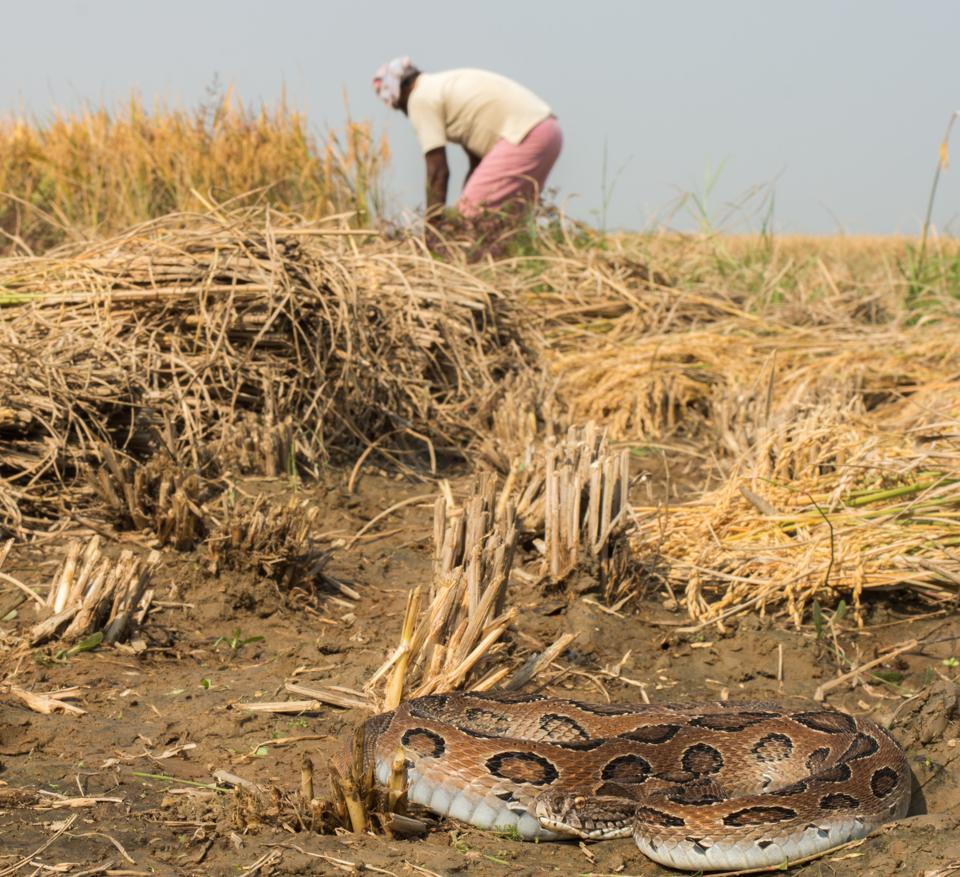
According to the World Health Organisation, which took on record the research study, India accounts for nearly half the globe’s snakebite deaths. “The WHO has set the target of reducing by half the number of (global) deaths due to snakebite envenoming by 2030 and India’s efforts to prevent and control this disease will largely influence this global target,” the WHO said.
That official data does not reveal the scale of snakebite deaths is revealed by the fact that the government of India’s figures for the years, 2003-2015, show only 15,500 deaths in government hospitals. The government figures are one-tenth of the 1,54,000 snakebite deaths detected during the same period from public and private hospitals by the research project.
The research study titled, Trends in snakebite deaths in India from 2000 to 2019 in a nationally representative mortality study, was conducted by the Centre for Global Health Research, University of Toronto, with Indian and UK partners including legendary herpetologist, Rom Whitaker, a Padma Shri awardee. The study was released to the public on July 7, 2020.
Though snakebite deaths are prevalent in northwest India, the States of Punjab and Haryana fall in the lowest-risk category. Around 70% of the deaths occurred in limited low altitude, rural areas of Bihar, Jharkhand, Madhya Pradesh, Odisha, Uttar Pradesh, Andhra Pradesh (including Telangana), Rajasthan and Gujarat.
“Snakes are a vital part of our ecosystem as rodent controllers and are important in religion and mythology. India’s tremendous snakebite burden is staring us in the face and we need to act now!” said Whitaker. Community education on snakebite prevention coupled with enhancement of rural health care could bring down the number of snakebite deaths. To repair the gross under-reporting of deaths in India, the study recommended that the government of India designate and enforce snakebite as a ‘notifiable disease’ within the integrated disease surveillance programme. Accurate snakebite data are essential if the government of India’s strategies to reduce snakebite deaths are to succeed.
“The study shows the need of the hour is to strengthen rural health care and resources, an investment for the future, particularly at this challenging time of the Covid-19 pandemic,” adds Whitaker.
UNICORN OF THE MORNI HILLS
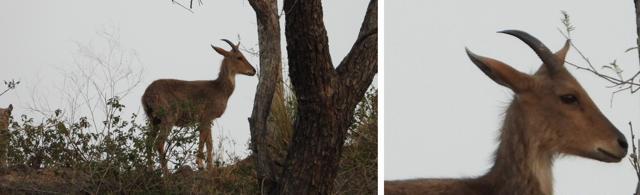
While Sambars are easily glimpsed by those travelling through the Shivaliks, the Himalayan Brown goral and the Barking deer remain elusive even to wildlife enthusiasts. While the Barking deer spurts off at great speed down nullahs, the goral darts around steep cliffs having caught a glimpse of humans a long way off. A goat-antelope as it is described by scientists and as Van Bakri by some Morni locals, a passionate wildlifer has procured a unique picture of a goral with one of its two swept-back horns missing. Haryana IAS officer and special secretary, home, Rajesh Jogpal, is habituated to forays at dawn or dusk around Panchkula for taking Nature pictures.
“One fine evening after I came back from office, I took my camera and accompanied by a friend went on a long drive on the Panchkula-Morni Road. I saw two wild animals grazing on the hill. One of them was a goral and the other a female Sambar. I was amazed to see the goral with one horn, I felt it was a kind of the mythical unicorn. I enquired about the the goral’s one-horned condition from the director, Wildlife Institute of India, Dehradun, Dr Dhananjai Mohan, and renowned wildlife scientist and field biologist, Dr AJT Johnsingh. I was told by Dr Johnsingh that either a genetic deformity had led to the one-horned goral of Morni or that one of the horns had broken off and would subsequently grow back.”
If the horn had broken off, then it could be because of an accident or fall while the goral was negotiating the rugged and precipitous terrain of the Shivaliks. The experience of gorals maintained in captivity at Chhatbir zoo reveals further that dominant males are compulsive head-butters and can break off a horn while waging aggression against rival males. One such male, which was confined in a solitary cell at Chhatbir to enable vaccination, got so annoyed that it broke one of its horns by repetitively banging its head against the door! Chhatbir zoo officials have also observed that in an estimated 40% of the female gorals in captivity, the growth in the two horns is mismatched and is not as even and prominent as the horn pairs of males.
vjswild1@gmail.com


