
Sign in

1 farmer hurt after clashes with police

Haryana Police said more than 20 tractors and hundreds of farmers tried to force their way across the Rajasthan-Haryana border but they stopped later as police held back their counterparts. The protesters also stopped due to ongoing rain.

Updated on: Jan 4, 2021, 02:15:08 IST
Hindustan Times, New Delhi | By
Share
Share via
  • facebook
  • twitter
  • linkedin
  • whatsapp
Copy link
  • copy link

Police lobbed tear gas shells and used water cannon to stop hundreds of farmers who allegedly broke police barricades at Masani village near Dharuhera on Delhi-Jaipur highway on Sunday, in an attempt to move towards Gurugram and Delhi.
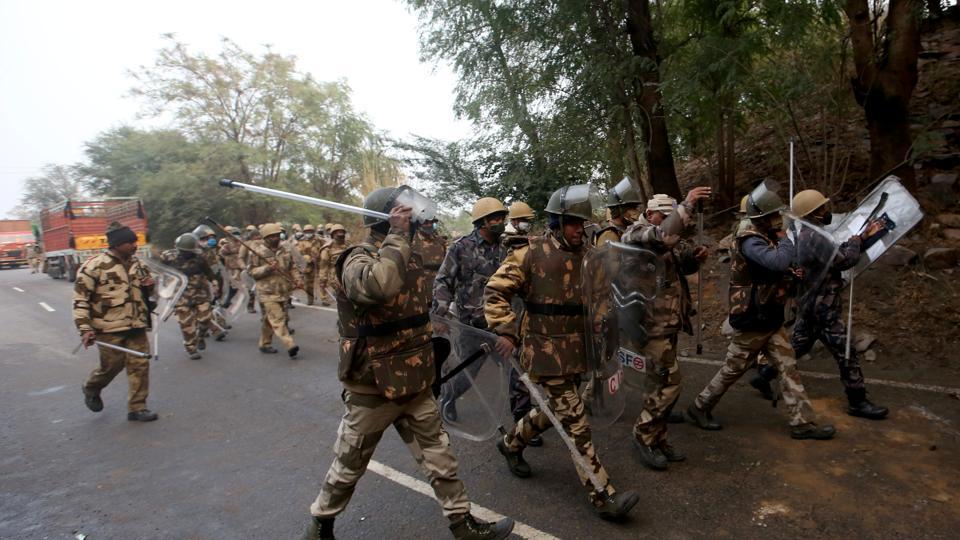
Members of Central Industrial Security Force (CISF) arrive to chase the farmers protesting against newly passed agricultural reforms on a national highway at Dharuhera in the northern state of Haryana, India. (Reuters)

At least one farmer has been injured, according to the initial reports from the spot.

Haryana Police said more than 20 tractors and hundreds of farmers tried to force their way across the Rajasthan-Haryana border but they stopped later as police held back their counterparts. The protesters also stopped due to ongoing rain.

Rajesh Kumar, deputy superintendent of Bawal, said farmers broke police barricades and tried to move towards Delhi. “Police had to use tear gas and water cannons to stop the protesters. They shouted slogans and forcefully tried to cross the barricades and we had to take the steps to stop them,” he said.

Farmers alleged that the police fired shells indiscriminately and it could have triggered a blast in the LPG cylinders they were carrying for cooking.

Last month, over a thousand farmers from Maharashtra, Gujarat, Rajasthan and Haryana reached Jaisinghpur Khera and joined the agitation. The protesting farmers had earlier announced that they would start moving towards Delhi on Monday.

Satnarayan Nehra, president of Nehra Khap of Haryana, said due to rains the volume of protesters was low on Sunday. “Our plan to move to Delhi failed but we will try late Sunday night as farmers from nearby areas are gathering at Kheda border,” he said.

On Sunday around 4pm, 20 tractors and hundreds of farmers crossed the Kheda border and reached Sangwari Chowk which is 20 kilometres ahead of the protest site. “Rajasthan Police allowed us to cross but Haryana Police is not cooperating. Many farmers have been camping since December 12 and are not well but they are not willing to return home,” said Rashid Ahmed, a protester from Nuh.

The community leaders have requested the police to let them cross the stretch peacefully and have tried to pacify the protesters.

Last Thursday, farmers had entered Shahjahanpur and reached Rewari on the Delhi-Jaipur highway, crossing the Shahjahanpur interstate border in Rajasthan, as the police were not letting them enter Haryana.

  • Leena Dhankhar
    ABOUT THE AUTHOR
    Leena Dhankhar

    Leena Dhankhar is Senior Editor and Bureau Chief, Gurugram, at Hindustan Times, where she has spent over 17 years chronicling the transformation of one of India's fastest-growing urban regions. From starting her career as a crime reporter to leading the Gurugram bureau, her journalism has been defined by investigative reporting, in-depth storytelling and an unwavering focus on public interest. Over nearly two decades, she has reported extensively across crime, politics, civic governance, elections, real estate, environment, courts, sports, education and entertainment, covering Gurugram, Faridabad, Nuh and Palwal. Her reporting has exposed several major scams and systemic failures, including insurance frauds, waste management irregularities, illegal arms manufacturing units in Nuh, illegal mining in the Aravallis, organised crime networks and governance lapses affecting millions of residents. Known for her investigative work and exclusive stories, Leena has reported on high-impact national issues, including the Nicaragua charter flight carrying Indian migrants that was turned back amid allegations of human trafficking, exposing the growing network of illegal immigration rackets. Her work has also focused on gang wars, prison administration, juvenile crime, women and child protection systems, the functioning of the Juvenile Justice Board and Child Welfare Committee, and environmental challenges such as pollution, waterlogging and deteriorating civic infrastructure. Beyond hard news, Leena has extensively documented Haryana's rich heritage, forests and wildlife, bringing attention to the state's historical landmarks, biodiversity, conservation efforts and ecological challenges through immersive reportage and feature writing. Her journalism has consistently gone beyond breaking news. She has documented Gurugram's rapid urbanisation through long-form narratives and enterprise reporting on issues ranging from pothole-ridden roads, flooding and waste management to the changing social fabric of India's Millennium City. She also writes widely read feature columns, including The Outsider, Changemaker, and Concern for Gurugram, profiling people, places and ideas shaping the city's identity. Leena is the author of Gurugram School Murder, published by Juggernaut Books, a deeply reported account of one of India's most high-profile school murder investigations. She is currently working on her second book, an investigative work exploring some of India's most significant scams and fraud investigations. Beyond print journalism, she has expanded her storytelling through public speaking and digital media. She is a TEDx speaker and has produced podcasts exploring Gurugram's transformation, civic challenges and untold stories. Her work reflects a commitment to narrative journalism that combines rigorous reporting with compelling storytelling. A law graduate with an MBA in Human Resources, Leena brings a multidisciplinary perspective to her reporting, particularly on governance, public policy and legal affairs. She has travelled extensively across India to pursue investigative assignments, often reporting from remote locations and conflict-prone areas in search of stories that matter.Read More