
 E-Paper



Atal Tunnel reverses winter migration from Lahaul-Spiti
Survey finds all-weather connectivity has brought down winter migration from 70% to 30% from snowbound tribal district of Himachal Pradesh

 Prefer HTon Google


The strategic Atal Tunnel built across the 13,050-ft Rohtang Pass, the gateway to Lahaul and Spiti, has come as a relief for residents of the remote, tribal district of Himachal Pradesh as the all-weather connectivity has ensured they needn’t migrate to low-lying hills for fear of being cut off from the rest of the world due to snowfall.
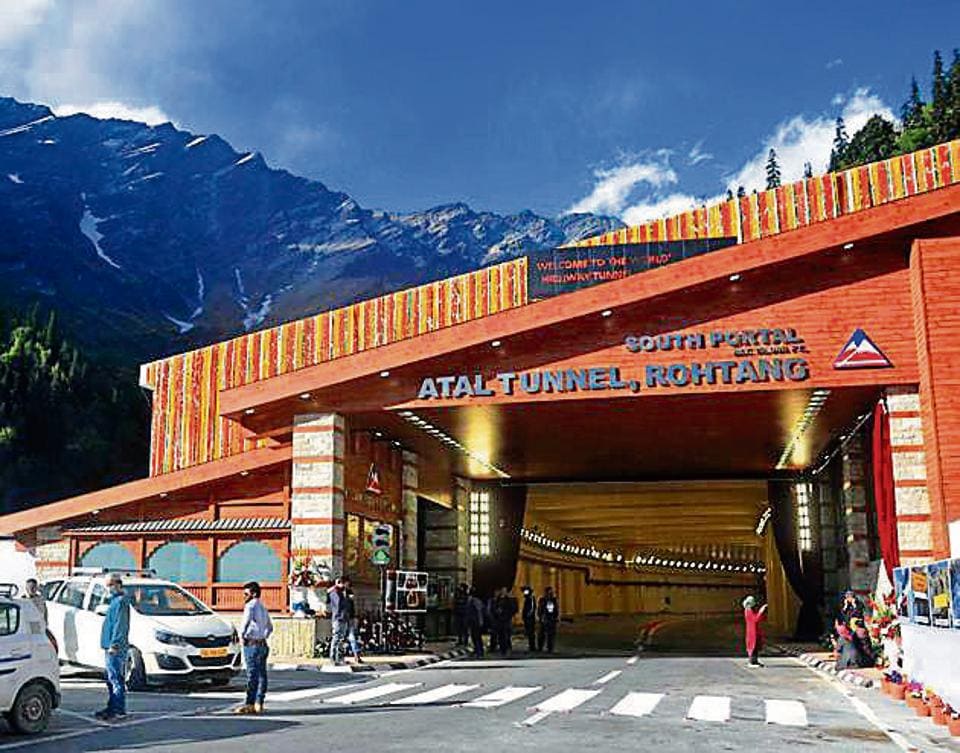
Lahaul and Spiti district has the toughest terrain in the region and remains cut off for six months due to snowfall on the Rohtang Pass, which literally means built on piles of bodies in the local Bhoti dialect. Usually, during winter, a majority of tribal residents migrate to Kullu, Manali and the low-lying plains of the state before the closure of the pass. By November, most people head to their houses in other parts of the state. The temperature in Lahaul dips to minus 30 degrees when winter peaks and life for tribal residents is tougher in Spiti valley, which is separated by the 15,000-ft Kunzum Pass.
The winter migration is more in the six panchayats of Pattan valley, known for growing potatoes. This is due to poor medical facility in the region. Till last year, the residents were dependent on chopper flights to travel outside the valley. The 2011 census pegged the district population at 31,564.” There was a time when 70% of the population migrated in winter. But with the opening of Atal Tunnel, named after former prime minister Atal Bihari Vajpayee, winter migration is down,” says Lahaul and Spiti deputy commissioner Pankaj Rai. “We conducted a random survey to assess the winter migration and found only 30% of the population migrated this time,” he says.
CONFIDENCE OF CONNECTIVITY
Residents of the three villages of Dimpuk, Koksar and Ramthang near the north portal of the tunnel at Sissu used to migrate with their livestock to Kullu and Manali in November and return in April. The three villages are located in a treacherous terrain and the area is susceptible to avalanches. “But this year, we are still in our villages,” says Anju Shashni, the head of the Koksar panchayat. Government offices in Koksar are still open.
“The opening of the tunnel has given hope and confidence to the villagers of Dimpuk and Koksar. We know even if the roads are closed due to snowfall, we can walk up to the tunnel and cross to the other side. Moreover, due to the Covid-19 pandemic, people feel safer at home in villages than migrating to crowded towns,” says Chander Mohan Prasheera, a social activist amd head of the Institute of Vocational (Tourism) Studies at Himachal Pradesh University, Shimla. “A day will come in the near future when people will return and resettle in their villages,” says Prasheera.
TOUGH LIFE IN TRIBAL DISTRICT
The tribal district does not offer much in terms of quality of education, employment, health and road connectivity. The living conditions in Lahaul-Spiti are bad in routine and turn worse in winter. Power supply remains suspended due to snowfall and people find it difficult to get medical aid when the roads are snowbound
“The younger generation is moving out of the valley. Many of my friends have settled down in cities like Chandigarh,” says Sonam Zanpo, 36, who runs a hotel in Keylong.
“As a child, we walked for five days to cross Rohtang Pass and there were no inns or hotels along the road where we could take shelter. We would halt at villages en route at night,” says BS Kapoor, a retired chief engineer from Tholang village, 113 km from Manali. The village is home to only 36 families but has produced a significant number of professionals, including bureaucrats, doctors and engineers.


