
 E-Paper



Bengaluru loses ₹20k crore annually due to frequent traffic congestions: Karnataka minister
In 2022, the Outer Ring Road Companies Association (ORRCA) wrote to then chief minister Basavaraj Bommai about the losses incurred due to traffic jams.

 Prefer HTon Google


Karnataka IT minister Priyank Kharge said that the traffic jams in Bengaluru are causing ₹20,000 crore loss annually. He also highlighted that the phenomenon is the same among most of the urban cities in the country.
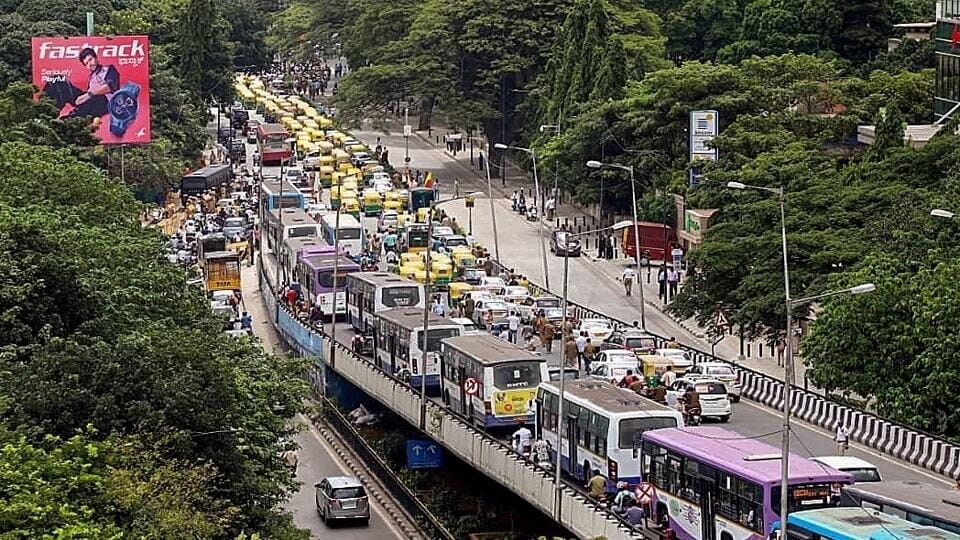
Speaking at an event, Priyank Kharge said, “Frequent traffic congestion can have serious economic implications on cities. Over ₹20,000 crore annual loss is estimated in Bengaluru because of long traffic jams. The loss includes the value of time, fuel wasted due to congestion and also low productivity among daily office goers.”
Also Read - ‘Best in the world': Railway minister Ashwini Vaishnav unveils Vande Bharat sleeper coach in Bengaluru
Bengaluru Development Minister DK Shivakumar has earlier proposed a tunnel road idea in the city, which is expected to decongest the entire city. The government also proposed funds for the project in the recent state budget.
In 2022, the Outer Ring Road Companies Association (ORRCA) wrote to then chief minister Basavaraj Bommai about the losses incurred due to traffic jams. ORRCA then said, “It is estimated that over a half a million people are employed on the Outer Ring Road stretch, starting from Krishnarajapuram to the Central Silk Board area in Bengaluru. The 17 km stretch is also providing direct and indirect employment to over a million people and has a great contribution to the economy of the state. It is appalling that there is no focus on the development of infrastructure in this particular area. The collapse of Bengaluru’s infrastructure is now a global concern and is also questions the growth of the city.”
Also Read - Bengaluru rains: Massive showers lead to water congestion across city, traffic police step up
Several governments have tried to solve the traffic issues in Bengaluru for a decade now and it has been a major complaint of both residents and visitors of the city.
According to TomTom, the average time to cover 10 kilometers in Bengaluru in 2023 was roughly 28 minutes and 10 seconds. However, in 2022, the average time to cover the same distance was reported as 29 minutes and 9 seconds, which made Bengaluru the second slowest city in the globe that year. The average speed in Bengaluru stood at 18kmph, slower than any Indian city.


