
 E-Paper



Bengaluru to get longest double-decker flyover under ₹9,700-crore Namma Metro Phase 3: Report
Under this plan, the Bangalore Metro Rail Corporation Limited (BMRCL) will construct elevated metro lines stacked above flyovers along two crucial corridors.

 Prefer HTon Google


Bengaluru is set to take a major step forward in its long-awaited Metro Phase 3 expansion. The Karnataka cabinet on Thursday cleared the ₹9,700-crore double-decker viaduct project, paving the way for civil works to begin after months of delay.
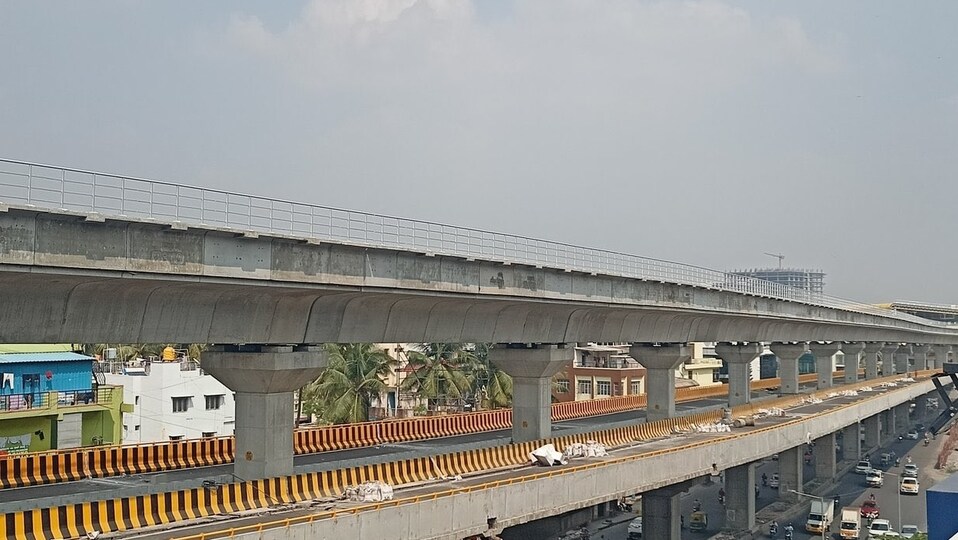
Under this plan, the Bangalore Metro Rail Corporation Limited (BMRCL) will construct elevated metro lines stacked above flyovers along two crucial corridors.
The first corridor will run from JP Nagar 4th Phase to Kempapura along the western stretch of the Outer Ring Road (ORR), featuring a 28.486-km flyover, the longest in Bengaluru, Deccan Herald reported.
(Also Read: 'Naanu Kannada...': How a Mumbaikar's efforts in Bengaluru won hearts and free drinks)
The second corridor will extend from Hosahalli to Kadabagere on Magadi Road, with a 8.635-km flyover. Together, the double-decker viaducts will cover 37.121 km, combining metro lines and roadways in a first-of-its-kind project for the city.
Parliamentary Affairs Minister HK Patil said the ₹9,700-crore cost includes civil works, land acquisition, design, and other expenses. The Union government will fund only the metro lines, while the state will bear 50% of the flyover cost, 10% will come from urban local bodies, and 40% will be raised through loans. The state has already earmarked ₹4,000 crore in the 2025-26 budget for Namma Metro, part of which will be spent on this project, the report further added.
Originally planned to stretch 44.65 km, the double-decker length has been trimmed to 37.121 km.
The cabinet nod marks the final approval for Phase 3, which the Union cabinet had cleared on August 16, 2024. Civil works are now expected to begin in early 2025, with tenders for the first four packages, covering both stations and viaducts, set to be floated later in September. Contractors will be given 45–60 days, and finalisation is expected by mid-November.
Groundwork could begin as early as January 2025. However, the delays caused by the double-decker plan have already pushed the completion timeline by six months. Phase 3 is now expected to be ready by May 2031, instead of 2030, at a 5% higher cost than the original ₹15,611 crore estimate.
(Also Read: How to check your new Bengaluru corporation under GBA: Full list of wards and link here)


