
 E-Paper



Bengaluru's Yellow Line metro brings relief to South, reduces peak hour traffic by 30%: Report
The Yellow Line between RV Road and Bommasandra has eased traffic congestion in south Bengaluru, with a reported 38% reduction in morning peak congestion.

 Prefer HTon Google


The launch of Namma Metro’s Yellow Line stretch between RV Road and Bommasandra has significantly eased traffic congestion along one of south Bengaluru’s busiest corridors.
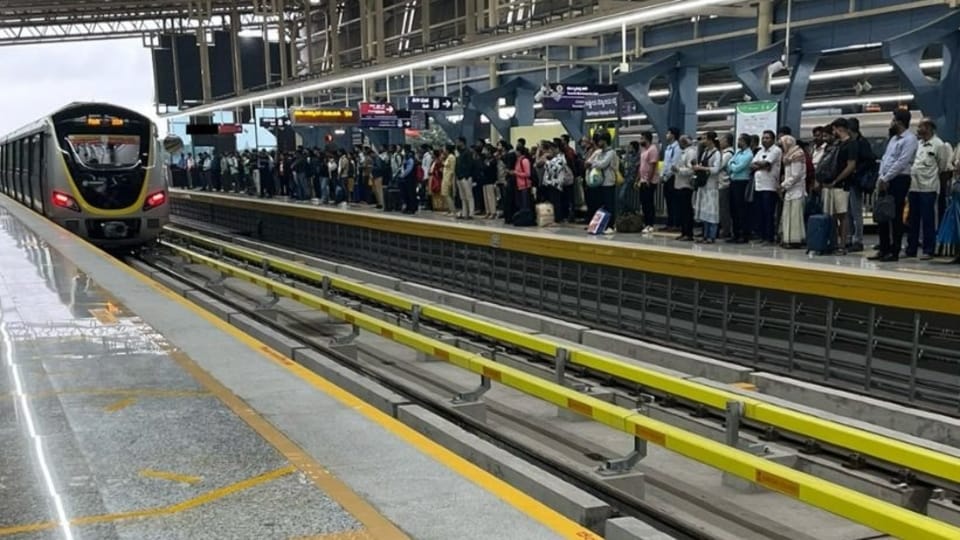
The Bengaluru Traffic Police (BTP) study indicates a marked drop in vehicle density during both peak and non-peak hours since the metro became operational, according to a report reviewed by The Hindu.
The 19.15 km Yellow Line, inaugurated by Prime Minister Narendra Modi on August 10 and opened to the public on August 11, was expected to reduce traffic woes in the southern part of the city.
Despite initial teething problems with only three trains operating and intervals exceeding 25 minutes, the recent addition of a fourth train has improved service frequency, bringing intervals down to 19 minutes.
38% reduction in peak congestion
The BTP’s Actionable Intelligence for Sustainable Traffic Management (ASTraM) system, which monitors real-time traffic conditions, recorded a 38% reduction in morning peak congestion and 37% in evening peak congestion on weekdays along the Yellow Line corridor.
Non-peak weekday traffic decreased by 17%, while weekend mornings saw an even sharper drop of 69% in congestion and 39% in the evenings. Non-peak weekend traffic fell by 58%, the report further added.
Weekday congestion typically spikes on Wednesdays, but the study shows the metro has helped cut morning peak congestion from 37.02 km to 26.79 km and evening peak from 64.10 km to 40.67 km. It should be noted that congestion data includes not only main roads but also connecting streets. However, non-peak congestion on Mondays and Wednesdays has increased by 25% and 21%, respectively, after the Yellow Line’s launch.
The Yellow Line serves four major junctions, BTM Circle, Silk Board, Hosa Road, and Electronics City, and nearly ten known traffic bottlenecks. BTP officials noted that relief along this corridor has also eased traffic on adjacent roads such as Hosur Main Road and in Madiwala, a major hub for inter-state buses. “The decline in peak-hour congestion has made traffic management on the ground easier,” said Gopal M. Byakod, Deputy Commissioner of Police (Traffic South), to The Hindu.
(Also Read: Bengaluru’s potholes to be gone by November? DK Shivakumar issues final deadline)


