
 E-Paper



Over ₹1k-cr project on anvil to help revive parched districts
Karnataka’s minister for minor irrigation, law and parliamentary affairs JC Madhuswamy said the department has sent a detailed project report (DPR) to the government for its approval.


The Karnataka government has proposed a ₹1,670-crore project to supply treated water from Vrishabhavathi river in Bengaluru to regions like Tumakuru, Nelamanagala, Chikballapur and Doddaballapur to help revive depleting water tables, in what appears to be the continuation of a policy to supply used water to surrounding areas of India’s IT capital.
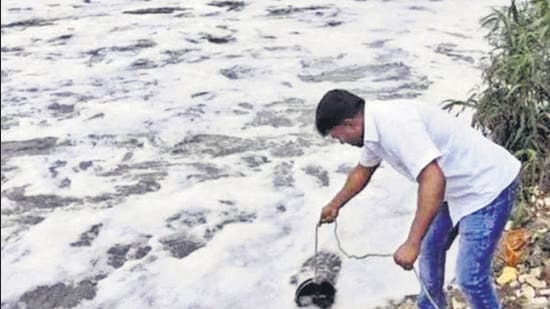
Karnataka’s minister for minor irrigation, law and parliamentary affairs JC Madhuswamy said the department has sent a detailed project report (DPR) to the government for its approval.
While the river, which resembles a drain due to an unchecked inflow of sewage water and industrial pollutants, the new programme is meant to salvage the drain inlets by treating them and then pumping around 300 mld (million litres per day) to nearby regions outside Bengaluru.
“Around 308 mld of secondary treated water will be used to fill up tanks in Chikballapur, Nelamangala, parts of Tumakuru and Doddaballapur,” a senior official at the state’s minor irrigation department told Hindustan Times.
Successive governments in Karnataka have pursued a policy to prioritise Bengaluru’s water needs, depriving regions around it. Despite that Bengaluru faces water scarcity as most parts of the city are fed with tankers that are filled by overexploiting borewells, adversely impacting groundwater tables.
The closest river to Bengaluru is over 100kms away, which has forced governments to spend thousands of crores to bring water for over 12 million residents of the city.
According to estimates by the Indian Institute of Science (IISc), Bengaluru receives around 700-850 mm of rain each year, which is enough to accumulate around 16 tmc ft of water -- almost 70% of its demand of around 19 tmc ft. But lack of treatment plants and awareness has given rise to a situation in which most of the water is let out into drains by most households except large apartment complexes where it is mandatory to have sewage treatment plants.
The Siddaramaiah-led Congress government had initiated the Koramangala and Challaghatta Valley (KC Valley) project to pump around 440 mld of secondary treated water to drought-prone Kolar and Chikkaballapur districts to fill up lakes and tanks. The treated water was pumped into Lakshmisagar lake in Narsapura of Kolar directly. The project had divided political groups and scientists who argued over the benefits and harms of such an exercise.
TV Ramachandra, a scientist at the Centre for Ecological Sciences at IISc, said, “Such projects are good if we are ensuring the removal of heavy metals from water.”
Ramachandra, who has authored several papers on water in Bengaluru, said the Vrishabhavathi belt has a concentration of industries that discharge heavy metals into the streams, which would enter the humans through any produce grown with this water. “We are so irresponsible as a regulatory body that we allow the industries to pollute the water bodies.”
The official cited above said the water from Vrishbhavathi will be used only to fill tanks and not for agriculture or drinking water purposes. However, experts see a problem with such an approach that does not prioritise tertiary treatment of wastewater.
The primary treatment removes large particles, chemical ions are removed in the secondary treatment and nutrients are removed in the tertiary treatment, experts said, pointing out the requirement to carry out all three processes to make the most of water.
Pumping inadequately treated water into tanks for the purpose of rejuvenating groundwater tables is unlikely to have a desired effect, experts said.
“Vegetables that are grown downstream and also the lake water have heavy metal contents. Those vegetables like pudina and spinach which we eat will naturally get into our body. Higher instances of heavy metals in our food items is also leading to the escalation in cancer and kidney failures in the region,” Ramchandra said.
He said instances of kidney failure in Bengaluru, which was 1 in 100,000 about 12 years ago, is around 1 in 5,000 today.
The Bruhat Bengaluru Mahanagara Palike (BBMP, the city’s civic body) has also prioritised aesthetics over quality of water in its lake rejuvenation projects, experts said.
A report by CSIR-National Environmental Engineering Research Institute (NEERI) indicated that there are around 21 lakes out of the 205 existing on paper in which water was fit for drinking. This claim has been contested by environmentalists, scientists, and citizens.
A report by the Karnataka State Pollution Control Board (KSPCB) in 2020 states that there is not even one lake which has water fit for drinking.
But fish from these lakes are often consumed in Bengaluru as licences are auctioned to the highest bidder. In Bengaluru’s BTM Lake, people throng to buy fish like rohu (Labeo Rohita), catla (Labeo Catla) and common carp (Cyprinus carpio), among others, almost every weekend.
Several citizen-initiative groups have aired concerns over such projects that focus on cosmetic beautification rather than improving the ecology of the spaces.
A July 2021 research paper, ‘Heavy metal in the food chain -- Consequences of polluting water bodies, by TV Ramachandra and NR Narayan studied the concentration of heavy metal in Varthur lake, near the technology corridor of the city.
“The study on heavy metal concentrations in vegetables grown near Varthur lake, Bangalore, has shown significant accumulation of heavy metals in vegetables that correlated well with its soil and lake water concentrations. The prolonged irrigation of vegetables using such contaminated lake water has led to soil contamination, which ultimately resulted in contamination of vegetables due to the uptake and accumulation of heavy metals in edible portions of vegetables. The heavy metal content in vegetables exceeded the safe limits in India,” the paper states.
Stay updated Bengaluru Weather Live and with all the Breaking News and Latest News from Bengaluru. Click here for comprehensive coverage of top cities including Delhi, Mumbai, Hyderabad, and more across India . Stay informed on the latest happenings in World News.


