E-Paper



Bhils don’t want their prized Baobabs stolen
Tribals are fighting the forest department’s permission to a Hyderabad-based businessman to uproot the trees for sale to rich clients, each tree costing ₹10 L

 Prefer HTon Google


It isn’t clear how they got here. After all, the distinctive trees that belong to the genus Adansonia are native to mainland Africa, Madagascar (where most of the species are found), and Australia. But there they are, around 1,000 Baobab trees in Dhar, in Madhya Pradesh’s Mandu district.
The trees here are clearly African (as evident from their shape), and according to a 2015 research paper (History of the introduction of the African baobab in the Indian subcontinent) by Karen L Bell, Haripriya Rangan, Christian A Kull, and Daniel J Murphy in Royal Society Open Science, they may have been brought to Dhar around the same time they were to Mumbai, Gujarat and Chennai -- between the 10th and 17th centuries, and likely by African soldiers hired by the Islamic kingdoms of the time.
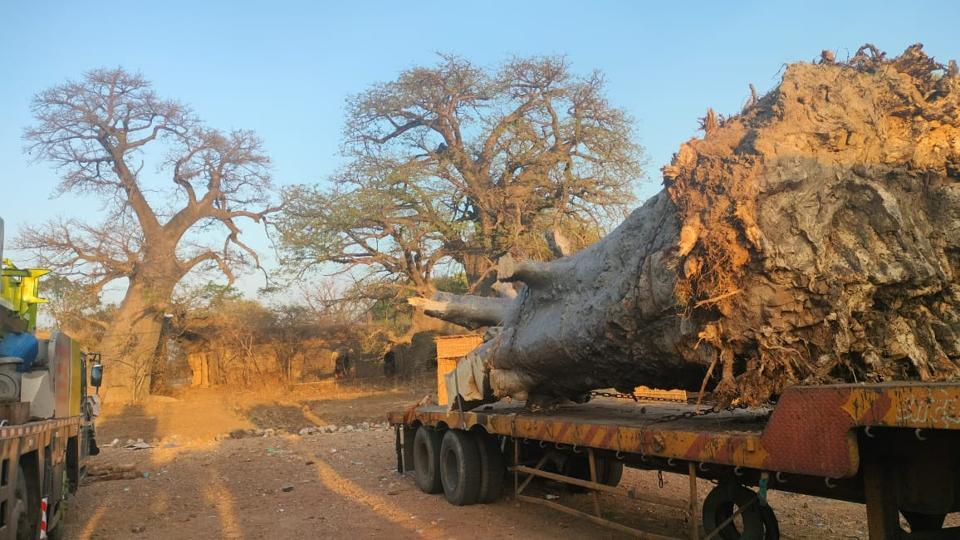
It is clear that Dhar’s Baobab’s are old -- they are tall and broad, exhibiting girth that comes only with age. They have always been precious to the locals, including Madhya Pradesh’s Bhil tribals, who consume the fruit, and use parts of the tree in traditional medicines. But in recent years, they have also become precious to collectors -- as evident from a recent incident , where Dhar’s Bhils stopped a Hyderabad-based businessman from taking away some Baobab trees from their traditional lands saying they will not give away their “part of heritage”.
The tribals are fighting the forest department’s permission to the businessman to uproot the trees and cart them to Hyderabad for sale to rich clients, with each tree costing about ₹10 lakh.
The tree, found in a few places in India (the ones in Mumbai’s zoo are famous) are abundant in Mandu, which has close to 1,000 Baobabs, some of which are on private land. The Madhya Pradesh government has applied for a GI tag for the endangered tree saying they are unique to Mandu, officials said, although this seems misplaced given that the trees are not native to India at all.
Dhar forest officials say they permitted the translocation of the 11 Baobab trees last year and Hyderabad-based naturalist and businessman, Ramdev Rao, claimed that the permission was renewed this year. Narendra Sanodiya, chief conservation forest (CCF), Indore, under whose jurisdiction Dhar comes, said, “The trees, which are on agricultural land can be translocated after consent by farmers. Last year, he (Rao) took permission for about two dozen trees and took only 13, and he came back this year to take the remaining ones.”
However, the permission last year was granted for 11 trees in two Mandu villages and no new permissions have been issued. HT has seen the 2022 permission. Sanodiya did not respond to a request for a clarification on this.
Rao reached Mandu a week ago with some of his staff and claimed the permission was renewed. The tribals disagree. Dhar district Panchayat member member, Gokul Girwal, said the trees are not only unique to Mandu but also part of the local heritage. “Ramdev Rao is selling these trees as exotic trees imported from Madgascar to rich people in Hyderabad. Instead of saving these trees, forest department is allowing uprooting the 200-500 year old trees,” he said.
It’s possible some of the trees being uprooted are older; Baobabs can live up to 2,000 years which means some of Dhar’s Baobabs could be the original ones planted by African soldiers. It’s also possible some are younger -- descended from the original trees. But the size of the trees being uprooted suggests that they are at least a few centuries old.
A tribal activist Bhanu Girwal countered the government claim that Rao was taking trees from private land. “If I find gold coins in my field, will the government allow me to keep them and sell it to anyone I want. No, I have to give them back to the government because it is a country’s treasure. Similarly, such old and rare trees shouldn’t be allowed for sale.”
Refuting all allegations, Ramdev Rao, who also claims to be a naturalist, said, “Some locals are staging protest for their personal interest. I am saving heritage at my botanical garden and I know how to translocate the old trees successfully. I am (also) a businessman and provide old trees to many clients.”
There’s also another issue. Can trees this old and so big be successfully translocated?
Madhya Pradesh-based environmentalist Ajay Dubey questioned Rao’s claim of success in translocation of such big trees. “There is no scientific evidence to show that such big trees can be translocated successfully. The MP government should ask Rao about the success of the earlier translocated trees and should conduct an inquiry.”
The government too seems to have swung into action.
Dhar district collector Priyank Mishra said: “I didn’t know about it earlier. Now, I am taking necessary action because it is about Baobab trees. We have stopped the translocation and written to the state government to take a policy decision in this regard to preserve the (local) culture.”