
 E-Paper



66% turnout in Himachal bypolls
Among the three assembly constituencies going to polls, Jubbal-Kotkhai recorded highest 78.69% voter turnout, while Mandi parliamentary constituency sees approximately 57.73% polling

 Prefer HTon Google


More than 66% of 15.36 lakh registered voters exercised their franchise at the four Himachal bypolls – one parliamentary and three assembly – that concluded on Saturday.
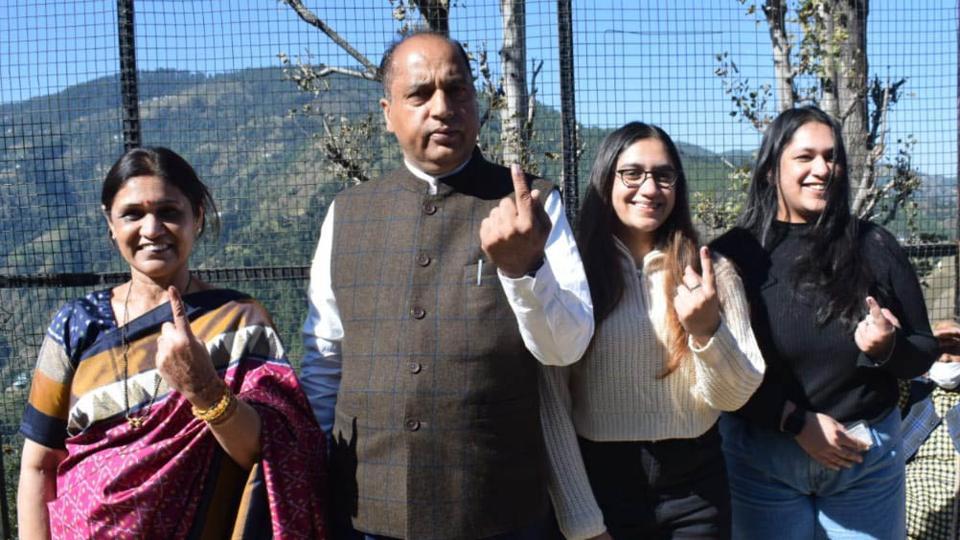
The Mandi parliamentary constituency, which is incidentally the second largest in the country, witnessed approximately 57.73% polling. Chief electoral officer C Paulrasu said the figures may go up as the data is still being compiled.
Among the assembly constituencies, Jubbal-Kotkhai recorded the highest voter turnout at 78.69%. Of 70,792 electorates, 55,708 turned up to cast their vote, of which 28,827 (81.9%) were men and 26,881 (75.45%) women.
Fatehpur recorded 66.2% polling and Arki 61.33%. As many as 56,726 of 87,222 voters exercised their franchise in Fatehpur exercised their franchise. “At 82.25%, the highest polling was recorded at Patti booth and lowest at 54.11% at Riyali,” said district electoral officer Nipun Jindal.
In the 2017 assembly elections, Fatehpur had recorded over 70% polling and 69% in the 2019 general elections.
Jindal said polling went on smoothly and there was no incidence of poll violence. “EVMs malfunctioned at some polling booths in Kullu and were replaced immediately. Polling was slow in the initial hours but eventually gathered pace,” he said.
A total 2,774 polling booths were setup across the four constituencies. The election results will be declared on November 2.
18 candidates in fray
There are a total 18 candidates in the fray—six in Mandi, five in Fatehpur, three in Arki and four in Jubbal-Kotkhai.
Polling is being held across 2,365 booths in 17 assembly segments of six districts, including Mandi, Kullu, Kinnaur, Lahaul-Spiti, Chamba and Shimla, that comprise the Mandi parliamentary seat.
The main contest in Mandi is between Congress’ Pratibha Singh, who is a two-time former MP, and BJP’s brigadier Khushal Thakur, who is making his electoral debut. The election is significant as Mandi is the home district of chief minister Jai Ram Thakur and will be the litmus test of his popularity.
Triangular contests in Jubbal-Kotkhai, Fatehpur
The Jubbal-Kotkhai assembly constituency in Shimla and Fatehpur in Kangra saw three-cornered contest. Bypoll in Jubbal-Kotkhai was necessitated after the death of incumbent MLA Narinder Bragta and that in Fatehpur was necessitated due to the death of sitting Congress legislator Sujan Singh Pathania.
Denied a ticket by the BJP, Chetan Bragta, the son of the late MLA, is contesting as an independent. He is being challenged by Congress’ Rohit Thakur, the grandson of former chief minister Thakur Ram Lal, and Neelam Saraik of the BJP.
Congress has fielded the late legislator’s son Bhawani Singh Pathania from the Fatehpur assembly. He will slug it out against BJP’s Baldev Thakur and former MP Rajan Sushant who is in the fray as an independent. In Arki, Congress’ Sanjay Awasthi will compete against BJP’s Rattan Pal Singh.
Kinnaur villagers boycott polls
Meanwhile, villagers of three panchcyats in Kinnaur district boycotted the polls in protest against the Jangi Thopan hydropower project and non-implementation of the Forest Rights Act.
The three panchayts are Jangi, Apka and Rarang. Gian Kumar, a local activist from Akpa panchcyat, said only four votes were polled in Akpa panchcyat of 298. “Only the polling staff cast their vote,” he said. Notably, the Forest Rights Committee had also given a call to use NOTA in the elections.
“No political party is clear about the Forest Rights Act. Most panchayats in Kinnaur are still unaware of their rights. We had given a call to press NOTA button to lodge our protest,” says Jiya Lal Negi, president, Forest Right Act Committee Kinnaur.
“Now, election results will revel how many people have used NOTA to protest against power projects,” he added. Voters in Ahlemi, Klans, Jagat, Balmuin and Klah booth of Bharmour area of Chamba also boycotted elections over non-fulfilment of their demands for roads and mobile connectivity.


