E-Paper



At 46.7°C, Chandigarh logs hottest day ever
Before Wednesday, the hottest day in Chandigarh’s history was May 28, 1988, when the maximum temperature had gone up to 46.5°C

 Prefer HTon Google


The maximum temperature soared to an all-time high of 46.7°C at the Chandigarh airport on Wednesday, according to the India Meteorological Department (IMD) that started maintaining records for the city around seven decades back.
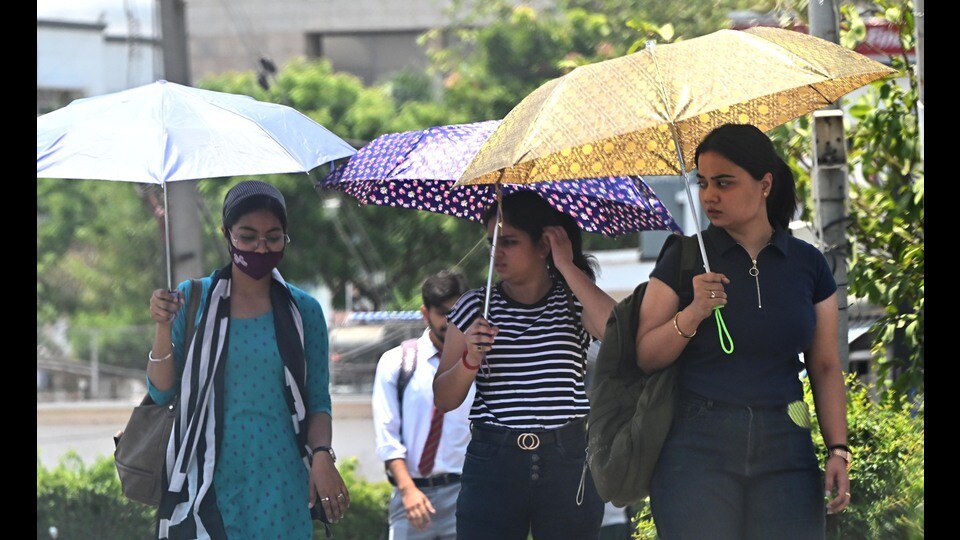
Before Wednesday, the hottest day in Chandigarh’s history was May 28, 1988, when the maximum temperature had gone up to 46.5°C.
Temperature readings at the Chandigarh airport were recorded from 1954 onwards, when the Indian Air Force started developing the airport here, as per former IMD Chandigarh director Surender Paul.
Before the IMD Chandigarh observatory was constructed in Sector 39 in 2010, the readings from the airport are taken as records for Chandigarh to maintain continuity in the data, even as temperature goes a bit higher at the airport due to its location as compared to Sector 39.
At 46.7°C, the maximum temperature at the airport was 6.6 degrees above normal.
With this, severe heat wave conditions were recorded for the first time this season in parts of the tricity. Severe heat wave for this region is declared when the maximum temperature goes over 6.5 degrees above normal after crossing 40°C.
On the other hand, a heatwave is declared when it goes between 4.5 degrees to 6.4 degrees above normal. No days with severe heatwave were observed last year.
At the IMD observatory in Sector 39, the maximum temperature was at 46°C, 5.9 degrees above normal. Heatwave conditions continued here for the second consecutive day.
Speaking about the increase in temperature, IMD Chandigarh director AK Singh said, “This is a direct effect of global warming and climate change. The occurrences of extreme weather have increased as seen in the cold spell in January and the record rain last July.”
On possible steps to reverse the effect of climate change, Singh said at this point, only emission of greenhouse gases can be minimised and reversing its effects may not be possible. Singh also discussed how something like cloud seeding, as used in the Middle-East, cannot be used to abate the heatwave in this region, as it is not financially viable and will have an uncontrolled effect over the region.
Orange alert to continue today
While Delhi got some relief from light rain, IMD Chandigarh scientist Shivinder Singh said it’s unlikely to bring much relief in Chandigarh. “While there are chances of isolated rain in the region on Thursday, the temperature here is unlikely to drop much.”
An orange alert will continue on Thursday, asking people to be prepared, but it will be downgraded to yellow from Friday onwards.
Meanwhile, the minimum temperature also rose from 25.6°C on Tuesday to 26.5°C on Wednesday, 0.8 degree above normal. Over the next three days, the maximum temperature will remain between 43°C and 45°C, while the minimum temperature may rise further to 28°C-30°C.
Three transformers damaged due to overload
Amid rising temperature and increasing power consumption, three transformers were damaged in Mohali’s Sector 71, Phase 8-B and Phase 9 on Wednesday, leading to power outages. Satvinder Singh Sehmbi, superintending engineer (SE), PSPCL, Mohali, said the power demand shot up from previous day due to extreme hot weather.
A few residents, including children and women, were trapped in a lift at Beverly Golf Avenue Apartments, Sector 65, due to power cut. Prabhjot Singh, an official of the society, said the generator developed a snag while the power was out, affecting lift operations.
A similar incident was reported from Savitry Greens society in Zirakpur. A PSPCL officer said both the societies had their own transformers that tripped, adding that there was no power cut by the electricity department.