
 E-Paper



At 99.9 mm, Chandigarh sees wettest September day in 3 years
Easterly winds are still blowing in the region and there are chances of heavy rain in the city on Tuesday as well. An orange alert for heavy rain has been declared in the city on Tuesday, while the situation is likely to improve from Wednesday onwards.

 Prefer HTon Google


Chandigarh/Mohali/Panchkula The city recorded 99.9 mm rain on Monday – 76.5 mm overnight and 23.4 mm during the day – making it the wettest September day in three years. The highest single-day rain was seen in 2022 when the city recorded 120.6 mm on September 25. India Meteorological Department (IMD) Chandigarh director Surender Paul said the downpour was a result of the monsoon system and an active Western Disturbance.
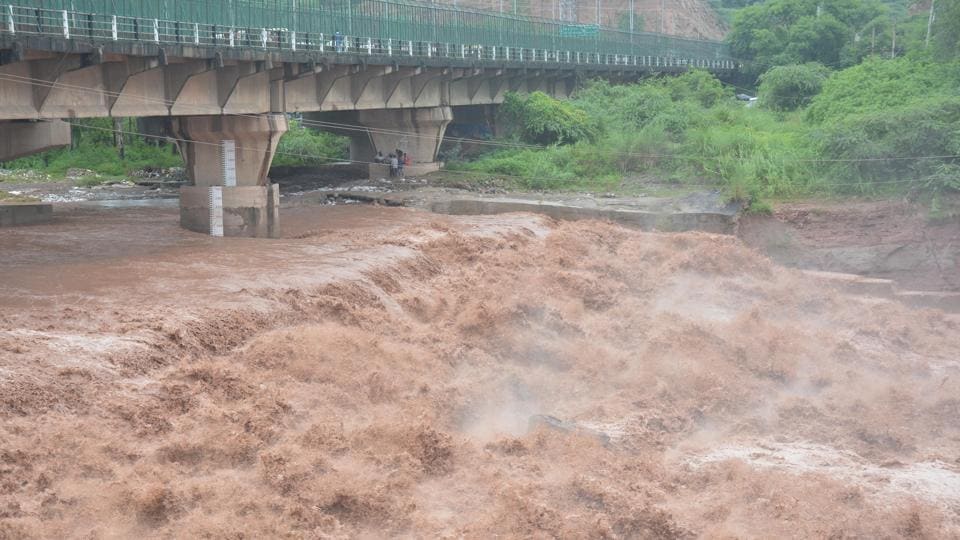
Easterly winds are still blowing in the region and there are chances of heavy rain in the city on Tuesday as well. An orange alert for heavy rain has been declared in the city on Tuesday, while the situation is likely to improve from Wednesday onwards. Orange is the second highest of the four-colour warning system, used by the IMD to ask people to be prepared.
2 Sukhna floodgates opened
Two of the three floodgates of Sukhna Lake were also opened this morning as the water level crossed the danger mark of 1,163 feet. The excess water was released into the Ghaggar river through the Sukhna Choe.
According to officials, one floodgate was opened around 7.30am and the second at 9am up to the height of three inches. As the water receded in the lake, one floodgate was closed around 3pm, said the officials. This was the eight time that the floodgates were opened this season. Earlier, the floodgates were opened on August 30, 29, 19, 17, 15, 8 and 6.
Life out of gear
The continuous rain threw life out of gear in Chandigarh, with several areas facing severe waterlogging and traffic snarls. According to Chandigarh Traffic Police, waterlogging was reported at the Jan Marg near the old Secretariat building in Sector 9, near the dumping ground opposite Dadumajra, and in various stretches of Sector 10, including Jan Marg, Sector 10B, and Sector 10D. All Chandigarh-bound vehicles came to a standstill at the Housing Board Chowk after traffic lights went out. The absence of police personnel to regulate the traffic worsened the situation. “From Panchkula Sector-7 roundabout to the Housing Board, a massive jam occurred, though I couldn’t capture the entire chaos,” commuter Partha Banerjee posted on social media.
In Panchkula, the bridge on the Mauli-Barwala road was damaged, and the route was now closed for traffic. Motorists were advised to use the Dera Bassi route instead. Other routes affected by potholes and poor road conditions include the Barwala bus stand to Barwala bypass, Sukhomajri bypass to Nawan Nagar T-Point, Mallah Mor Pinjore to Parwanoo border Kalka, Mauli to Pyarewala road, and Mattawali to Trilokpur Mod. Water accumulated under the railway bridge from Kohani Sahib Gurudwara towards Sai Dairy, as well as at the Amartek Red Light and Majri Chowk, slowing down vehicle movement. Additionally, a section of the road under the bridge from Industrial Area to Baltana is broken and submerged, disrupting traffic.
2,000 hectares of crop damaged in Mohali
Mohali deputy commissioner Komal Mittal on Monday informed that due to heavy rainfall and water overflow in seasonal rivulets (choes), nearly 2000 hectares of agricultural land in the district has been damaged, so far.
She said the affected areas include Tiwana, Khajur Mandi, Sadhanpur, and Dangdhera. The damaged crop area will soon be assessed through special girdawari, and a detailed report will be submitted to the government.
The DC further said a farmer died of drowning in Lalru while one kutcha house collapsed due to the rains.
She added that heavy rain and strong water flow in the seasonal rivulets/choes have also disrupted road connectivity to five villages near Jayanti Ki Rao.


