E-Paper



With 103 mm rain, Chandigarh crosses annual quota
Against annual average of 1,059.3 mm, Chandigarh has logged 1,089.8 mm rain in just three months of monsoon, making it the wettest season since 2015

 Prefer HTon Google


With a little over four months still to go in the year, Chandigarh crossed its annual rainfall quota on Wednesday after 103.4 mm rain lashed the city.
As per the India Meteorological Department (IMD), Chandigarh’s annual average rain quota is 1,059.3 mm. But the city has logged 1,089.8 mm rain in just a little less than three months of monsoon. At 1,089.8 mm, this is also already the wettest monsoon in the city since 2015.
IMD considers the period between June 1 and September 30 as monsoon season.
The average monsoon quota of 845.7 mm was crossed in the first week of August itself.
Monsoon had hit a lull thereafter and Wednesday’s was the first heavy spell of rain in the city after the first week of August.
On Wednesday, Chandigarh recorded 84 mm rain till 8.30 am and further 19.4 mm rain during the day. Panchkula recorded 77 mm rain, while Mohali got 38 mm showers.
Speaking about the rain, IMD Chandigarh director Manmohan Singh said, “While a Western Disturbance (WD) is active in the region, the rain was primarily brought about by the monsoon system. A cyclonic circulation had formed over the Bay of Bengal and after crossing central India, it travelled north-westwards and affected our region.”
On the excessive rain this monsoon, Singh said it was caused by the confluence of the already active monsoon system with WDs, which are mostly dormant during the season.
Even the 103.4 mm rain on Wednesday was highest for a single August day since 2020 when 133.5 mm rain was recorded on August 12. Overall, 263.2 mm rain has been recorded in the city this month till now, which is also highest since 2020 when 441.3 mm rain was logged in the entire month.
Heavy rain will be unlikely in the city from Thursday onwards, but chances of light to moderate rain will continue till the end of the week. A yellow alert for thunderstorms will stay in effect till then. Second of the four colour warnings used by IMD, yellow alert asks people to watch and be updated.
Maximum temperature dropped from 31.6°C on Tuesday to 27.7°C on Wednesday, 5.1 degrees below normal. It is the lowest this season since July 10 when the maximum temperature had gone down to 25.8°C.
The minimum temperature also fell from 28.3°C on Tuesday to 24.6°C on Wednesday, 0.9 degrees below normal. It’s tied with the lowest minimum temperature in August last year that was also 24.6°C on August 15.
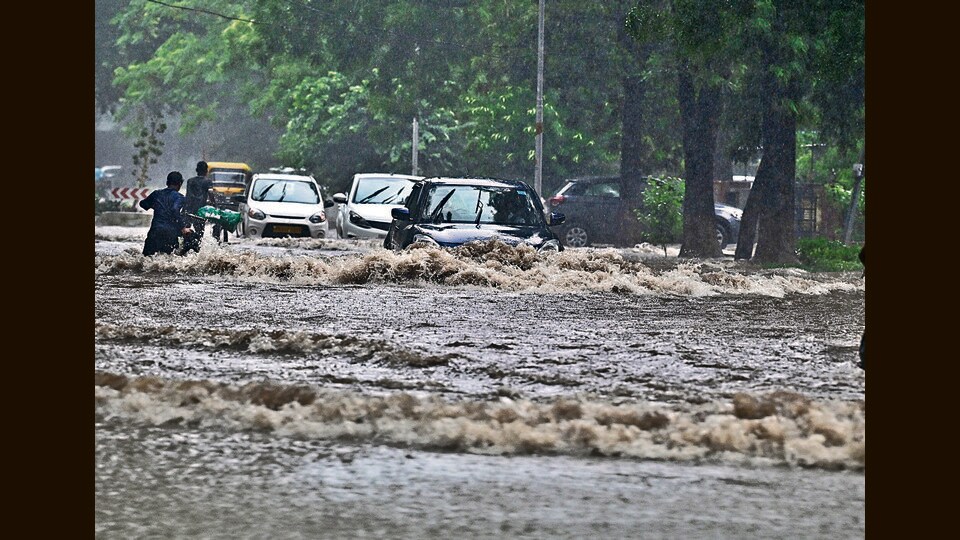
Heavy rain once again threw traffic out of gear in the city, forcing police to divert traffic routes and even close a road due to excessive waterlogging.
Due to waterlogging at railway under bridge road near CTU workshop, Industrial Area, Phase 1, the stretch was closed at 12.50 pm and reopened around 3.20 pm.
Meanwhile, after a floodgate of Sukhna Lake was opened and water was released into Sukhna Choe, the road from Makhan Majra bridge towards Raipur Khurd was closed around 12.30 pm, effecting traffic movement on all bridges on the choe.
Traffic was also moving at a snail’s pace due to waterlogging in various parts of the city, including Kishangarh turn, backside of Sector-43 ISBT, Sector 41/42/53/54 Chowk; Sector 39/40/55/56 Chowk and Centra Mall road. The rain also damaged a storm water drainage pipe at the Sector 50/51 Chowk and a manhole at Ram Darbar.
Traffic cops remained on their toes to clear the traffic and generated timely alerts on their social media platforms about waterlogging and road closures to ensure least harassment to commuters.
The rain also damaged a storm water drainage pipe at the Sector 50/51 Chowk.
Sukhna floodgate opened again
Following the rain in the city on Wednesday, the water level in Sukhna Lake once again rose to the danger mark, prompting the UT engineering department to open one of the three floodgates.
An official said the floodgate was opened around 11.45 am after the water level reached 1163 feet and was closed around 9 pm. This marked the fourth time the gate has been opened this year.
The department has deployed personnel at the regulator end on a 24x7 basis to monitor the water level of the lake.
A control room has been established to monitor discharge from the lake and coordinate with the deputy commissioners of Chandigarh, Mohali and Panchkula for proper communication during the opening of floodgates, as Sukhna Choe carries excess water of the lake to Ghaggar river.
Last year, floodgates were opened six times until September 26, 2022.
Meanwhile, in view of heavy rainfall, the UT administration has restricted the entry of humans and pet animals in water bodies so that their lives are not put at stake. The order will be in force from August 23 to October 21.
Chandigarh municipal corporation’s fire team on Wednesday rescued a couple from their Maruti Suzuki Swift car that was stuck in a flooded railway under bridge in Industrial Area, Phase 1. The couple sounded the alarm at 6.35 am, following which a team led by fireman Akin Kumar reached the spot and rescued them. Municipal commissioner Anindita Mitra appreciated the fire team’s prompt action and directed them to stay alert over the coming days keeping in view the weather forecast.