
 E-Paper



Chandigarh: With 260.7 mm rain, this July already wetter than last year’s
Multiple heavy rain spells since monsoon’s onset on June 30 have totalled to 260.7 mm in just 10 days, surpassing 128.6 mm rain during July 2021


With 62.3 mm rain in the city on Sunday and multiple heavy rain spells before this, this July, in just 10 days, has already become wetter than July 2021.
While Chandigarh recorded 128.6 mm rain during the entire month last year, since the beginning of July this year, it has already witnessed 260.7 mm rain, which is also just 12.5 mm shy of the monthly normal of 273.2 mm, calculated through the average rain received in the month over the past 30 years.
The onset of monsoon was declared on June 30 this year, following which the city has received two spells of heavy rain, with Sunday’s showers just falling short of the mark.
According to the India Meteorological Department (IMD), rain between 64.5 mm and 115.5 mm within one day is considered “heavy”. The heaviest spell this month was 97 mm rain on July 6.
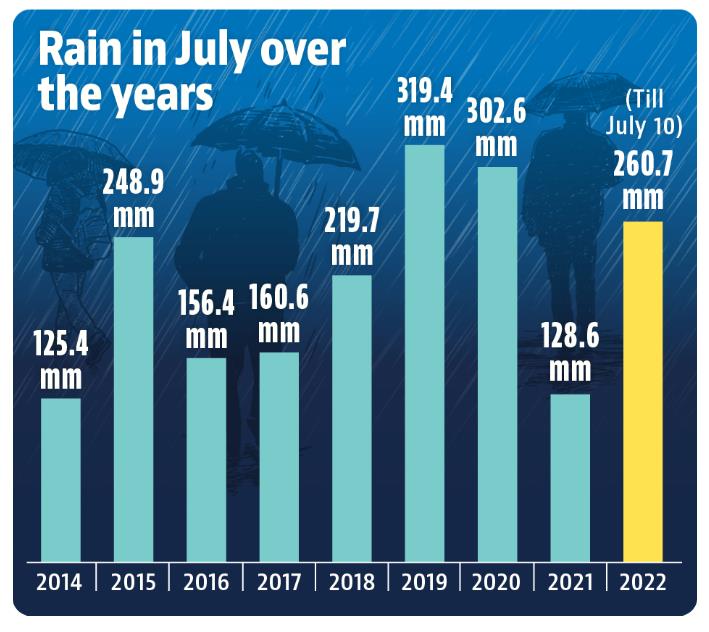
Last year, after the monsoon was declared in June, its activity had remained subdued through July and only 128.6 mm rain was recorded, far lower than the normal of 273.2 mm.
The rain in July this year is still lower than the 302.6 mm rain recorded in the whole month in 2020 and 319.4 mm rain recorded in the same period in 2019.
But it has surpassed the 219.7 mm rain seen in July 2018 and 160.6 mm rain in July 2017.
Speaking about of the heavy rail spells this monsoon, IMD Chandigarh director Manmohan Singh said, “The monsoon trough shifting southwards and low-lying easterly winds led to a good amount of rainfall here. Chandigarh’s location at the foothills of the Himalayas has also contributed to it getting more rain as compared to other parts of the region.”
Light rain, thunder on the cards today, tomorrow
After the rain on Sunday morning, chances of rain will reduce slightly on Monday and Tuesday, though light rain and thunder can be expected.
The monsoon system is expected to pick up again from Wednesday onwards and heavy rain can be expected in the later part of the week.
With the weather turning sunny after the morning rain, the city’s maximum temperature rose from 31°C on Saturday to 32.2°C on Sunday, 2.6 degrees above normal. But the minimum temperature dropped from 29.6°C to 24.6°C, 0.4 degree above normal.
Over the next three days, highs and lows of 34°C and 27°C, respectively, can be expected.
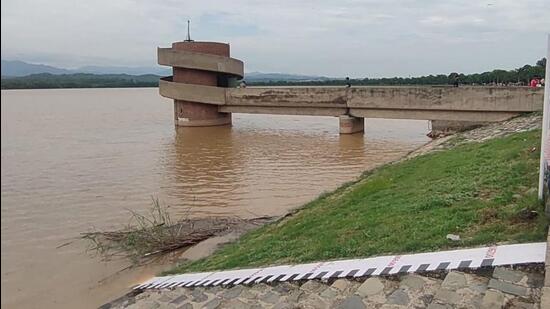
Sukhna Lake nearing danger mark, Chandigarh admn sounds alert
Amid the rising level of Sukhna Lake water, the UT administration has issued an alert for opening of flood gates.
While last year, the water level had crossed the danger mark of 1,163 feet in late August, this time around, with heavy rains in the lake’s catchment areas over the last week, the water level has already touched 1,161.50 feet.
The UT engineering department has alerted the Mohali administration about the rising water level at the lake.
Flood gates are opened when the level reaches 1,163 feet and the staff sounds an alert, the moment it inches towards 1,162 feet.
In 2021, the flood gates were opened five times in August and September after the water reached the danger mark.
UT chief engineer CB Ojha said, “We start releasing water by opening flood gates at 1,162 feet to avoid any chance of flooding downstream. In case heavy rains continue in the hills, the danger mark might be crossed in a day or two.”
In August 2020, incessant rain in the catchment area had forced the UT officials to open two floodgates of the lake after the water level crossed the danger mark, which had led to widespread flooding in low-lying areas of Zirakpur, adjacent to the Sukhna choe. Similar situation was witnessed a decade ago in 2008.
On the reason for current high level of the lake’s water, Ojha said, “Generally, the water in the lake recedes between March and June. But the city registered good monsoon seasons over the last couple of years. So, this year, even before the rainy season, the lake was already full of water.”
Synonymous with the city, the lake was created by Le Corbusier in 1958. By up to 1988, 66% of the original water holding capacity of the lake was lost due to silting. Following this, check dams were constructed in the catchment area. The man-made lake now has a capacity of around 500 hectare metres against the original capacity of over 1,074 hectare metres. On the north side, the lake is surrounded by 26 square kilometre area of wildlife sanctuary.


