
 E-Paper



Data-driven governance | Chandigarh to come up with ward index to identify, rectify problem areas in city
The Integrated Command and Control Centre (ICCC) will be the hub to collect, analyse and share real-time information by syncing the data of different departments


To step up the quality and speed of delivery of services to city residents, Chandigarh Smart City Ltd (CSCL) is set to undertake a data integrating exercise to prepare a ‘ward index’ on the basis of which, the problem areas of each ward will be identified so that the departments concerned can take corrective measures.

The Integrated Command and Control Centre (ICCC) will be the hub to collect, analyse and share real-time information by syncing the data of different departments of the administration for day-to-day operations.
A meeting under the chairmanship of UT adviser Dharam Pal was held here on Monday to discuss the road map for ICCC. The ICCC was inaugurated on March 27, 2022 by Union home minister Amit Shah.
As per the road map, all UT departments will be onboard the ICCC. Department attributes and services rendered by them will be monitored at ICCC.
How it will work
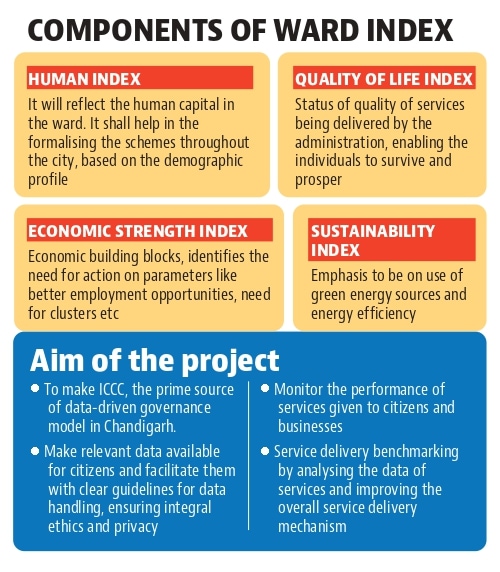
Under the ICCC road map, each asset and property in the city will be given a unique ID. These unique IDs will be mapped with their respective wards. Thereafter, indexing will be done identify the area of concern in each ward.
“Indexing data will be analysed to improve decision making process and city’s policies. Analysed data shall be used to improve the services delivered at the ground-level,” said a senior CSCL official.
Each property ID will contain information regarding its location (address, building plan, property tax, tenants, parking, vehicle, etc), utility (water, electricity, sewerage, etc) and institutional (school, dispensaries, Sampark centres, spots complex, etc) services delivered to it, its safety parameters (CCTV, FIR, armed license, fire NOC, police station, street light, etc) and the other features (restaurants, hotels, etc).
“Information from these unique IDs will be consolidated for each ward. On the basis of it, ward index will be prepared. It will give a vivid picture of where each ward stands in terms of services,” said the official.
Calculation of each ward index shall be done on the basis of ease-of-living standard of Government of India.
Data collection, analysis, syncing
The data will be collected on short and long-terms basis, depending on its availability.
Department-wise service integration will be done through ICCC. For instance, the police department integration points will include, integrated road accident database, traffic violation points analysis, integration with vahan database analysis of police verification requests, CCTNS emergency response system integrated complaint management e-Saathi.
Department data will be analysed and correlated with other departments. For instance, traffic data will be correlated with parking data, city bus with public-bike sharing, social welfare data with NULM etc. Findings of the analysis shall be fed into the ground-level service delivery systems.


