
 E-Paper



Day after Punjab government’s proposal, architects say edict of Chandigarh doesn’t allow statues
Architects cited Le Corbusier’s Edict of Chandigarh and UT’s autonomy to voice disagreement with with Punjab government’s proposal to install statues in Vidhan Sabha at the capital complex

 Prefer HTon Google


City-based architects voiced disagreement with Punjab government’s proposal to install statues of national figures—Bhagat Singh, Dr Bhim Rao Ambedkar and Maharaja Ranjit Singh—in the Vidhan Sabha at the capital complex, saying there was no place for such sculptures in Le Corbusier’s design for the city.
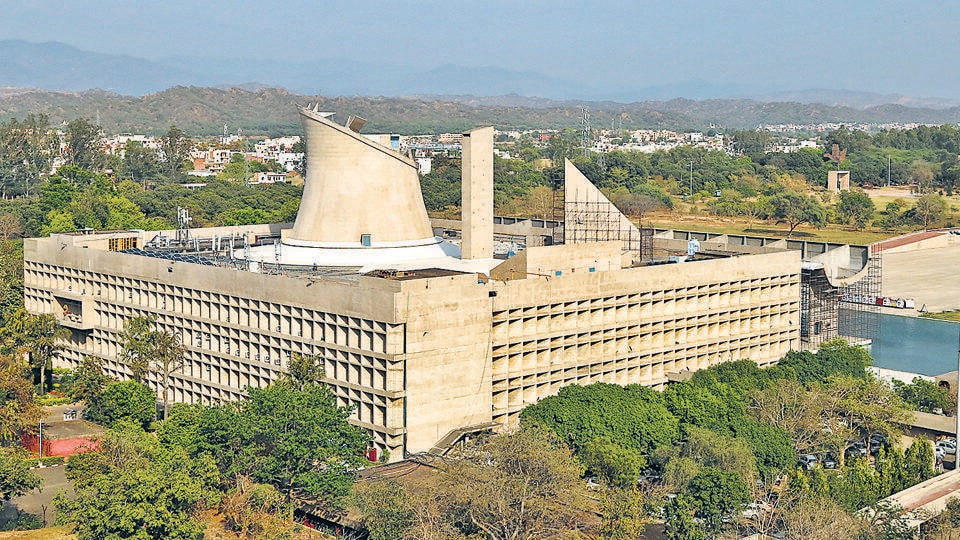
Punjab Vidhan Sabha had on Tuesday passed a resolution for the installation, which city architects feel was done without proper homework.
The proposal will next be submitted to the UT administration, which will be sent to the advisor via the urban planning department. He will then need to refer the proposal to the heritage committee, which comes under home ministry.
Hinting at a difficult road ahead for the proposal, a committee member, who did not wish to be named, said, “The Edict of Chandigarh, written by Le Corbusier, does not allow it. This edict is a Bible and part of the notified master plan of Chandigarh, a legal binding.”
The member added, “It was quite amusing to read how ministers are seeking statues of these great personalities. After the three names, others are presenting more names. Tomorrow, the new government will want more statues. Where will the end?”
UT-based architect Kapil Setia, echoing the sentiment, said, “In the Edict of Chandigarh, which was written by Le Corbusier does not allow statues of humans, naming of streets after personalities.”
“I believe, a removable statue can be allowed which can be displaced as and when required but nothing permanent can be installed,” he added.
‘UNESCO heritage status needs to be upheld’
In July 2016, the United Nations Educational, Scientific and Cultural Organisation (UNESCO) conferred heritage status on the capitol complex in the city, which put Chandigarh on the global map.
Spread over more than 100 acres in Sector 1, the capitol complex is the prime manifestation of the city’s architecture, designed by Le Corbusier. The buildings at capitol complex include the Open Hand monument, Punjab and Haryana high court, Tower of Shadows, Geometric Hill, the legislative assembly and the secretariat.
Notably, this is not the first time a government has announced such a proposal. In 2016, the Punjab Vidhan Sabha, to commemorate Ambedkar’s 125th birth anniversary, passed the resolution to install his statue at the complex. However, it was turned down by the UT administration.
Setia said a few years ago, six-seven-feet-long portraits of Punjab leaders were placed in the Vidhan Sabha members’ lounge, but were removed to uphold the UNESCO heritage status.
‘Statues against modern city-planning’
India Institutions of Architects former chairperson Surinder Bahga said, “The installation of statues or sculptures is against the concept of modern city-planning. Nehru envisioned it as a modern city depicting the aspiration of a new nation..”
“The UT administration is the ultimate owner, the Punjab and Haryana government are the users. Can a tenant change the design of the building?” he further questioned.
Chandigarh College of Architecture Deepika Gandhi, meanwhile, offered a more ambivalent response, saying “It’s a grey area and depends on how big the statue will be, whether it will be inside the building or out in the capitol complex. Within a building, they can install but again it all depends on what exact their proposal is.”


