
 E-Paper



Guest Col | Dr Manmohan Singh: A homage riddled with guilt
Dr Singh and Badal Saab were unquestionably the tallest leaders of the era and the undefined and unspoken bond between the two kept Punjab free of needless turmoil for over two decades


Almost the first feeling that I have as an Indian towards our late prime minister Dr Manmohan Singh is one of profound guilt: We as people were extremely unfair to the sensitive, suave leader who was all things except one — a politician. And our betrayal of him came when he most needed his people to know how the people of tomorrow’s India matter more than today’s politics and politicians.
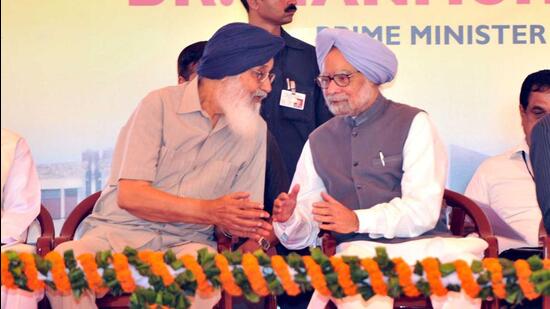
It should always haunt the conscience of our nation that we allowed the worthiest incumbent to be called an “accidental prime minister”. Or perhaps it was a reflection of our own priorities that virtues such as integrity and humility appeared as “accidents” to us. In a country where corruption, political rowdyism and megalomania pass for “political strength and stature of a leader”, Dr Singh’s self-effacing refusal to demand and hog the limelight were sure to puzzle his country, especially the press and politicians, and the
people. To those for whom their own ugly disdain for decency, culture and unpretentious honesty is the new “normal”, Dr Singh’s unassuming insistence on modesty, quiet efficiency and professional integrity were bound to appear as “accidental”.
Dr Singh never claimed credit for achievements
My memories of Dr Singh are of a person for whom doing the right thing the right way was the only normal way to do anything. No surprises then that he never claimed credit either for his path-breaking economic reforms or for his absolute insistence on administrative efficiency, transparency and accountability. For him, this was the only “normal” way a government could and should function. I am not surprised then that his media adviser felt uncomfortable working for a prime minister who believed that the news needed no “doctoring” and that the media could not be dishonest and therefore required no goading or “management”.
I was fortunate that I worked with a leader who shared Dr Singh’s approach to and respect for the media and allowed his adviser to function as an adviser rather than a manipulator of public opinion. So, I was never made to think of him as an “accidental” leader.
But I think Dr Singh must have been a media adviser’s worst nightmare. He always preferred me to address him as “Doctor Saab” rather than “PM Saab”. I once asked him how he felt being described as an accidental PM by his own adviser. His response was typically respectful of his former aide: “Perhaps, he was trying to be helpful. He probably thought accidents make better news than prime ministers.”
Bond between Dr Singh and Badal Saab
One of the great memories of my own professional career centres around being a close witness to an incident of amazing sensitivity involving the relationship between two truly great leaders – Dr Manmohan Singh and Parkash Singh Badal. Both shared much more than the background of a common religious faith and a common ancestral state. Both were humble and modest about their own achievements. Both had a distaste for the high-profile and spotlight – and both were passionate about rural development, health and education, especially the education of the girl child. And both were gentlemen in politics, born democrats and extremely respectful of the Opposition. For both, consensus rather than confrontation was the essence of politics, especially in a country where federal approach is the only way to address issues of diversity. Both were at once devotees as well as champions of dignified decorum in public life. And even while being devoutly religious, both believed in the power of religion to function as a binding glue rather than a divisive potion injected with fanatical poison. For both, peace and communal harmony remained cardinal principles of politics and religious faith.
Sympathetic to Punjab, Sikh community
Whenever the issues of Punjab and the Sikh community came up for discussion, Badal Saab found a most sympathetic heart and ears waiting for him on the other side of the table. Two instances come immediately to my mind. One: The then chief minister Captain Amarinder Singh was on a personal rampage to decisively finish the political career of Parkash Singh Badal. He and Akali stalwart Gurcharan Singh Tohra had personal grouses to settle with Badal and he was not averse to taking the Congress government’s help to achieve his goals. As election to the 2002 Shiromani Gurdwara Parbandhak Committee (SGPC) executive poll drew closer, the holy city of Amritsar turned khaki and the police entered Harmandar Sahib to block the Badal supporters from voting. Dr Singh saw this as a dangerous development in Sikh politics, fraught with dangers for Punjab and the country. It was an unsolicited but firm prime ministerial intervention by Dr Singh which stopped Captain Amarinder dead in his tracks, and normalcy was restored. I recall Badal Saab personally thanking Dr Singh much later for his intervention. Dr Singh’s response was typically modest and understated: “Oh, I am glad it was resolved. These things must never happen.” Badal Saab was touched to tears by the then prime minister’s modesty.
Foiled bid to weaken SGPC
The second instance was when the Congress government in Haryana launched a dangerous course to split and weaken the apex Sikh religious body, the SGPC, by bifurcating it with a separate body in that state. It was and it is a step that can come back to haunt the country. And all this just for petty political gains. A divided Sikh community is not the best recipe for stability in Punjab nor is it in the larger and long-term interests of the country as a whole. No one understood this better than Dr Singh. When Badal Saab broached the subject with Dr Singh in his office, I watched the late PM go silent, profound pain and anxiety writ large on his face. Soon, he would emerge as if from the depths of anguished soul to speak in his trademark gentle voice: “Badal Saab, please relax. This won’t happen, not as long as I am in this office.” And then, almost as an afterthought, he added: “My father took part in ‘Jaitu da morcha’ and other movements to set up the SGPC.”
Each in his own right, Dr Singh and Badal Saab were unquestionably the tallest leaders of the era and the undefined and unspoken bond between the two kept Punjab free of needless turmoil for over two decades. Nothing would sum up this silent emotional fibre of their relationship better than an incident that happened at the peak of the Lok Sabha polls in 2009. Both leaders were slated to campaign against each other in Punjab. We were in Amritsar when the news of Dr Singh’s impending surgery was flashed on my laptop. When I passed the news to Badal Saab, he was immediately on line with the PMO to inquire about the PM’s health. Minutes afterwards, he told me he would start “akhand path” at Harmandar Sahib for Dr Singh’s successful surgery and speedy recovery. Badal Saab remained in Amritsar all three days of the “akhand path”.
Will this remain a mere nostalgia or will our country ever return to this era of dignified democracy wherein political opposition is merely an expression of alternative paths to the promotion of the national interest and the people’s welfare? Dr Manmohan Singh leaves us at a time when we were just beginning to realise how unfair we had been to him – and exactly when we needed him the most.
(The author is a freelance writer and was adviser to former CM Parkash Singh Badal)


