
 E-Paper



Guest Column: A marvel on Madhya Marg
The poetic imagination of a budding naturalist may describe the bulbous fluff hanging conspicuously from a pavement tree adjacent to a signal light on the Sector-15 side as the “tree’s ephemeral earring”


Driving down Madhya Marg towards the PGIMER rotary, a layman’s glance could momentarily engage with a large, whitish and porous structure hanging conspicuously from a pavement tree adjacent to a signal light on the Sector-15 side. The poetic imagination of a budding naturalist may describe the bulbous fluff as the “tree’s ephemeral earring”. Others, more grounded, could wonder as the car engine idles: “It is a nest of some larvae or a cocoon, what exactly is it”? Meanwhile, the traffic signal flashes a quick green light, vehicles flee into urban busyness and another one of nature’s seemingly-inscrutable creations is forgotten or bulldozed all the way back to memory’s twilight zones.

Very few from the non-scientific community would be able to ascertain the antecedents of that structure. Within the realm of zoologists, there are a handful who study the kind of enigmatic creature that dwells within these structures. That unsung Madhya Marg marvel is the home of a classic ‘trap hunter’, a creature from genus Cyrtophora, insect family, Araneidae, or the Tent-web spiders. Eight species of Tent-web spiders have so far been discovered in India.
Spiders come across as repulsive and ugly to the “conditioned human eye”. They are under a perpetual, and largely unfounded, suspicion of being highly-venomous to humans. By cluttering ceilings, they attract the eternal annoyance of house owners. Hence, spiders do not top humanity’s popularity charts as dogs and birds do. But spiders constitute an incredibly diverse order of insects. Their webs are engineering marvels of precision: in tension, anchorage spots and design. Webs facilitate hunting, food storage, breeding and prop up the early lives of progeny. Along with lizards, spiders are unsung biocontrol agents, wiping beetles, house flies, dengue/chikungunya/malaria mosquitoes from the face of human dwellings.
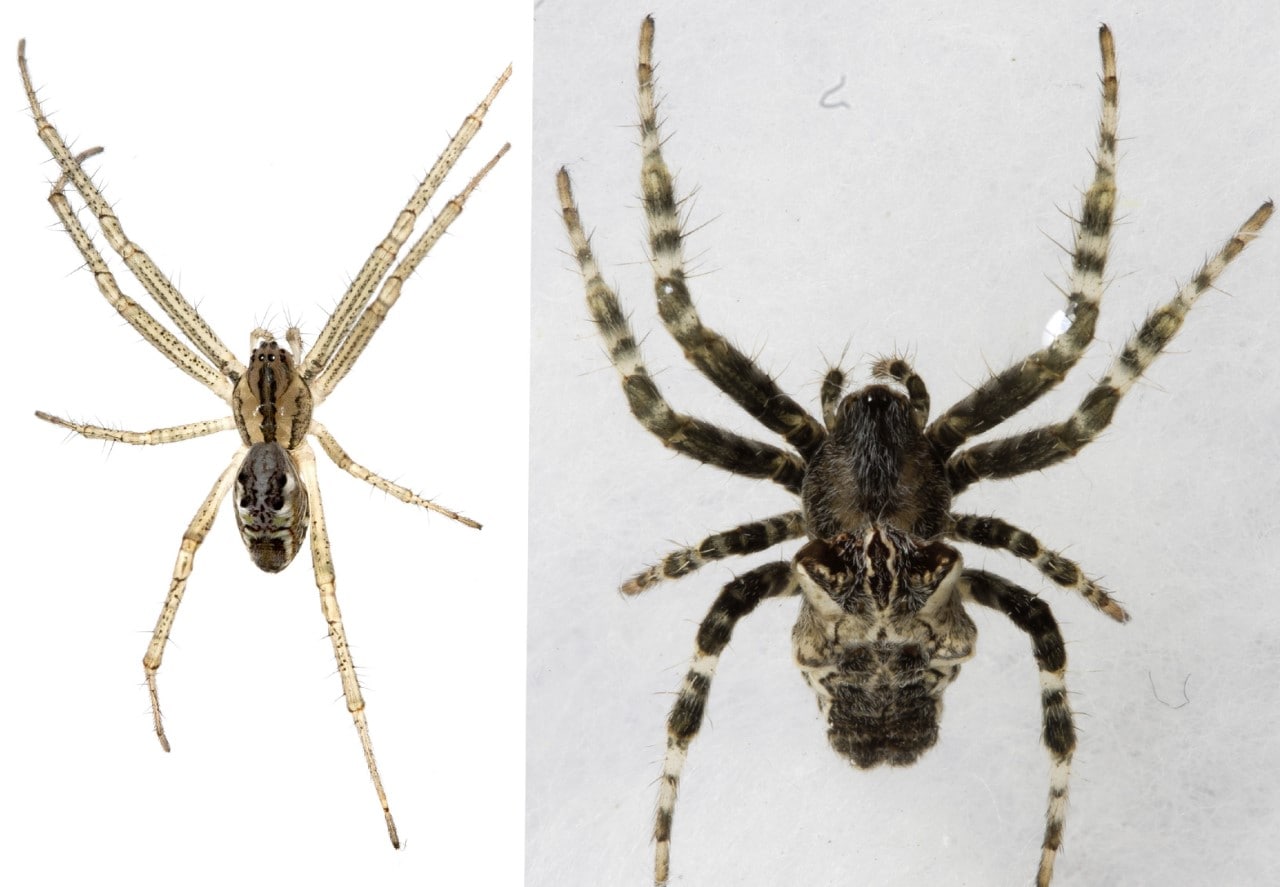
Looking for an insight into the lives of Tent-web spiders, let us now turn to associate professor Vivek Goyal — one of few zoologists from our region who has cared to decipher their highly-evolved existence. Goyal’s early-career PhD dissertation dealt with spiders of Haryana and Punjab and he has sustained that interest. “I love spiders,” he declares with disarming ardour.
“Tent-web spiders do not build a typical orb, but make a mesh-like web with many horizontal thick and thin stands above and below the orb. The tent-like web helps capture prey and provides space for living. Spiders are not specific when choosing a tree, as they don’t feed on plant material but are purely carnivorous. Like in hawks and falcons, the female spider is bigger, approximately 10 mm in length, and about three times male size,” explains Goyal.
Females are bigger because they have the abdominal sac to carry eggs (can deliver 200 eggs at one time!) while male spiders have evolved in smaller sizes as they need to be agile and mobile to copulate with multiple females. His sex sprees are hazardous, a kind of indulgence in Russian roulette. Depending upon her hunger and remnant energy levels, one of the serviced females may gobble him after he presses the copulatory trigger.
“Many spiders live in a large tent web in what is known as a ‘colony’ but the territory of all spiders is marked, and each fends for itself. The egg sacs look like a small cocoon and contain numerous fertilised eggs wrapped in a web, lending them a beaded appearance. They hang inside the web and are guarded by the mother. Sometimes, these intricately woven webs cover major parts of the tree in response to better availability of food. This may hamper the tree growth as webs restrict air and light,” added Goyal.


