
 E-Paper



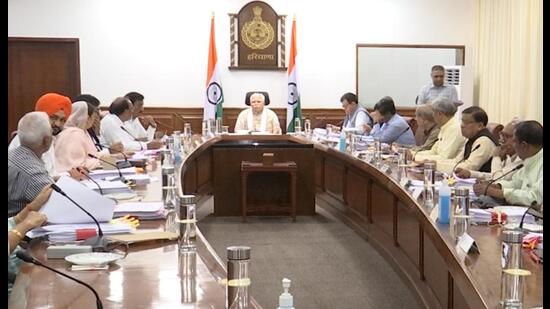
Haryana Cabinet approves metro extension
The Haryana Cabinet also accorded approval of the gross project cost along with the state government’s share of ₹ 1,541 crore


: For providing better connectivity between Rezangla Chowk, Gurugram to Sector 21 in Dwarka, New Delhi, the final detailed project report (DPR) of the metro rail was on Wednesday approved by the Haryana cabinet.
An official spokesperson quoting the DPR said that the spur or metro extension connecting Rezangla Chowk in Palam Vihar and Dwarka Sector 21 station will be 8.40km long, of which 4 km will be from Palam Vihar to Sector 111 in Gurugram and the remaining 4.40 km will be from sector 111 to sector 21 Dwarka. This entire route will have seven stations.
The cabinet also accorded approval of the gross project cost along with the state government’s share of ₹ 1,541 crore. Approval was also given to nominate the administrative secretary, town and country planning department as nodal officer for the signing of agreements and other related documents for the implementation of the said project.
This Mass Rapid Transport System (MRTS) project will give connectivity to the maximum part of Gurugram city with Delhi and other surroundings. It will interchange with Palam Vihar station of Gurugram metro corridor, with IECC station of airport express metro corridor and with Sector 21 Dwarka station of DMRC blue line and airport express metro corridor.
This MRTS will also have an interchange with Dwarka Expressway at Sector 110-A. These linkages will enhance the efficiency of the transportation system in the National Capital Region (NCR). This will also give hassle-free transportation facility to the passengers who would be travelling to Delhi international airport as there will be check-in facility given at sector-21, Dwarka Metro Station.
The introduction of MRTS will result in the reduction of the number of buses, intermediate public transport (IPT), usage of private vehicles, air pollution and an increase in the speed of road-based vehicles. This, in turn, will result in significant social benefits due to reduction in fuel consumption, vehicle operating cost and travel time of passengers. Reduction in accidents, pollution and road maintenance costs are the other benefits to society in general, the spokesperson said.
Other decisions
The Cabinet accorded approval to a proposal regarding the framing of Faridabad Metropolitan Development Rules, 2022. The notification of the said rules shall enable the Faridabad Metropolitan Development Authority to meet out financial expenses and meeting of the Authority.
In a bid to ensure a complete ban on the promotion or conduct of prize chits and money circulation schemes, the Haryana government has formulated Money Circulation Schemes (Banning) Rules-2022. A decision in this regard was taken in the Cabinet on Wednesday.
The provisions of the ‘Prize Chits and Money Circulation Schemes (Banning), Act, 1978’ were made applicable to the state as per section 13 of the Act and under this now, the Money Circulation Schemes (Banning) Rules-2022 has been formulated. As per the Money Circulation Schemes (Banning) Rules-2022, no individual or company or firm or business association, in any form will promote, run or participate in money circulation scheme including a disguised money circulation scheme.
The nodal police authority will be responsible for coordinating with other state governments, the central government and agencies concerned under such government and the Reserve Bank of India and will also be responsible for furnishing the information to the RBI.
The Cabinet accorded ex-post facto approval to a proposal for providing state government guarantee of ₹ 500 crore in favour of State Bank of India, against the sanctioned Capex loan of ₹ 500 to Uttar Haryana Bijli Vitran Nigam Ltd. (UHBVNL) for meeting the capital expenditure and power purchase payments. An official spokesperson said the Nigam manages its day-to-day operations by using fund-based and non-fund-based working capital limits sanctioned by various banks. Due to the increase in power purchase payments, to meet the capital expenditure requirement and provide a Letter of Credit in favour of power suppliers as per Ministry of Power guidelines, UHBVNL requires fresh working capital loans and Capex loans. To meet the fund-based requirement, UHBVNL had requested the bank to sanction the Capex loan of ₹ 500 crores, which the bank sanctioned.
The Cabinet accorded ex-post facto approval to the appointment of Justice (retd) LN Mittal as Commission of Inquiry to probe into the circumstances leading to the assault and death of Surender Singh, former deputy superintendent of police, Taoru in Nuh, while conducting a raid to check illegal mining activities. It was also decided to extend the term of commission up to October 31. By this time the enquiry is supposed to be completed, an official spokesperson said.
The commission, set up on August 18, will also suggest deterrent measures to prevent the reoccurrence of such incidents and to curb illegal mining in that area in the future.
The Cabinet accorded approval to a proposal regarding replacing Punjab Jail Manual- 1894 (as applicable in Haryana) with the Haryana Prison Rule, 2022. The manual notified during the British rule governs the establishment of prisons in the state. An official spokesperson said that this more than a century-old document needs updation in conformity with the changing times.
The spokesperson said these 2022 rules will apply to all prisons in the state with regard to its administration and management, staff members, convicts, under-trial prisoners, civil prisoners, female prisoners, young offenders, and detainues under preventive detention laws.
The Haryana Prison Rules, 2022 are based on the Model Prison Manual, 2016, approved by the Union ministry of home affairs after making suitable amendments, additions, alterations and deletions as per the local laws and local conditions. The establishment of reception centres in every prison for newly admitted prisoners to enable their individual behavioural study, health screening and orientation have been incorporated in these newly framed rules. Under these rules, classification of prisoners for segregation, special provisions for gangsters and hardcore prisoners have been provided. Besides this, the rights and duties of prisoners have also been included. Provisions for prison diet, its preparation and distribution management have been provided in the Haryana Prison Rules, 2022.Special provisions have also been made for female, old age and terminally ill prisoners, the spokesperson said.
The Haryana cabinet gave its nod to the draft of the Program to Accelerate Development of MSME Advancement (PADMA) scheme aimed at designing and implementing developmental interventions focused on micro and small enterprises at the block level. An official spokesperson said the scheme further aims to set up 143 new clusters (one in each block) of MSMEs over about 4000 acres of land, enable the setting up of 10,000 plus new enterprises, attract new investments of ₹ 25,000-30,000 crores, creation of 3,00,000 new employment (direct and Indirect), designing and implementing developmental interventions focused on micro and small enterprises at block level by leveraging cluster approach.
The scheme also aims to give a thrust to sustainable employment and entrepreneurship opportunities, encouraging holistic socio-economic development and a robust industrial ecosystem at the block level, empowering the state’s youth to set up new enterprises by providing them opportunities to grow and be a part of the formal economy and promotion of locally relevant products and provide an opportunity to state farmers to broaden their horizon-from producers to processors.


