
 E-Paper



Haryana’s basmati belt fights farm fires with manual harvesting
The traditional method of paddy harvesting has helped generate additional income for farmers and jobs for labourers


: At a time when Punjab, Haryana and Delhi are choking on air pollution due to stubble burning, and different methods are being suggested to manage ‘parali’ (paddy straw), hundreds of farmers in the basmati-growing belt of Haryana have opted for manual harvesting that has not only helped control farm fires but also generate additional income for farmers and jobs for labourers.
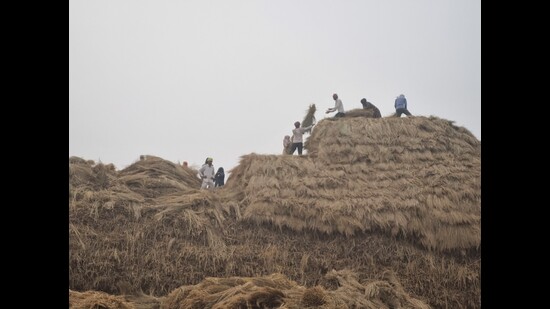
With most of the farmers growing the premium paddy variety in the basmati belt and preferring the traditional harvesting method, the area in the state spread over 400 villages in Nilokheri, Nissing and Assandh blocks of Karnal district; Pehowa and Thanesar blocks in Kurukshetra district; Dhand, Pundri and Rajaund blocks of Kaithal district; has witnessed negligible incidents of stubble burning.
According to farmers, those growing the aromatic long-grain basmati rice earn around ₹ 9,000-10,000 per acre extra from the crop waste as there are 30 units set up in different locations by private buyers to purchase the residue.
Earning from crop waste
Aman Kashyap, 27-year-old parali trader from Nigdhu village of Karnal said that he was purchasing paddy straw from farmers at ₹ 400 per quintal and selling the paddy straw fodder to the local dairy farmers and gaushalas at ₹ 600 to ₹ 700 per quintal, thus earning a profit of more than ₹ 100 per quintal after spending on transportation, labour and other expenses.
Ravi Kumar, an employee at Rana farm, which also deals in paddy residue, said that this year, the prices of basmati parali doubled. Last year, they purchased parali at ₹ 200 to ₹ 250 per quintal and now they are paying ₹ 450 to buy it.
“But it does not have any impact on our earnings as there is a huge demand of chopped straw in the local market,” he said.
The traders said that chopped paddy straw is the best alternative to wheat fodder which is lesser in supply and is sold at ₹ 1200 per quintal.
Boon for sculptors
This area is also known for selling ‘parali’, which is used by sculptors of Rajasthan and Gujarat to wrap idols to avoid any damage to them during transportation.
“There is a huge demand for basmati straw with a length of more than 24 inches in Gujarat and Rajasthan. We buy it directly from the farmers and pack it after pressing with hydraulic pressing machines to transport,” said Hemant Kumar, who runs a purchase centre in Pundri.
Manual harvesting key to fight farm fires
According to agriculture experts, there is a spike in the incidents of farm fires since farmers shifted to combine harvesters from the traditional manual harvesting.
“There is no burning of crop waste when the crop is harvested manually, as this is the best way to manage crop waste and now there is also a market for it,” said a basmati grower Raghubir Singh of Karnal’s Yunispur village.
Another farmer Raj Kumar from Sakra village in Kaithal district said, “there is a huge demand of basmati parali. That is why we pay ₹ 6,000 to ₹ 7,000 per acre on manual harvesting and sell parali at ₹ 10000 per acre”.
The farmers said that the manual harvesting also generate jobs for locals and migrant labourers as a group of 10 -12 people can harvest one acre of paddy in one day and they can easily earn ₹ 500 to ₹ 600 per person while working in their village.
Need to promote basmati cultivation
Agriculture experts are of the view that the government should take immediate steps to promote cultivation of basmati varieties. As per officials from the agriculture department, the state has witnessed a rise in the incidents of farm fires since the area under basmati cultivation has declined and farmers shifted to parmal varieties.
Hardeep Singh, director general of agriculture and farmers welfare department said, “We also want that area under basmati should increase and even government has made efforts for it, but there are two problems, yield is comparatively less, which is around one third less than the parmal varieties”.
“Due to residual impact of banned pesticides, the consignments were rejected by European countries and Arabian countries last year. This year, we issued 60 days temporary ban also on use of these pesticides,” he added.
The experts demand that the government should also announce cash incentives for farmers adopting manual harvesting and this will help to cut farm fires further.
Assured price could help
Virender Lather, a retired scientist from Indian Agricultural Institute, ICAR, New Delh said, “there are two reasons for no burning of stubble in the basmati belt as its waste is being used as cattle fodder and there are several paper mills buying the managed straw from farmers.”
Though the government can promote cultivation of traditional basmati varieties and manual harvesting, it has limitations as there is very short population of consumers as it is sold in the private sector and government do not purchase it, he said.
“Due to lack of assured prices, on several occasions basmati growers were not even able to earn the input cost,” he said.
He advised that the government should take steps so that the basmati buyers ink an agreement with the farmers by promising them a fixed price and this will definitely help to increase the area under basmati and cut incidents of farm fires.
According to the figures from the state agriculture department this year, paddy cultivation in Haryana was spread across 34.35 lakh acre and basmati was grown in over 18 lakh acres and non-basmati varieties in 16.26 lakh acres. Also, the area under basmait PB 30, Pusa 1121 and Moochal, which are harvested manually, is squeezing, following which the area under parmal varieties has increased.
The estimated total quantity of straw being generated is about 70 lakh metric tonnes, officials said, adding that since basmati is harvested manually, the total crop waste to be managed was expected to be around 40 lakh MT.
“If the area under traditional basmati varieties, which are harvested manually, is increased, it will definitely help to cut the incidents of farm fires,” said a senior officer of the agriculture department.
Chief minister Manohar Lal Khattar during his recent visit to Karnal had announced that the state government was also working on a parali policy by fixing a price for parali which can be used as cattle fodder.


