
 E-Paper



Himachal’s budget lays road map for self-reliance
Tax-free budget stresses on strengthening agriculture and infrastructure development; education sector gets the highest allocation


With an eye on catalysing systemic change and addressing critical sectors, chief minister (CM) Sukhvinder Singh Sukhu, who also holds the finance portfolio, unveiled a ₹58,444 crore tax-free budget with a commitment to inclusive development and public welfare. The vision, he said, was to make the state “self-reliant” over the next one decade.
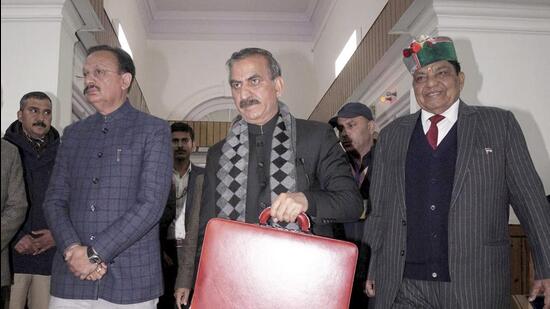
The budget is 9.1% higher than the ₹53,413 crore figure for 2023-24 fiscal year and places special emphasis on vital areas including agriculture, infrastructure development, animal husbandry, education, health and digitisation. There is also a big push to make Himachal a green state, the major theme in last year’s budget, also resonates with focus on clean energy.
Listing the restoration of the Old Pension Scheme (OPS) and a ₹680-cr start-up scheme as its achievements from last year, Sukhu said the strategic allocation in the second budget reflects his government’s steadfast dedication to ushering in a new era of progress and prosperity for the state.
“The path of development is difficult, there are obstacles, but we will not let them get in the way of development,” the CM said, adding that good governance is the ability to take tough decisions during challenging times.
“The government is capable of dealing with any situation. We demonstrated the capability during last year’s monsoon disaster,” he added.
Sukhu said the budget emphasises increased investment in infrastructure spanning sectors of tourism, transport, roads and bridges, and power, while also continuing work to strengthen healthcare, education, and digitisation initiatives.
An upward graph
The CM said the state’s economy is estimated to grow at 7.1% during 2023-24 and per capita income is estimated at ₹2,35,199..
The state’s gross domestic product (GDP) for 2023-24 is estimated to be ₹2,07,430 crore.
“The government proposes to spend ₹9,990 crores for the state development budget during 2024- 25,” he said, adding that ₹2,516 crore have been allocated to the Scheduled Caste Development Programme, ₹899 crores for Tribal Development Programme and ₹110 crores for Backward Area Development Programme. An outlay of ₹5,280 crore, meanwhile, is proposed for central schemes.
State bets on transformation cell, sustainable devp centre
With the aim to transform challenges in the state’s development process into opportunities, a Himachal Pradesh Transformation Cell will be established in the planning department.
The cell will provide suggestions to accelerate the development of the state based on best practices followed at local, national and international levels.
A separate Sustainable Development Goals Coordination Centre will be established in the department to monitor and evaluate the development programmes. Both bodies would start functioning next year.
Education sector at the heart of budget
Proposing a whooping ₹9,560 crore outlay for education, the chief minister said that educational institutions will be developed as Institutions of Excellence (IOE) in a phased manner based on predetermined parameters.
The initial target stands at 850 educational institutions, 500 primary schools, 100 high schools, 200 senior secondary schools and 50 degree colleges. For better coordination between schools and encouraging community participation, the “Mera Vidyalaya, Mera Samman” scheme was announced. Under the scheme, office bearers from CM to the block-level officers will adopt one educational institution each,
Besides, annual rankings and performance-based grants were also tipped.
Taking note of an educated youth being the future of the state, the CM announced Padho Himachal scheme aimed at promoting reading among kids.
The curriculum in the State will be re-evaluated in the context of Constitutional values and the rich cultural heritage of the State will be given representation in it, he said.
₹582-crore for agriculture
Describing agriculture as the backbone of the state’s economy, the CM announced Rajiv Gandhi Prakritik Kheti Start-up Yojana as the third component of ₹680-crore Rajiv Gandhi Start-up Yojana aimed at increasing farmer income.
Ten farmers from each panchayat will be encouraged to take up chemical-free farming, making way for around 36,000 farmers adopting natural farming. Those already in the practice will be given priority.
To motivate unemployed youth to natural farming, a maximum of 20 quintals of naturally grown grains per family will be procured by the government at a minimum support price (MSP) of ₹40 per kg and maize at ₹30 per kg.
“The MSP given by our state government is the highest in the country,” Sukhu said, announcing that an outlay of ₹580 crore has been proposed for the agriculture sector.
The CM also announced the formation of a state-level task force to tackle the stray cattle menace, which will give suggestions to construct new and maintain the existing cow shelters.
Besides, a ₹531-crore outlay was announced for the horticulture sector. Push was also given to the contentious universal cartons, which the CM said will be used from the upcoming apple season in 2024. Earlier, there was a tendency to package more than the prescribed layers of the apple to increase the weight of the box, a practice that was highly unfavourable to growers.
Seventy-five new irrigation schemes will be set up, as will a Centre of Excellence in Horticulture as a one-stop resource centre for all the needs related to quality, skill, tourism and marketing, state-of-the-art fruit processing units in sub-tropical areas and a foundation block for mother trees/bud wood banks for the promotion of guava, lemon among others.
Green energy a priority still
Reiterating his commitment to making Himachal the first “Green Energy” state by 2026, Sukhu said a 32-MW solar power plant, the state’s largest, will be commissioned in Una by March 2024, while another plant with an installed capacity of 10 MW will be ready for commissioning by June 2024.
“Bhanjal Solar Power Project with an installed capacity of 5 MW will be dedicated to the people of the state by September 2024,” Sukhu said, adding that solar panels ranging from 100 to 500 KW will be installed on owned land at a 45% subsidy under the Rajiv Gandhi Start-up Yojana. A target of harnessing 100 MW of solar energy has been envisaged under the scheme’s first phase.
Registration of solar energy projects to be established on private land will also remain year-round and solar parks and other projects will take shape in Una, Kangra, Solan, Sirmaur, Mandi and Shimla districts.
A tourism master plan
Maintaining that the state government was committed to upgrade tourism infrastructure, the CM said a master plan has been prepared for the development and management of Pong Dam under Swadesh Darshan-2.
Apart from this Chandratal, Kaza, and Tandi in Lahaul-Spiti and Rackchham and Nako–Chango–Khab in Kinnaur will be developed from a tourism point of view and a skywalk bridge will be built at Haasan Valley near Kufri.
To provide better facilities to tourists during their stay in the state, all homestays will also be brought under the Himachal Pradesh Tourism Development and Registration Act.
Improved healthcare services
Sukhu said the increasing number of cancer patients in Himachal was a matter of concern and a State Cancer Institute will be set up at the Hamirpur Medical College with the latest state-of-the-art diagnostic and treatment facilities at a cost of ₹100 crore.
“A study will be conducted with the help of the Indian Council of Medical Research to find out the reasons for the increasing incidence of cancer in the state,” he said, while announcing cancer daycare centres at the district hospitals and select Adarsh Swasthya Kendras.


