
 E-Paper



Lahaul’s Blueberry farming trial tastes success, paves way for new cash crop
A new initiative to cultivate blueberries in the Lahaul Valley has been launched through the efforts of the horticulture department in the tribal district of Lahaul-Spiti

 Prefer HTon Google


Blueberry cultivation is expanding to high-altitude open fields in Lahaul and Spiti, Himachal Pradesh, reaching elevations of 11,500 feet (3,500 metres) above sea level providing an option of cash crop to the farmers of Lahaul.
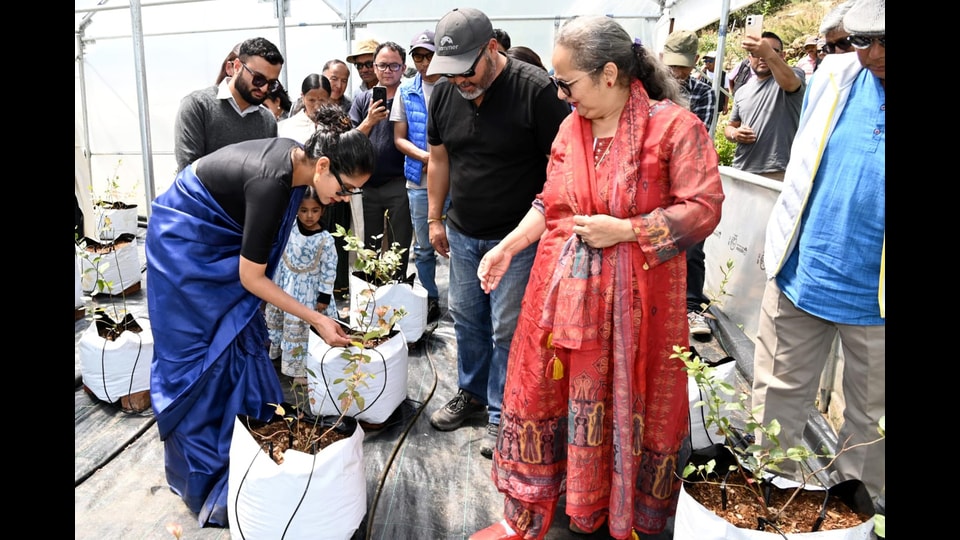
A new initiative to cultivate blueberries in the Lahaul Valley has been launched through the efforts of the horticulture department in the tribal district of Lahaul-Spiti.
With appropriate training, guidance, and support from the horticulture department, Pratap Chand—a progressive grower from Gondhla—has successfully cultivated 500 blueberry plants in a 500-square-metre polyhouse and these plants are expected to bear fruit soon.
Lahaul and Spiti deputy commissioner (DC) Kiran Bhadana formally inaugurated this blueberry demonstration site on Wednesday. This blueberry demonstration site was established by the horticulture department under the central government’s ‘Mission for Integrated Development of Horticulture’ (MIDH) scheme.
She said that the cost of setting up this site was approximately ₹12.50 lakh, with the horticulture department providing a subsidy of ₹9,37,500 to the grower. She noted that 500 blueberry plants have been cultivated in the 500-square-metre polyhouse.
The DC said, “This is an example of achieving high yields from a small land area.” She also urged other residents of the region to visit the demonstration site and draw inspiration to take up blueberry cultivation, assuring them of full support from the horticulture department.
She explained that the blueberry is a small, soft, blue-purple berry; the initial attempt to cultivate it in the valley—specifically in Gaundhla—has been successful.
She said that farmers would be contacted and provided with all possible assistance to encourage them to take up blueberry cultivation. She noted that in India, blueberries are still considered a premium or exotic fruit, commanding a significantly higher market price compared to common fruits like apples, oranges, and bananas.
“Rich in antioxidants, fiber, and vitamins, the fruit is seeing rising demand among urban consumers; consequently, if farmers in the valley cultivate it, they could achieve significant economic prosperity,” added Bhadana.
Deputy director of horticulture Meenakshi Sharma explained that blueberry cultivation differs slightly from that of standard fruit-bearing plants. “It requires acidic soil or grow-bags, controlled irrigation, and the right variety,” said Sharma, adding that the blueberries are also being grown in other districts of the state, including relatively warmer areas like Palampur/Kangra, Mandi, and Kullu.
She added, “While domestic production is currently relatively low, experimental and commercial cultivation is expanding rapidly across several states; work is underway to explore commercial prospects in Kashmir, and Himachal Pradesh, in particular, is considered to have excellent potential for blueberry farming. If farmers and orchardists in the valley venture into blueberry cultivation, there are promising prospects for future income.”


