
 E-Paper



Mohali’s 2 govt-run cow shelters sorely inadequate
Officials admitted that the lack of adequate shelter space has made it nearly impossible to carry out sustained cattle-catching drives, allowing the problem to persist across the city.

 Prefer HTon Google


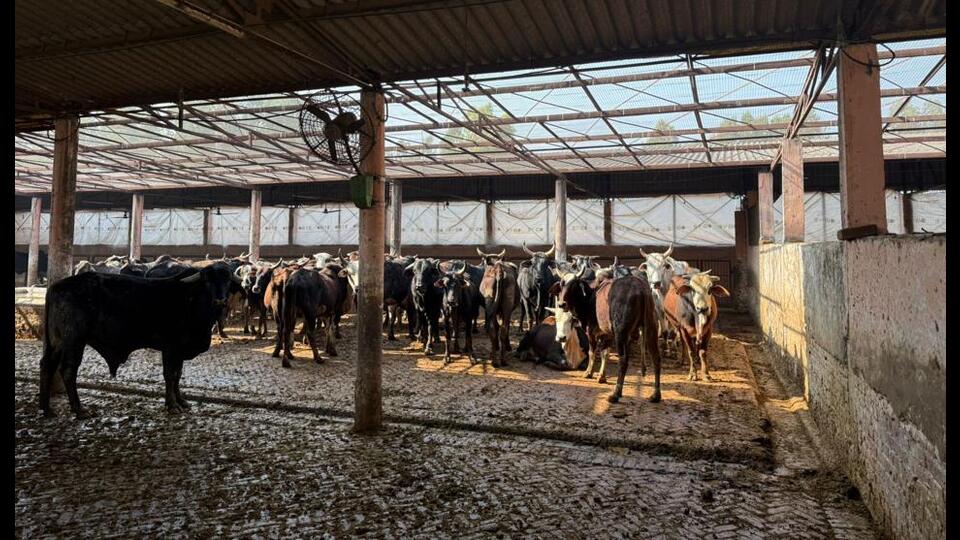
Mohali continues to grapple with the menace of stray cattle on its roads, exposing the severe shortage of government-run cow shelters in the district. Despite repeated complaints from residents about traffic disruptions and accidents caused by roaming cattle, the Mohali municipal corporation (MC) has only one gaushala to house seized animals, and it is already operating beyond capacity.
Officials admitted that the lack of adequate shelter space has made it nearly impossible to carry out sustained cattle-catching drives, allowing the problem to persist across the city.
At present, there are 17 registered gaushalas in Mohali district, but only two are government-run — one by the Punjab government in Lalru and the other by the Mohali MC in Phase 1. As per Mohali’s animal husbandry department, the remaining 15 gaushalas are operated by private institutions and non-governmental organisations, limiting the administration’s direct control over cattle management.
At the MC-run gaushala in Phase 1, the sanctioned capacity of the shelter is 600 cattle, but it houses more than 800 cows at any given time. “On a daily basis, two to three new cows are brought to the shelter. We are already overcrowded, but there is no alternative place to keep the rescued animals,” said an official of the NGO managing the gaushala on behalf of the MC. The official added that 28 staff members, including two veterinary doctors, are currently engaged in maintaining the shelter and ensuring the animals’ health and feeding needs, despite limited space and resources.
MC commissioner Parminder Singh said the civic body has been struggling for years to expand its animal shelter infrastructure. “For years, we have been requesting Greater Mohali Area Development Authority (GMADA) to allot land for building another gaushala, a dog shelter or a proper cattle pound, but the discussions have never yielded results,” said Singh. He added that with several village areas recently being brought under MC limits, the requirement for additional facilities has become even more urgent. “We definitely need at least one more cattle pound, preferably near Aerocity, so that cattle can be caught promptly and kept safely in a shelter instead of being left on the roads,” the officer said.
Residents, meanwhile, say the unchecked presence of stray cattle has turned daily commuting into a risky affair. These animals are frequently spotted on main roads, leading to traffic chaos and, in several cases, road accidents. “Every evening, large herds can be seen near the municipal corporation office in Sector 68. It has become routine, but nothing changes,” said Megha Kaur, a resident of Phase 11.
Other affected areas include Phase 1, 11, Industrial Area Phase 9, Airport Road, Sectors 76 to 80, Sector 82 and Phase 9, where motorists often slow down or take detours to avoid collisions with cattle.
MC seeks eviction of organisation claiming to be running a gau hospital in Phase 1
The Mohali MC has written to the Mohali deputy commissioner seeking eviction of an organisation, Gau Grass Sewa Samiti, which claims to be running a gaushala-cum-gau hospital in Sector 55, Phase 1. “The government land has been illegally occupied and no permission was granted for such use,” said MC commissioner.
Recently, GMADA has also written to the deputy commissioner and has asked the animal husbandry department to make arrangements for the cows during the eviction. It is worth mentioning that GMADA attempted to remove the encroachment twice — on August 18, 2025, and again on November 12, 2025 — but both attempts failed.
Subsequently, on October 28, 2025, GMADA wrote to the deputy commissioner, Mohali, seeking adequate police force to facilitate eviction of the land. The land has still not been vacated to date.
MC chief orders reforms to strengthen animal welfare in UT
Municipal Corporation Chandigarh commissioner Amit Kumar, on Thursday chaired a review meeting to assess the working and management of all gaushalas functioning under the municipal corporation. The meeting focused on improving infrastructure, animal welfare standards, transparency, and operational efficiency across all facilities.
During the review, Kumar directed the concerned officers to immediately invite Expression of Interest (EOI) from reputed NGOs for operating the Raipur Kalan Gaushala, ensuring professional and accountable management.
Key issues related to various wings were discussed in detail, including levelling of floors in cowsheds, development of proper feeding points, availability of clean drinking water, provision of electricity points along with necessary supplies and fixtures, and installation of CCTV cameras to enhance monitoring and transparency.
It was decided that the executive engineer, Solid Waste Management (SWM) will act as the nodal officer for ensuring the full functionality of the incinerator plant. The officer has been directed to maintain proper records and regularly cross-check data to ensure that the number of animal death cases does not show any abnormal increase.
To ensure nutritional adequacy and quality control, the commissioner ordered random sampling of fodder to verify both the quantity and quality of dry and green fodder being supplied to the gaushalas. He further directed that diet charts must be displayed prominently and immediately at all facilities for better monitoring and accountability.
Recognising the need for adequate medical care, Kumar instructed the joint commissioner to initiate the recruitment process for a veterinary doctor and a pharmacist at the earliest to strengthen veterinary services in gaushalas.
The meeting also included detailed discussions on standard operating procedures (SOPs) and working proformas. To ensure continuous oversight, the commissioner directed all concerned officers to submit weekly inspection reports without fail.


