E-Paper



Monthly stipend for women, 50% quota for deprived SCs soon after BJP 3.0 swearing-in
BJP functionaries said that the soon to be constituted Council of Ministers headed by the newly elected leader of the BJP legislature group, Nayab Saini will approve Lado Lakshmi Yojana entailing a monthly stipend of ₹2,100 to every woman in the state in its first meeting likely to take place on October 18. The yojana was announced by the BJP in its 2024 assembly poll manifesto.

 Prefer HTon Google


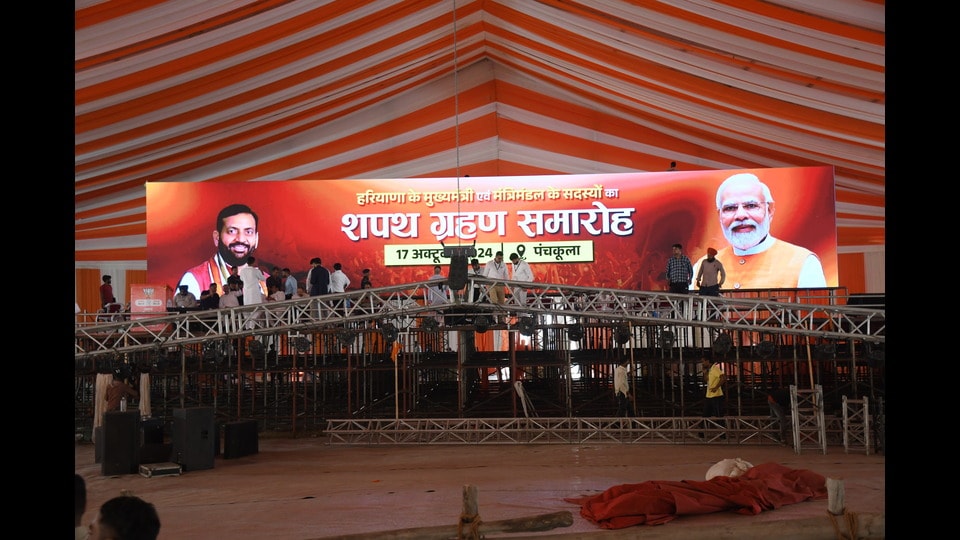
One of the first decisions that the Nayab Singh Saini-led BJP government in Haryana will take soon after being sworn in on October 17 will be to implement its election promise of providing monthly financial assistance of ₹2,100 to every woman in the state and notify 50% reservation for deprived Scheduled Castes (DSC).
BJP functionaries said that the soon to be constituted Council of Ministers headed by the newly elected leader of the BJP legislature group, Nayab Saini will approve Lado Lakshmi Yojana entailing a monthly stipend of ₹2,100 to every woman in the state in its first meeting likely to take place on October 18. The yojana was announced by the BJP in its 2024 assembly poll manifesto.
Lado Lakshmi Yojana to cost about ₹23,000 cr to exchequer
While the contours of the scheme are being finetuned, officials said that if about 95 lakh women in the 18-100 age group were given the benefit of ₹2,100 monthly stipend, it will cost the state exchequer ₹23,940 crore annually.
“If the state government decides to provide ₹2,100 every month to about 77 lakh women in the 18-60 age group considering that many will become beneficiaries of old age social security pension after 60, then the state government will have to spend about ₹19,000 crore annually. It will cost the state exchequer about ₹17,640 crore if only 70 lakh women who are below the poverty line (BPL) are made beneficiaries of the monthly stipend scheme,” officials said.
Subsidised LPG to burden exchequer by ₹1,200 crore
The new BJP government is also expected to provide cooking gas cylinder at a subsidized rate of ₹500 to every BPL and Antyodaya family in the state, also a poll promise. This would mean that the state will have to bear a subsidy of about ₹320 per cylinder. “If 30 lakh BPL families are provided subsidised cooking gas, the government will incur an additional expenditure of about ₹1,200 crore annually,’’ official said.
50% reservation for deprived Scheduled Castes to be notified
The new government will also notify 50% of the 20% reserved vacancies in government jobs for Scheduled Castes for a newly created category of deprived Scheduled Castes (DSC) comprising 36 Scheduled Castes such as Balmiki, Dhanaks, Khatiks, Mazhabi Sikhs. The erstwhile Council of Ministers also led by Nayab Saini had on August 17 accepted the recommendations of the Haryana State Commission for Scheduled Castes to create subclassification of Scheduled castes (SCs) in the state, a step in line with the August 1 Supreme Court constitution bench judgment that allowed states to create such categorisation. However, since the model code of conduct was in place, it was decided that a notification to undertake subclassification would be done after the code of conduct ceases to be in effect, Saini had said.
As per the report of the State Scheduled Castes Commission, 36 Scheduled castes from Haryana, Balmikis, Dhanaks, Khatiks, Mazhabi Sikhs, who have been provided reservation in government employment occupied a mere 35% share of class 1, 2 and 3 jobs reserved for SCs despite comprising a majority 52% of the total Scheduled Caste population in the state.
In contrast, Chamars and related scheduled castes like Mochi, Jatav, Rahgars, Raigars, Ramdasias, Ravidasias with less than 50% share in SC population of the state occupied 65% of the class 1, 2 and 3 posts reserved for the SCs. “This shows the stark difference of 30 percentage points in posts occupied by DSC (the 36 castes) and the other Scheduled Castes (OSC),” said the findings of an analysis done by the State Commission for Scheduled Castes. The data analysis was done to ascertain the inadequacy of representation of Scheduled Castes in public employment because of their backwardness for the purpose of doing sub-classification as ordered by the Supreme Court on August 1.
‘DSCs not adequately represented in govt jobs’
The commission’s report said that as a result of contemporaneous study conducted to assess the representation of DSC in government services, it has come to the conclusion that the DSC were not adequately represented (39.70%) in the state government services whereas other Scheduled Castes (OSC) such as Chamars and related castes likes Jatav, Mochi, Raigars, Ramdasias, Ravidasia were represented more than adequately (60.30%) in the state services in comparison to their proportion of their population in the SC category in Haryana.
The commission said that it has clearly found that the reservations for SCs in Groups A, B and C jobs were skewed towards castes in other Scheduled Castes and reservations for SCs in Group D is skewed towards the deprived Scheduled Castes. “Group D has jobs related to sanitation and scavenging which are ascriptive (by birth) in nature and are mostly taken up by the castes included in deprived Scheduled Castes especially the Balmikis. This needs to be broken to remove the ascription of occupation to birth,” the commission said.