
 E-Paper



Parents in Jammu jail, Rohingya children forced to live as orphans
After 2021 crackdown on illegal immigrants in J&K, 50 children being brought up by community members in slum cluster at Kiryani Talab near Narwal in Jammu district

 Prefer HTon Google


: “My four-and-a-half-year-old sister, Noora, often wakes up at night crying for our parents. I give her a tight hug and try to console her. We cry back to sleep with hope that the morning brings,” says 12-year-old Halima Bibi. She is among the 50 children left to live as orphans at a cluster of Rohingya Muslims in the Kiryani Talab area of Narwal in Jammu city.
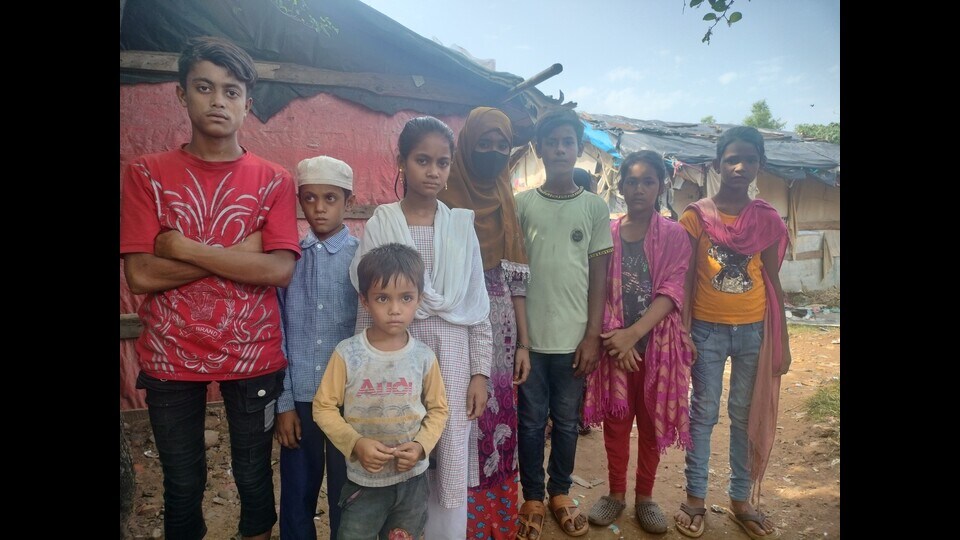
Noora was barely two when her parents, Mohammad Ibrahim and Shahida Begum, were sent to Hiranagar sub-jail in March 2021. They were among the 270 Rohingyas jailed after a government crackdown on illegal immigrants in Jammu. The sub-jail was notified as a holding centre on March 5, 2021, for lodging illegal immigrants as defined under Section 2(b) of the Citizenship Act.“Our parents have been in jail for nearly three years. We miss them. We are surviving at the mercy of neighbours who give us food, milk and clothes besides medicines when we fall sick,” said Halima. “Earlier, we were allowed to meet our parents but since June, we have not seen them. We don’t know why and appeal to the government to release them,” she added.
A Rohingya woman, requesting anonymity, said, “In March 2021, Halima’s parents had taken along one of their three daughters, Shamin Ara Begum, 9, to the MA Stadium where they were called by the administration for biometric testing. Shamin was also sent to the jail with the parents, but these two girls were left behind in the cluster.”
To escape persecution back home in Myanmar, Rohingya Muslims travelled thousands of kilometres and reached Jammu and Kashmir to eke out a living by taking up petty works.
On March 6, 2021 on the instructions of the Union home ministry, the Jammu and Kashmir administration started a verification drive of Rohingyas and sent 271 without documents to the Hiranagar holding centre.
Humane handling needed
Amir Hussain, 50, the chairman of the Myanmar Rohingyas Refugees’ Committee, registered with the United Nations High Commission for Refugees (UNHCR) in Delhi, called the situation a “human issue that needs to be tackled humanely”. “There are 50 such children who are being looked after by members of the community. We have apprised officials from time to time of their plight but in vain,” he said.
Hussain looked worried about the fate of these children. “They keep enquiring about their parents and ask us to bring them back. We requested officials to take these children to the jail too so that they can live with their parents but they didn’t agree,” he said.
A week ago, Hussain wrote to the authorities urging them to allow relatives to meet the jail inmates.
On June 18, the jail inmates demanded that they either be repatriated to their country or be freed. Their protest turned violent, forcing the police to use force to control the situation.
Since then, strict measures are in place inside the jail. “In the letter, we apologised on behalf of the jail inmates for the June 18 violence and requested the authorities to allow children to meet their parents,” he said.
A community member, Salamatullah, 38, said he takes care of 22 such children in plot number 2. “We tried to persuade the authorities to keep these children in jail with their parents but they didn’t listen to us,” he said.
Children left to fend for themselves
“We are refugees, who fled our native land to escape religious persecution. We want to return home but we urge the government to be empathetic,” he said.
Salamatullah said that there was no government help for Rohingya refugee children and they have been left to fend for themselves. “Though we look after them but the Rohingya community here does menial jobs and finds it hard to make ends meet. We have cases where the husband is in Hiranagar jail and the wife is bed-ridden due to diseases,” he said.
“We can’t force the government to provide these children help because we are refugees but we are also human beings,” he added.
Rohingya Muslims are largely settled in and around Samba, Bari-Brahmana, Talab Tilloo, Bhagwati Nagar, Sidhra, Bhatindi and in Srinagar.
Earlier, NGOs used to give them donations but they have also stopped helping the community following the objection by political parties, the BJP and the Panthers’ Party, seeking their ouster from J&K.
Home ministry to take call
A senior police officer said, “The home ministry has to take the call on those lodged in Hiranagar jail. The matter had been taken up with the Myanmar embassy in Delhi but it’s an intricate issue.”
A top home department official, requesting anonymity said, “Since the issue is a policy matter, the Government of India has to take the call. There’s nothing in our hands.”
He, however, refused to admit that there were children, living like orphans in the clusters. He denied that the administration was ever approached by the Rohingyas with a request to take the remaining children to the jail to be reunited with their parents.
Influx of refugees in Jammu
On April 6, 2022, the J&K and Ladakh high court directed the home secretary to identify all illegal immigrants from Myanmar and Bangladesh within six weeks.
While community members put the figure of Rohingya refugees at 6,000, the government claims 13,400 Myanmar and Bangladesh refugees were living in various areas of J&K.
According to an official estimate of the last BJP-PDP government in J&K, 5,700 Rohingyas had settled in and around Jammu.
Rohingya Muslims are considered to be one of the most persecuted communities in the world.
A government document stated that 17 FIRs were registered against 38 Rohingyas for offences, including those related to illegal border crossing and drug-trafficking.
On March 3, 2017 the then home minister Rajnath Singh had sought a report from the state over unabated influx of refugees to Jammu.


