
 E-Paper



Rains, floods damage historic Lahori Gate at Hargobindpur
Sri Hargobindpur, an important religious and historical site, was founded by the fifth Sikh master Guru Arjan Dev, and later developed by his son, Guru Hargobind, as per “Mahan Kosh” (the first Punjabi encyclopedia) created by legendary Sikh scholar Bhai Kahn Singh Nabha.

 Prefer HTon Google


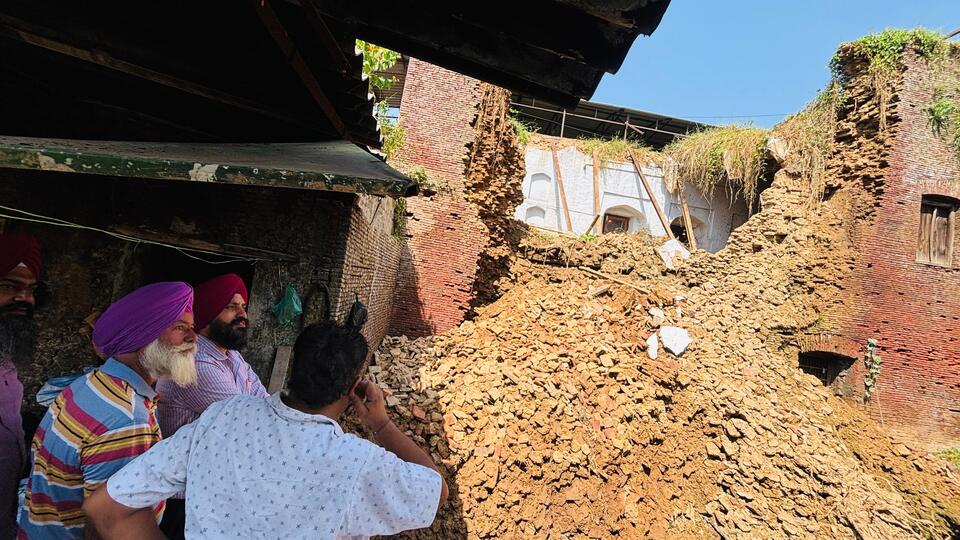
Recent heavy rains and flooding have inflicted severe damage on the historic Lahori Gate, the last surviving gate of the historical town of Sri Hargobindpur. A portion of this rare heritage structure has collapsed, putting its very existence at risk.
Sri Hargobindpur, an important religious and historical site, was founded by the fifth Sikh master Guru Arjan Dev, and later developed by his son, Guru Hargobind, as per “Mahan Kosh” (the first Punjabi encyclopedia) created by legendary Sikh scholar Bhai Kahn Singh Nabha. The town, located on the right bank of the Beas, was strategically built on a high mound and was originally enclosed by a protective wall. It had six gates, which served as entry points into the town — Lahori Gate, Mori Gate, Shahmana Gate, Miyadi Gate, Teli Gate and Ghirar Gate. The town also served as the headquarters of the Ramgarhia Misl, a military faction of the Sikh Empire, led by renowned Sikh warrior Jassa Singh Ramgarhia.
Over time, the other gates have disappeared, leaving Lahori Gate as the sole survivor of the original structure. However, the gate, which has already fallen into a state of disrepair, is now in urgent need of restoration following the recent rain-induced damage.
The collapse of the gate’s portion has heightened concerns over the future of this invaluable piece of Sikh heritage.
On Wednesday, representatives from the Heritage Forum, Batala, including Inderjit Singh Harpura, Kulwinder Singh Laddi Jassal, Principal Singh Chattha, Balwinder Singh Panj Graian, and Rajpreet Singh Dhillon, visited the Lahori Gate to assess the damage. Inderjit Singh Harpura, who also serves as the district public relations officer, warned that without immediate restoration, the gate could face further deterioration, potentially leading to its complete loss.
“Immediate action is necessary to prevent further collapse,” Harpura said. “The Lahori Gate is an irreplaceable part of our heritage, and we cannot afford to lose it,” he added.
In response to the damage, the Heritage Forum, through the intervention of MLA Amarpal Singh, submitted a memorandum to the Punjab government urging the state to intervene swiftly. The memorandum calls for the gate to be repaired by experts from the archaeology department, ensuring that the restoration process preserves the gate’s historical integrity and original character.
“The Lahori Gate is a symbol of our rich Sikh heritage, and it is imperative that we act quickly to save it from further damage,” said the MLA, who pledged to raise the issue with the Punjab government. “I will personally ensure that this matter receives immediate attention.”
Municipal council president Navdeep Singh Pannu said the restoration work would proceed with or without government funds. “I will not wait for the approval of funds from the government. We will begin repairs using civic body resources to prevent the gate from falling into further disrepair,” Pannu said.


