
 E-Paper



Roundabout: Call it by another name love will just be love
Ruth Vanita, an Indian author and activist, who has consistently written on gender and love, breaks many myths in her latest book ‘On the Edge’ on how the truths of life travel to literature


Celebrated American gay novelist James Baldwin (1924-1987) wrote thus in his famous novel “Giovanni’s Room” that sex and gender do not matter and all that really matters is that two people love each other.
However, this simple statement irked the straight society for long and even in the US. Even in the liberal West, gay rights have taken their own sweet time to come bit by bit. in India, after a long struggle, the Supreme Court decriminalised gay sex a few years ago in 2018. The discrimination and prejudice, however, may take a very long time to go away.
The denial by the hetrosexual majority makes its way from life to literature easily and so was the case with modern Indian literature.
One recalls how the acclaimed Urdu writer Saadat Hasan Manto, considered today as a literary genius and the true chronicler of the violence of Partition in literature, had to face as many as six trials for obscenity in his stories: three before Partition in British India and three after 1947 for obscenity in his stories. Manto’s famous take on obscenity was: “If you find that the characters are living an obscene life, it is because life is obscene”.
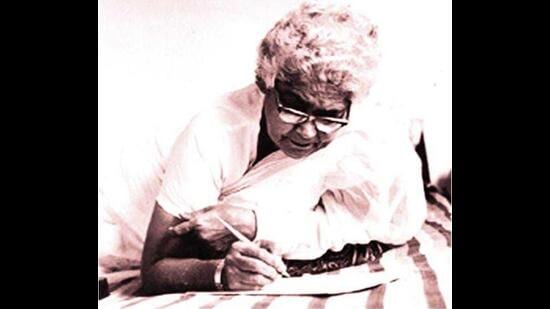
An obscenity charge was also slapped on a contemporary of Manto, the famous Ismat Chughtai for her story “Lihaaf” (The Quilt) and had the prominent city lawyer late Hira Lal Sibal defending her in the Lahore quote along with Manto in 1945 for her story “Lihaaf”, which narrated same-sex love between two women. Talking about the famous case of his Lahore days in an interview, Sibal told me: “Both were acquitted, but Ismat had to pay a fine of ₹50”. This is because women were not supposed to talk about such things. With progressing time, a film based on Ismat Appa’s “Lihaaf” by director Rahat Kazmi won a Special Honour Award at a US Film Festival in 2019.
From Ismat Appa to Ruth Vanita
From the times of Ismat Chughtai, whose one story on same-sex love created a furore, we come to this age when an author activist like Ruth Vanita has created a full body of work through immaculate research and translation on the same theme. Specialising in British and Indian literary history with emphasis on gender and sexuality studies, besides writing on Hindu philosophy. She did her BA, MA and Phd in English literature from Delhi University.
In 1978, Vanita co-founded “Manushi: A Journal about Women and Society” and worked with the journal as co-editor till 1991. It was in the mid-80s that one came into contact with her in Delhi when Manushi was staging an anti-dowry street play in which I was picked to be the greedy mother-in-law. I still recall her gentle support and presence while her co-editor Madhu Kihswar and director Feisal Alkazi supervised the play. After having worked as a reader in the English department, she subsequently moved to the University of Montana in the US where she directed the programme of South-East Asian Studies. She has a vast repertoire of writings and translations from Hindi literature. Her books include “Queering India: Same-sex Love and eroticism in Indian Culture and writing” and “Same-sex Love in India: Readings from Literature and History”, co-edited with Saleem Kidwai.
Desire on the edge
In hand is her latest book published by Penguin Random House titled “On the Edge: 100 years of Hindi Fiction on Same-Sext Desire”. It is indeed the first-of-its-kind collection of short stories and extracts from Hindi novels translated from novels, which seems to be an answer to Indian critics who have rejected depiction of such love as they consider it a western phenomenon.
Vanita points out persistent prejudice in the words of none other than the revered Marxist critic Namwar Singh in his comments as late as 2010 to editor Ashish Tripahti in his introduction to Namwar Singh, “Zamane Se Do-Do Haath”: “It is to be admitted that homosexuality is an exception. Whether it is between men or women, it is unnatural. That is how it should be portrayed in literature. Some English-language writers, under Western influence, are trying to gain cheap popularity by glorifying this exception.”
As a reply to this, Vanitha has translated writings from Hindi fiction, published between 1927 to 1922 including classic works by Asha Sahay, Geetanjali Shree, Sara Rai, Rajanedra Yadav and several others.
Characters from the pieces of fiction, who remained in the shadows for long, come out in the light to tell their stories. And now it is over to this rare collection by an author of repute, of whom Daisy Rockwell winner of the 2022 Booker Award for translating the novel Rait Samadhi by Geetanjali Shree, says: “Ruth Vanita’s sensitive translations in this exciting new anthology enable English readers to connect with depictions of same-sex desire in Hindi literature over the past century”.
So over to these stories that Vanita has translated, hoping that no one growls and points it all to the “foreign hand”!


