
 E-Paper



Sharp rise in farm fires, air quality dips in Punjab
As per the Punjab Remote Sensing Centre (PRSC) data, the total number of farm fires till October 13 was 1,230, which is the highest as compared to the number of incidents in the corresponding period of 2021 and 2022.


A total of 154 active cases of paddy stubble burning were detected across Punjab on Friday which was the highest number of fires on a single day this kharif harvest cycle.
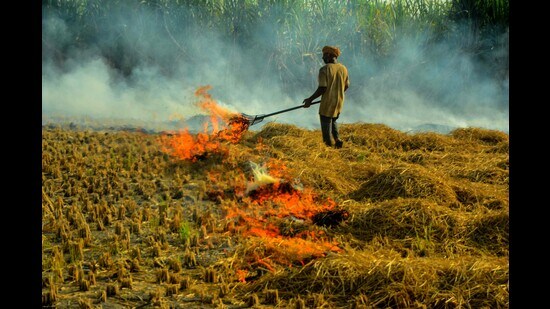
As per the Punjab Remote Sensing Centre (PRSC) data, the total number of farm fires till October 13 was 1,230, which is the highest as compared to the number of incidents in the corresponding period of 2021 and 2022.
On Friday, Amritsar saw 54 cases, Tarn Taran 28, Patiala 18 and Kapurthala 14.
The number of farm fires reported on Friday was 11 times higher than that on Thursday.
The air quality index (AQI) at six of eight continuous ambient air quality monitoring stations (CAAQMS) in the state remained ‘moderate’ which leads to breathing discomfort to asthmatic patients and people with lung and heart diseases.
During the harvest in October-November, Punjab farmers usually have a shorter window to clear their fields for the winter crop, and many choose to burn the paddy stubble, sending up plumes of smoke that drift over to large population centres, sink and choke settlements in toxic smog.
The crisis often pushes air in North Indian states and that of the national capital Delhi, into the severe category. Apart from Punjab, Haryana and Western Uttar Pradesh farmers also contribute to the smog.
In view of the rampant farm fires, PRSC used a satellite and started tracking the burning of rice residue by farmers from September 15.
As per the Central Pollution Control Board data, Bathinda’s AQI was ‘moderate’ at 197, followed by Rupnagar (169), Amritsar (130), Jalandhar (121), Mandi Gobindgarh (118) and Ludhiana (107).
Meanwhile, Friday witnessed a surge in paddy arrival in mandis when farmers brought more than 3 lakh tonnes of non-basmati varieties of rice at various purchase centres.
According to the Punjab Mandi Board data, 18.72 lakh tonnes reached mandis by October 13 and 17.88 lakh tonnes were procured by government agencies and private players.


