
 E-Paper



Speed breeding facility at PAU to combat climate change impact on agriculture
To address the impacts of climatic changes and evolving diseases on agriculture, Punjab Agricultural University (PAU) has unveiled the country’s first-ever speed breeding facility, valued at ₹5 crore. This cutting-edge facility, constructed under a research project grant from the Union Ministry of Science and Technology, marks a significant leap forward in agricultural innovation.

 Prefer HTon Google


In a move to address the impacts of climatic changes and evolving diseases on agriculture, Punjab Agricultural University (PAU) has unveiled the country’s first-ever speed breeding facility, valued at ₹5 crore. This cutting-edge facility, constructed under a research project grant from the Union Ministry of Science and Technology, marks a significant leap forward in agricultural innovation.
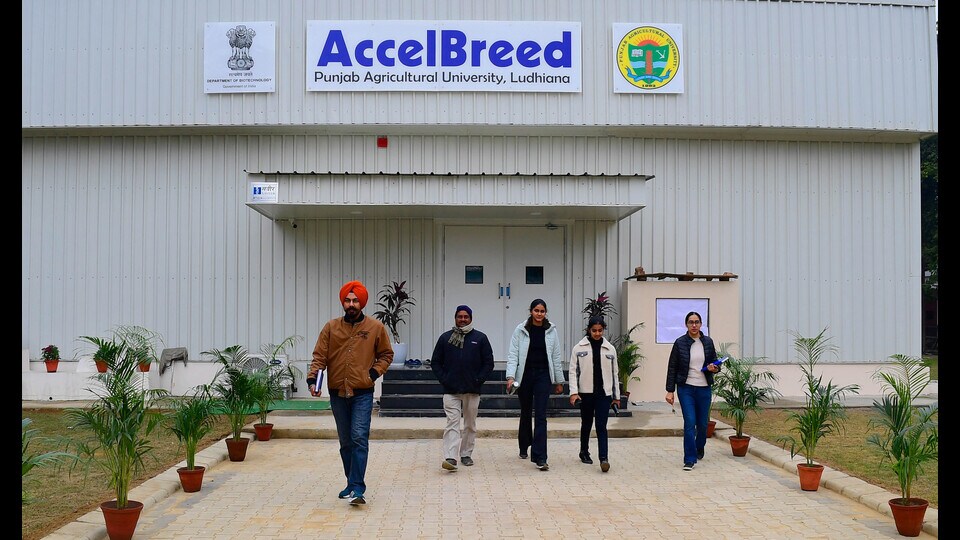
The newly inaugurated facility, named AccelBreed, has eight fully automated and insulated chambers. This state-of-the-art laboratory enables agricultural scientists to breed up to six generations of a crop, a remarkable advancement compared to the traditional limit of two per year in normal field conditions. The controlled environment empowers scientists to develop new varieties in half the time it traditionally takes.
Dr Dharaminder Bhatia, a scientist at the School of Biotechnology at PAU, emphasised the urgency of addressing climate change and a rapidly growing population said, “Breeders are now tasked with developing disease-resistant varieties to achieve higher yields and meet the increasing demand for food. Traditionally, creating a new variety, whether of wheat or paddy, takes 10-12 years, constrained by environmental limitations that allow only two crops of wheat or rice, grown locally and in the Himalayan region. However, the AccelBreed facility provides exceptional control over light, temperature, and other environmental factors, enabling the cultivation of six crops annually.”
“The AccelBreed facility, with a capacity for around 40,000 plants at any given time, operates within a fully controlled environment. Scientists can meticulously regulate light intensity, spectra, temperature, and humidity to optimize plant growth,” explained Dr Praveen Kaur Chhuneja, director of PAU’s School of Agricultural Biotechnology.
Highlighting the challenges faced due to early snowfall in Lahaul Spiti, Dr Chhuneja recalled instances where the collection of a generation for developing wheat varieties was hindered. The facility addresses uncertainties with reduced costs, representing a one-time investment. The only recurring cost is the electricity bill, which, once rationalised over time, promises significant benefits. Dr Chhuneja envisioned a sustainable future, suggesting that the addition of solar panels at a cost of 60-70 lakhs could eliminate the sole recurring expense. Moreover, if coupled with DNA markers, the facility could enhance precision, doubling the acceleration of procedures.
Excluding scientist salaries, the traditional method of breeding a new variety incurs a cost of around 15 to 20 crores.
Moreover, if coupled with DNA markers, the facility could enhance precision, doubling the acceleration of procedures.
Dr Satbir Singh Gosal, Vice-Chancellor, PAU emphasised that this pioneering facility stands as the first of its kind in any state or Centre-run universities in the country, surpassing the previously available facility only at International Rice and Research Institute (IRRI) South Asia Regional Centre at Varanasi. Dr Gosal stated that this facility will serve as a boon for PAU crop breeding programmes.


