
 E-Paper



Unable to run units to capacity for want of enough raw cotton, ginners face losses in Punjab
Most ginning factories working between 25-50% of capacity while nearly 10 units in Bathinda and Mansa districts of Punjab are lying shut

 Prefer HTon Google


All 82 cotton ginning units of Punjab are unable to keep their operations running to capacity due to a shortage of nearly one-fourth of the required natural fibre in the market.
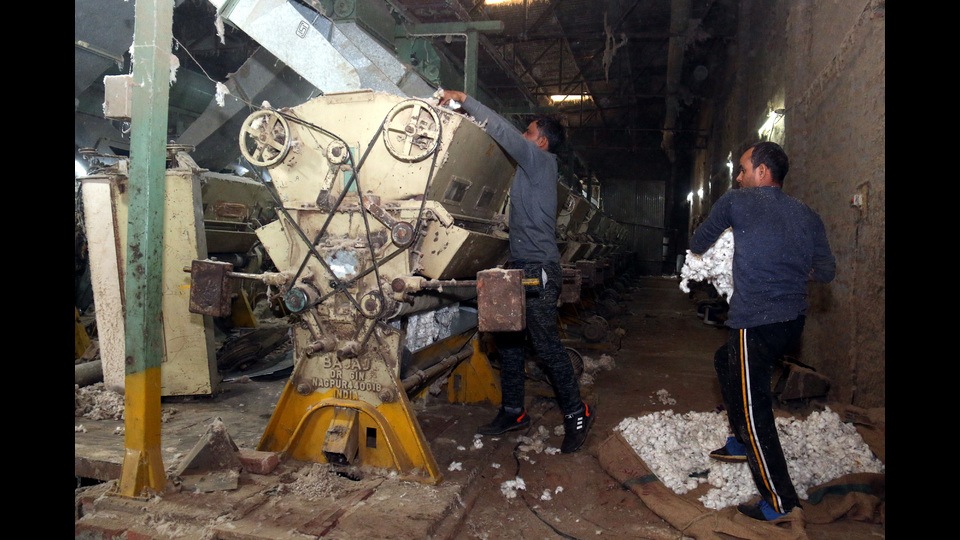
Industry sources say the shortage of raw cotton is due to pink bollworm attack in the major cotton-growing districts of Bathinda and Mansa and pockets of Barnala, Sangrur and Muktsar. State government’s projection says a drastic drop in cotton production due to the pest attack. Factory owners say they are facing financial losses as the units are working between 25-50% of the capacity while nearly 10 units are lying shut in Bathinda and Mansa.
A leading cotton ginner from Malout in Muktsar Bhagwan Bansal said against the average minimum requirement of 150 bales or 750 quintals per day, meagre 200 quintal cotton is available for processing. “A cotton ginning unit operator has to pay about ₹10 lakh fixed electricity charges for the nine-month season from September 1 onwards. As the pest attack has severely hit crop production, we are unable to run factories. We have to pay fixed charges even when electricity is not used,” he said.
“Punjab government was quick to grant compensation to affected cotton growers, the interest of ginners has been overlooked. The government is biased towards investors,” said Bansal, who led a delegation of ginners for a meeting with state agriculture minister Randeep Singh Nabha on Friday, demanding a relief package for the sector.
Ashwani Kumar, who strengthened his cotton factory after shifting it from Bathinda city limits to Sangat town this year, said the sector is struggling for survival. “A factory employs about 125 workers with an estimated annual salary commitment of ₹25 lakh. A planned policy in the adjoining Rajasthan made it a major cotton-growing state in a decade producing over one crore quintals. It has incentivised entrepreneurs with zero market committee fees for cotton. Punjab still charges 1% fees with no incentive for ginners,” he said.
For the current season, ginners were expecting 60 lakh quintal raw cotton after Punjab saw an increase of 25% area under cotton. As per Punjab Mandi Board data, different districts of south Malwa had recorded sales of 8.60 lakh quintals till November 27.
Board authorities opine the production this year may be around 25 lakh quintals while the industry say cotton arrival may touch the 30-35 lakh quintal mark.
Punjab Cotton Mills and Ginning Association president Suresh Bansal said owing to the negligent attitude of the state government, 76% of factories closed down since 2005. He blames the absence of a dedicated policy for agriculture and the industrial sector in Punjab.
“Punjab had 335 ginning factories 16 years ago that came down to 82 in 2021. In 2005, factories were ginning 18 lakh bales or 90 lakh quintals in a season and in 2020-21 kharif season, Punjab produced 49 lakh quintals,” he said.
“After irrigation system strengthened in over last decade, farmers of the semi-arid region of Malwa switched from the traditional cotton to less labour-intensive crop of non-basmati rice. Kotkapura town used to be a major purchase centre where 20-lakh quintal cotton was a regular feature 10-12 years ago. In 2020-21, the entire Faridkot district registered the arrival of mere 50,000 quintals. It shows the government has failed to set its priorities right,” said Bansal.


