
 E-Paper



Urban Pulse| Where does a city voice its dissent?
Conceived as a planned capital with generous public plazas, institutional precincts and a clear civic hierarchy, it provides multiple settings for public expression

 Prefer HTon Google


Over the past few weeks, images of protests have once again dominated television screens and social media feeds. Whether over education reforms, farmers’ demands or regional political issues, public debate has largely revolved around the legitimacy of the demands and the disruption they caused. Yet these events also raise a less obvious question, one that belongs as much to urban design as it does to politics. Why do some protests gather in public squares while others occupy highways? Why do some choose university campuses, others government precincts and still others roads that bring entire cities to a standstill?
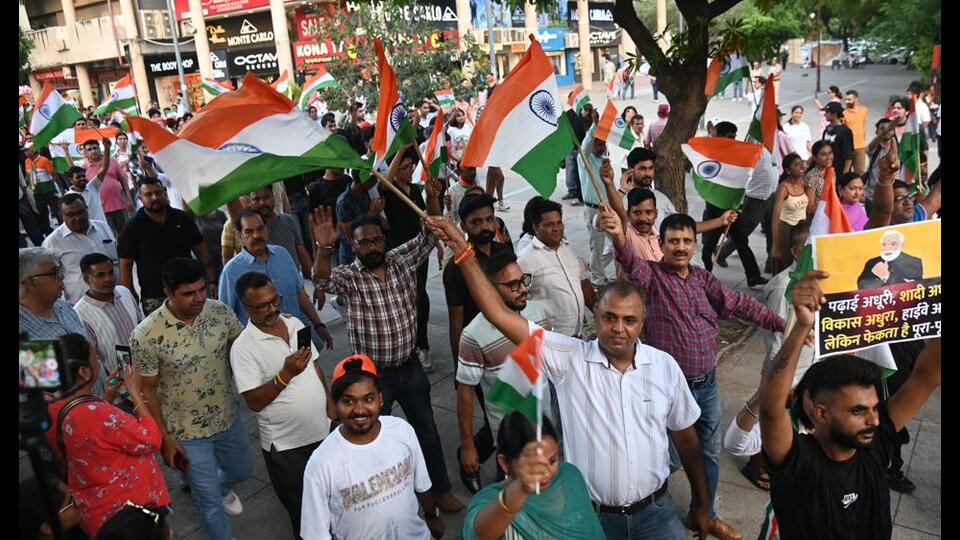
The answer may lie not only in the nature of the protest, but also in the nature of the city itself. Urban design cannot determine whether citizens will dissent. It can, however, influence the forms that dissent takes. Every city offers different stages and the one a movement chooses becomes part of its message.
Cities offer different stages
Every protest begins with a choice of location. Before slogans are raised, organisers decide where they want to be seen and whom they wish to address. Chandigarh offers an unusually compelling example. Conceived as a planned capital with generous public plazas, institutional precincts and a clear civic hierarchy, it provides multiple settings for public expression. A gathering at Sector 17 Plaza communicates something very different from a demonstration outside the UT secretariat. Student movements gravitate towards Panjab University, while administrative demands converge near government offices. Each location creates a different relationship between citizens, institutions and the public.
Delhi’s democratic geography has shifted from the Boat Club lawns and Ramleela Maidan to Jantar Mantar and, more recently, the capital’s border highways. These places are more than venues. Their symbolism amplifies the movements they host. Cities do not merely contain democracy. They give it a geography.
When roads become the message
Not every movement, however, chooses a civic square. Recent protests offer an interesting contrast. The CJP demonstrations in Chandigarh largely unfolded in Sector 17 Plaza, a civic space designed for people to gather without bringing the city to a halt. More recently, demonstrations by Akali Dal leaders were centred outside institutions of government, taking the conversation directly to those in authority. The farmers’ protests, meanwhile, occupied highways and city borders, where disruption itself became part of the movement’s strategy.
Each choice of location communicated something different. A public square invited visibility. Government precincts sought accountability. Highways created pressure by interrupting the everyday rhythm of life. The choice of location, therefore, is as strategic as the slogans themselves.
The democracy a city makes possible
This leads to a question that deserves greater attention from architects and planners alike: What kind of democracy does a city’s design make possible? Cities are often judged by the efficiency of their transport networks, the quality of their infrastructure or the height of their skylines. Yet democracy also depends on places where movement gives way to gathering, where circulation pauses for conversation and disagreement remains visible without descending into disorder.
The recent protests will eventually fade from the headlines. The barricades will disappear, traffic will resume and cities will return to their familiar rhythm. Yet they leave behind a valuable lesson. Every movement reveals something about the city in which it unfolds. It exposes the spaces citizens instinctively believe will make them visible, credible or impossible to ignore.
One of the most overlooked measures of a democratic city is not simply the institutions it builds for those in power, but the civic spaces it leaves open for those who wish to speak back. Long before democracy is experienced inside legislatures and courtrooms, it is experienced in streets, squares, campuses and public places. In that way, every city shapes the democracy it makes possible.
aashna.gakhar@gmail.com
(The writer is a Chandigarh-based architect and interior designer)


