
 E-Paper



14 monuments under restoration process: Delhi CM Gupta
The chief minister’s office said that the four monuments which have been rejuvenated by the department include Gol Gumbad, Quli Khan tomb, a horse stable at Mehrauli Archeological Park and Bara Lao ka Gumbad in south Delhi.


Chief minister Rekha Gupta said on Sunday the Delhi government is currently working on rejuvenation of 14 monuments which are being preserved and four of these have already been revived.
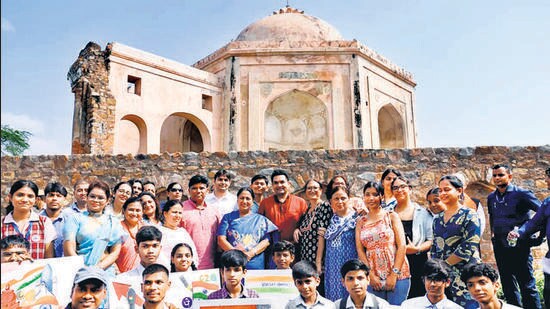
“We are reviving all monuments in Delhi. We have revived four such monuments. Our aim is to dedicate Delhi’s monumental history to the people of Delhi,” Gupta said at Mehrauli Archeological Park during a “Viksit Bharat Art Camp” as part of the “seva pakhwada” fortnight. The event was attended by around 1,000 children and 75 young artists showcased their creativity and art.
The event was organised jointly by the government’s department of art, culture, and language and the Sahitya Kala Parishad. The chief minister’s office said that the four monuments which have been rejuvenated by the department include Gol Gumbad, Quli Khan tomb, a horse stable at Mehrauli Archeological Park and Bara Lao ka Gumbad in south Delhi.
Art and culture minister Kapil Mishra said that monuments in Mehrauli Archaeological Park have been restored and preserved by the Delhi government. “The site is now being presented in a new form with high-tech lighting and is being developed as a major tourist destination. Our government is restoring approximately 14 historical monuments, work on four of which have been completed,” he added.
Later in the day, during a second event at Vasant Vihar’s Bara Lao ka Gumbad, Mishra said the Delhi government is working to transform monuments into cultural hubs. “Delhi Government will soon introduce a new policy to open major monuments for cultural and social activities, ensuring they become lively centres for society rather than mere memorials,” he added
A government official said that the restored horse stable belongs to the Mughal period and is located in Mehrauli. “The existing structure is said to be a part of a super structure, probably a Mughal period cavalry. The structure stands on a rectangular plan and has multiple arched doorways,” the official said.
The Muhammad Quli Khan tomb is believed to be from the 17th century. “The tomb was constructed for Muhammad Quli Khan — brother of Adham Khan who was the son of Maham Anga. Anga was the nurse of Mughal emperor Akbar’s child. It was originally decorated with painted plaster and was later converted into a residence by Sir Thomas Theophilus Metcalfe, the governor general of India,” the government official said. The tomb stands on a high platform which is octagonal from outside and square from inside.
The Gol Gumbad is from the Lodhi period. “There is evidence of the presence of two graves as mentioned by Zafar Hasan in 1916 but there is no specific significance of them. Unlike some other Lodhi period tombs, Gol Gumbad does not have a Mihrab recess on the west side wall. It has a square base plan with recessed pointed arch and central doorway, Jali over the doorways,” the official said.
The fourth monument Bara Lao Ka Gumbad also belongs to the Lodhi era. “There is one mosque and baradari associated with this tomb which can also be seen in the park itself. The architectural style of the monument traces itself to the Lodhi era,” the official added.

Stay updated with all top Cities including, Bengaluru, Delhi, Mumbai and more across India. Stay informed on the latest happenings in World News along with Delhi Election 2025 and Delhi Election Result 2025 Live, New Delhi Election Result Live, Kalkaji Election Result Live at Hindustan Times.


