E-Paper



2 weeks on, cave-ins on Ashoka Road in Delhi remain unfixed
NDMC oversees an area which hosts a resident population of 0.25 million and a floating population of 1.6-2.0 million daily

 Prefer HTon Google


More than a fortnight after two separate sections of Ashoka Road in Lutyens’ Delhi caved in due to damage to the underground sewer lines, the craters on the road are yet to be repaired, with officials blaming the delay on paperwork, saying that they are still waiting for “approval from higher-ups”.
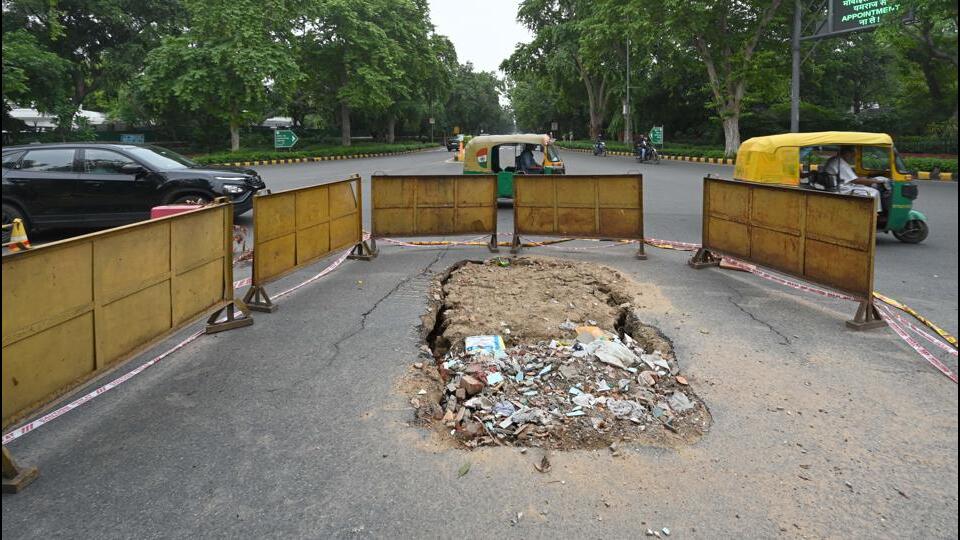
At least 22 alerts have been issued on social media in just the past week by the Delhi Traffic Police cautioning commuters about disruption in traffic movement due to the craters, but no resolution appears to be in sight with New Delhi Municipal Council (NDMC) officials insisting that repair works will “likely take more time.”
Almost half the road near Le Meridian hotel has been barricaded due to the first (and larger) cave-in that took place on July 7. The second, and smaller, cave-in that occurred on July 10 is located on the roundabout near 14, Ashoka Road. Both cave-in sites, which were filled with debris by the NDMC shortly after the incidents, repeatedly cause traffic jams at peak hours on the road that serves as a critical feeder route connecting north and west Delhi to south Delhi via India Gate’s C-Hexagon.
A senior NDMC official, speaking on condition of anonymity, said that the repair work is likely to take even more time. “We have sent the files for carrying out the repair to the maintenance department, but the repair project is awaiting approval from higher officials. Meanwhile, the long-term work on the repair and strengthening of old sewer lines under the road is being carried out.” the official added.
In its latest advisory, the Delhi Traffic Police posted on X on Monday: “Traffic is affected in front of 14, Ashoka Road towards Windsor Palace from C-Hexagon due to damage of sewerage pipeline and road. Kindly plan your journey accordingly.”
Both the cave-ins have been caused due to a 1200mm-diameter British-era sewer line which passes under the Ashoka Road. “The old sewer line settled in and started leaking, which led to soil erosion and a portion of the road getting damaged. The damaged section of the pipeline will have to be replaced,” a second NDMC official said requesting anonymity.
The larger damaged section is close to the roundabout, therefore it slows down the movement of traffic flow from Janpath, Ferozshah Road, Raisina Road besides Ashoka Road during the peak commuting period.
A Delhi traffic police officer said: “This is a key road for movement in New Delhi and with half of the road carriageway getting barricaded, the movement of vehicles slows down, especially during the peak office commuting hours. The underlying problem which caused the cave-ins has not been repaired by the concerned agency. We are issuing advisories daily,” the official said.
Gopal Krishan, who heads the New Delhi RWA federation, blamed lack of timely repair for the cave-in issue which has been dragging on for at least two weeks now. “Most of the infrastructure in New Delhi was built before the Independence, but it has not been upgraded in a timely and phased manner. The civic agencies wake up only after a section is damaged. Instead of treating these isolated sites, we need a comprehensive plan for increasing the capacity of the basic infrastructure as the population has gone up several times,” he added.
NDMC oversees an area which hosts a resident population of 0.25 million and a floating population of 1.6-2.0 million daily.
A recurring problem
A large section of C-Hexagon near India Gate had also caved in near the National Gallery of Modern Art last year in July leading to traffic disruptions for two days. The cause behind the damage to the road was also attributed to an old leaking sewer line. Meanwhile, a large section of the Ashoka Road had also caved in July 2020, also due to leaking sewer lines.
A second official said that several of the NDMC’s sewer lines were laid down before Independence and needed to be replaced. “We are taking up the upgrade work in phases. The old brick barrel lines are also to be rehabilitated starting from Q point to Sunehri Pulla drain via Bharti Nagar and Archbishop Marg. The repair at Ashoka Road may take multiple days,” the official added.
Much of New Delhi was built between 1920-1930. A civic official said that Lutyens’ Delhi has trunk sewer lines spread over 250km area and many of them are at least 80 to 90 years old. “The rehabilitation and repair work is already underway. The sewer lines in areas like Mathura Road, and Lodhi Road, among other places, have already been completed and the project is underway for areas like Connaught Place, KG Marg, Satya Marg, Kautulya Marg, Shanti Path and C-Hexagon. Some of these lines are brick barrelled and others have been made using concrete using technology that has since become obsolete,” the official added.
NDMC officials explained that over the decades the corrosive gases peel off the outer layers and bricks get stacked at nodes. “This leads to collapse or settlement every year during the monsoon season,” the official said requesting anonymity.
The core of the city has a network of 315 km of sewage lines with 11,907 manholes out of which a 30km network was rehabilitated.
Incidents such as road cave-ins increase during the monsoons. Recently, a series of cave-ins were reported from Sangam Vihar where Delhi Jal Board’s sewer line laying work was recently carried out, trapping many water tankers and vehicles. Experts attribute such cave-ins to bad road laying techniques when the road layers and soil underneath are not properly consolidated and compacted during the construction process; damage to water or sewer lines beneath roads due to which the water seeps in, the lower sublayer becomes soft and thirdly the depletion of the groundwater table which makes the soil beneath roads hollow.