E-Paper



'Deeply worrisome': India condemns attack on GFS Galaxy vessel off Oman's coast amid US-Iran war
The Ministry of External Affairs stated it is closely monitoring the statement and has called for immediate de-escalation.

 Prefer HTon Google


India on Sunday condemned an Iranian attack on a Cyprus-flagged container ship that left an Indian crew member missing and repeated its call for de-escalation of tensions and conclusion of negotiations for a diplomatic solution that ensures peace and stability in the region.
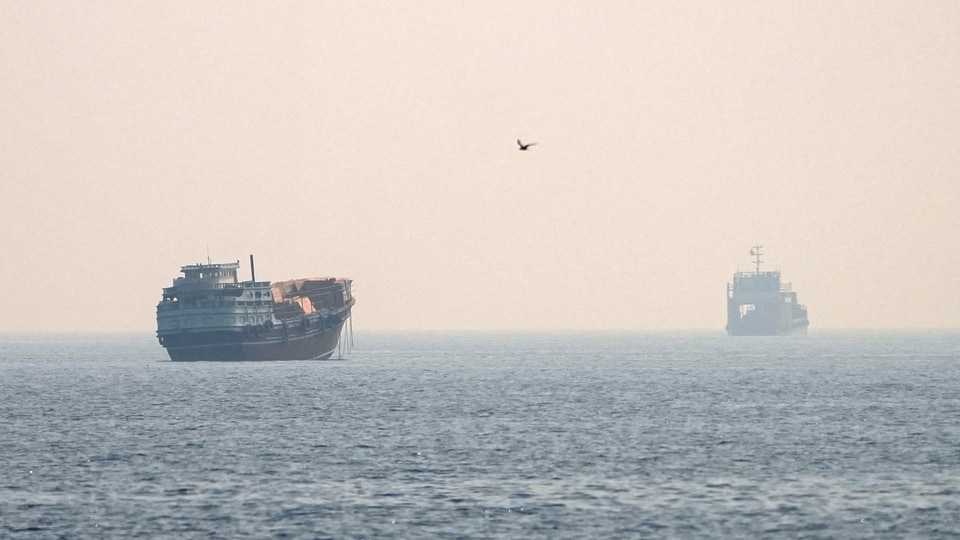
GFS Galaxy was targeted by Iranian forces off the coast of Oman early on Sunday, resulting in a fire on board that forced the crew to abandon the vessel and leave in a lifeboat, the UK Maritime Trade Operations agency reported. Track LIVE updates on the US-Iran war
“We condemn the attack on the commercial vessel GFS Galaxy off the coast of Oman, earlier today. Of the 11 Indian nationals on board, 10 have been rescued so far, while one Indian national is reportedly missing,” the external affairs ministry said in a statement, without naming Iran in connection with the attack.
The Indian embassy in Oman is monitoring the situation and coordinating with Omani authorities for the search and rescue operation. The Indian side thanked the Omani authorities for their support.
“The continuing incidents of attacks on commercial shipping in the region are deeply worrisome. We reiterate our call for immediate de-escalation of tensions, and the conclusion of ongoing negotiations for a diplomatic solution so that peace and stability can return to the region,” the statement said.
India reiterated its call for ending the targeting of commercial shipping and civilian infrastructure in the region, and said that free and unimpeded navigation and commerce through international waterways, in line with international law, “must be restored at the earliest”.
US-Iran war escalates
US President Donald Trump ordered renewed air strikes against Iran after the Islamic Revolutionary Guard Corps (IRGC) Navy attacked GFS Galaxy while it was transiting the Strait of Hormuz, the US Central Command said. It said the container ship was unable to continue its journey after the Iranian attack caused a fire and significant damage to the engine room.
The IRGC Navy said in a statement that the GFS Galaxy, which “had jeopardised maritime security by switching off its systems”, was struck and brought to a halt. It also announced the closure of the Strait of Hormuz.
“The Strait of Hormuz has been closed until further notice and will remain closed until the US ends its intervention in the region. No vessel will be permitted to transit the strait,” the IRGC Navy said in a statement.
This was the third time the US bombed Iran within a week in retaliation for attacks on commercial vessels in the Strait of Hormuz.
Explosions were heard in the Iranian port cities of Bandar Abbas, Sirik and Chabahar, and on Qeshm Island, the largest island in the Persian Gulf and home to an underground Iranian missile base.
The IRGC retaliated by launching ballistic missile strikes on US military bases in Oman, Kuwait and Jordan, including Al Udeid airbase in Qatar, and said it destroyed command and control centres and drone and refuelling facilities.
Kuwait reported the interception of aerial targets in its airspace, while the United Arab Emirates responded to missiles and drones from Iran. Qatar intercepted a missile attack as explosions were heard in Doha.
India's concerns
Last week, India expressed deep concern over recent attacks and escalating tensions in West Asia after Trump said the memorandum of understanding (MoU) signed last month for a ceasefire with Iran was “over” following Iranian attacks on merchant shipping in the Strait of Hormuz.
India, which was hit hard when the West Asia conflict disrupted oil, gas and fertiliser supplies through the Strait of Hormuz, has also doubled down on its message for a return to dialogue and diplomacy as tensions soared, threatening the fragile ceasefire between Iran and the US.
Iran has attacked merchant vessels using a southern route along Oman's coast protected by the US military, and demanded that ships use a northern route passing through its territorial waters. The US and Iran are also disputing the terms for reopening the Strait of Hormuz under the MoU signed on June 17.
Thirteen Indians have died in West Asia since Israel and the US’s attacks on Iran on February 28 triggered a conflict.