E-Paper



30,000 potholes among major sources of dust pollution: Study
A programme to identify pollution sources across the Capital has unearthed more than 94,000 distinct or point-sources of dust pollution between November 2021 and June 2023

 Prefer HTon Google


A programme to identify pollution sources across the Capital has unearthed more than 94,000 distinct or point-sources of dust pollution between November 2021 and June 2023, with the most common being the over 30,000 potholes found in the city, officials aware of the matter said on Wednesday.
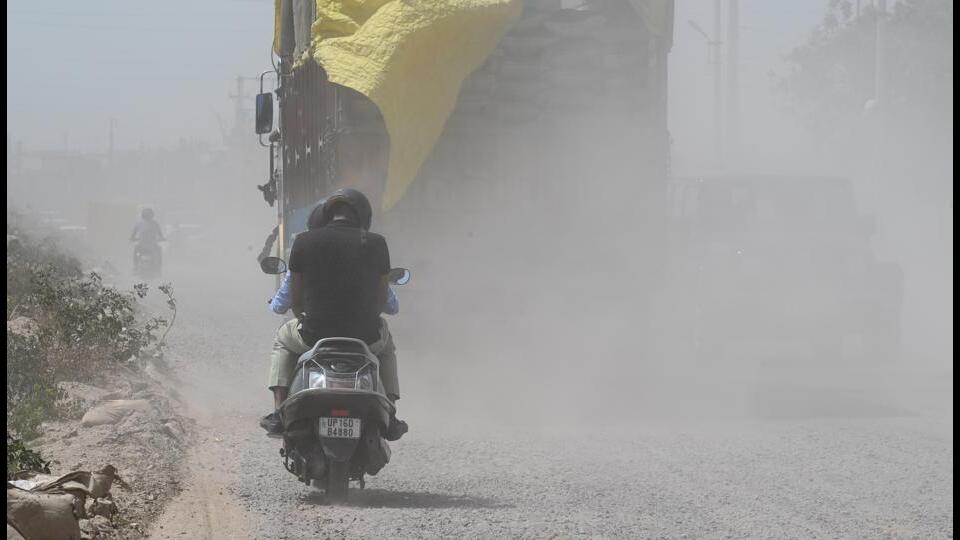
The finding assumes significance as a 2018 source apportionment study by The Energy and Resources Institute (TERI) revealed that dust pollution is one of the biggest sources of pollution for Delhi, particularly in the summer, where its contribution can be as high as 25% of the total contaminants in the air.
Data shared by not-for-profit foundation Air Pollution Action Group (A-PAG), which is working with the Municipal Corporation of Delhi (MCD) and other land-owning agencies in Delhi, also showed that there were more than 29,000 different locations where debris was dumped in the open, followed by over 11,000 instances of broken footpaths or dividers, all of which could be contributing to dust pollution in the city.
“These are all smaller, localised sources that officials from the MCD and other agencies come across every day in their jurisdiction. On their own, they may not contribute much to Delhi’s pollution, but cumulatively, it can certainly be a significant chunk. These are sources that can easily be addressed and through the app, each problem gets assigned to the department whose jurisdiction it falls under,” said Abhishek Kumar, deputy commissioner of the MCD’s Karol Bagh zone.
Using on-ground data identified by third-party teams employed by MCD, 94,374 dust-related complaints were registered on the civic body’s SmartCity-311 app between November 2021 and June this year, with each complaint then being assigned to the land-owning agency under whose jurisdiction the complaint falls under, such as the Public Works Department, Delhi Jal Board, Delhi Development Authority, among others.
Data from the SmartCity-311 app shows out of the 94,374 complaints it received since November 2021, 80,575 have been resolved –a pendency rate of less than 15%. MCD officials said that not only does the programme identify unique sources of dust pollution, these are also being fixed simultaneously, with each agency given 30 days to resolve each issue.
A-PAG director Mohit Beotra said while transboundary movement of dust -- when dust blows in from neighbouring states upwind-- will continue, the programme allows Delhi to crack down on its own sources of such pollution. “The data shows not only have these sources been identified, but all agencies are now cracking down upon these sources simultaneously, and this is being reviewed at the Commission for Air Quality Management (CAQM)-level and at the levels of the Delhi chief secretary and principal secretary environment. Such a coordinated programme has huge potential to tackle different point-sources of pollution,” he said.
Data showed that the most complaints on the app were about potholes (30,334 instances), followed by debris in the open (29,737) and broken footpaths or dividers (11,349). A total of 10,930 unpaved roads were also identified as dust pollution sources, along with sand dumped on the roadside (5,168 instances). Surprisingly, construction and demolition sites operating without safeguards constituted only 4,162 instances.
The A-PAG programme to identify dispersed sources of pollution began in January 2021 as a pilot project in association with the erstwhile south MCD. Its success led the CAQM to direct the civic body to launch from November 2021 a full-fledged programme in coordination with other land-owning agencies in the Capital to identify and fix such sources.
Beotra added that an Indian Institute of technology, Delhi (IIT Delhi) study is currently underway to measure the impact of these point sources on air pollution.
Experts meanwhile said that the programme sheds light on the need for every agency to have a standard operating procedure (SOP) to periodically review its infrastructure and to maintain it.
Anumita Roy Chowdhury, executive director, research and advocacy at the Centre for Science and Environment (CSE), said, “This shows that there are localised sources of dust, and a number of these sources can be fixed by simply carrying out proper maintenance and review of the infrastructure. It also shows that every summer, simply sweeping the roads and sprinkling water is not enough, but rather, there is a need to tackle these sources too, and such an SOP needs to be institutionalised at the agency-level.”