E-Paper



A year on, memories of 2023 floods linger
On July 13, 2023, a rapidly swelling Yamuna spilled on to streets and homes in Delhi. A look at the lasting impact of the floods in the affected areas

 Prefer HTon Google


Standing on top of the Signature Bridge in northeast Delhi, Rajkumar Sharma, 49, can see the muddy waters of the Yamuna flowing downstream from the Wazirabad barrage, mingling with black sludge and sewage that enters the river from the Najafgarh drain. With areas upstream recording heavy rainfall, gate number 3 of the barrage has been opened, carrying slush of brownish rainwater interspersed with chunks of water hyacinth.
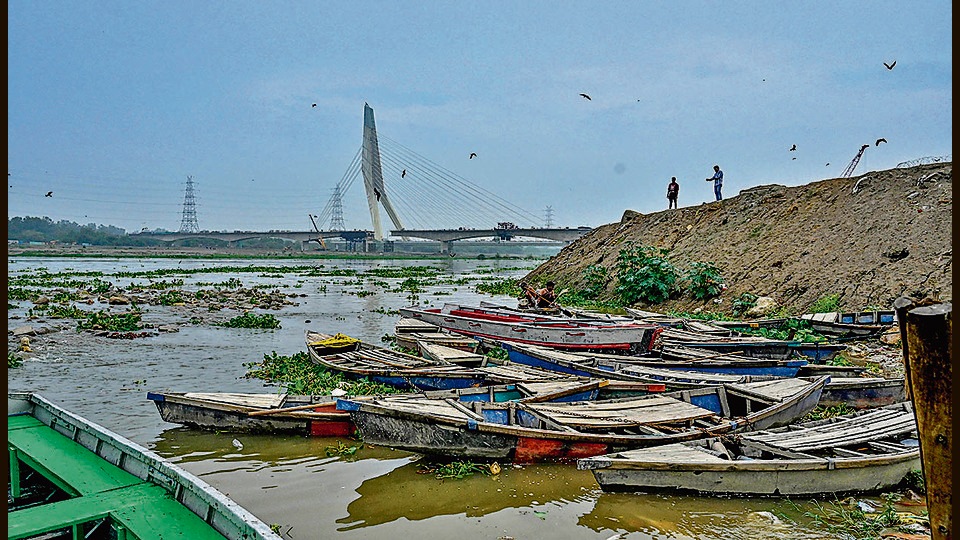
A little over a fortnight into the monsoon season, the annual flooding cycle of the Yamuna is about to start — the water level of the river is currently 202.6m — 1.4m below the warning level of 204m. Sharma watches the river anxiously — his village Garhi Mandu lies 1.5km to the east, along the Yamuna’s floodplains.
Last year, the river touched an all-time high of 208.66m on July 13, breaching embankments and causing widespread flooding through most of the area in Delhi along the river. Hundreds of illegal settlements along the floodplains as well as legitimately built areas such as Mayur Vihar, ITO, and Civil Lines were impacted by the swollen river, with more than 23,000 people evacuated.
One year on, many of these villages and colonies, from Wazirabad to Okhla, still bear signs of the floods. HT tracked the length of the river, discovering that many people are still to recover from the devastation that the 2023 floods wrought, and that little has changed in terms of preventing a similar disaster from occurring again.
Garhi Mandu
One of the first areas in Delhi to be evacuated after the 2023 floods, Garhi Mandu’s lanes are full of dumped construction waste — a crude attempt to raise a barrier against the river — and most residents have already moved their perishable goods to the first floor.
However, Sharma rues, little has been done by the administration to help the villagers get back on their feet. “No repair work has been taken up over the last one year. We have been demanding that a pushta (embankment) be set up so that our village can be saved from the river’s annual fury, but no one has heard our pleas,” he said.
Sharma said that the administration has not even repaired the boundary wall of a memorial to the victims of the 1997 Wazirabad bus tragedy — an accident in which a school bus lost control and plunged into the Yamuna, leading to the death of 28 children.
According to the Master Plan Delhi, 2021, Garhi Mandu falls under the O-zone — a 22-km stretch of the Yamuna floodplains where no construction or dumping of waste is allowed, in order to protect the river’s ecology. However, Sharma argues that his village predates the regulations.
“Old Garhi Mandu is hundreds of years old. Over the last decades it has extended further, but the area has been traditionally used for running dairies and grazing animals. The regulations of a master plan came much later,” Sharma said.
The Gujjar-dominated village is replete with dairy farms, godowns, and small-scale industrial units. Many of these properties still bear the marks of the river water from last year.
Md Haseen, 65, another resident of the village, said locals have come together and have used construction and demolition (C&D) debris to build small barriers outside home, and to raise the levels of lanes. “How much protection can it grant, if the river swells up again? Those who have the luxury of upper floors are moving goods upstairs,” he said.
Activists, meanwhile, say it is important that the Yamuna and its floodplains get protection.
“People may ask for embankments, but it is the floodplains that need protection first. The more floodplains get occupied, the greater the chances of floods impacting settlements. Over time, due to constructions and encroachments, the path of the river has become narrow and when it floods, it reclaims its original path, where these settlements have come up,” said Bhim Singh Rawat, who is a member of the South Asia Network on Dams, Rivers and People (SANDRP).
New Aruna Nagar
On the opposite bank of Garhi Mandu lies New Aruna Nagar — an unplanned colony that popped up adjacent to Majnu Ka Tilla, which was regularised in 2012. Though this neighbourhood has seen its fair share of floods, nothing prepared it for the fury of the river in July 2023.
“I have been living here for nearly two decades, but have never seen this scale of flooding,” said Salim Ahmed, 55, who runs an electronic and hardware shop barely 200 metres from the Yamuna. He said water would often cover the floodplains, with the water reaching up to ankle length in the locality, but it would still be business as usual. “Last year though, it was almost up to my head,” he said.
The residents here have a simple demand — and a long-term solution to protect them from the river.
“A long-term solution is needed for a flood in the future too. Something must be done to prevent the water from flowing towards the colony,” Lakpa Sherpa, 45, who runs a furniture shop in the area, said.
Rawat said the entire colony should never have been regularised.
“The proximity to the Yamuna is minimal in this area and even during moderate floods, the water ends up reaching the cafes built on the floodplains. This itself shows that the area where they are built is a part of the river,” he said, adding that the unceasing development along this stretch of the river, along with an increase in the number of bridges over the Yamuna, were some of the reasons that exacerbated last year’s floods.
Rawat added that embankments are not the solution, but rather, people should be shifted from these areas.
“Housing can be provided in other areas, with these encroachments being cleared. Once the river has a clear path, it is not likely to swell up the same way it did last year,” he said.
Old Usmanpur
A few kilometres downstream from New Aruna Nagar is Old Usmanpur village. The area surrounding the village has been developed by the Delhi Development Authority (DDA) as empty lake beds for two large water bodies, and the entry to Old Usmanpur is marked with truckloads of construction waste.
The villagers have now started using this construction waste to build embankments on their own. Dinesh Kumar, 40, a dairy operator, said that a trolley of construction waste costs only ₹100-150 in the area. “They (DDA) want to get rid of the malba (C&D waste), and we have the perfect use for it,” he said.
But residents are now apprehensive about the two new water bodies in the area. “Where will our wastewater go? It will lead to drainage issues,” 32-year-old resident Sushant Kumar said.
Anita Dhedha, another resident, said that she was forced to live in the local baratghar for 10 days during last year’s floods, and dreads a repeat this year. “Truckloads of soil and debris have been dumped towards the outer periphery of the village. Those who have relatives on the other side of the embankment have already made arrangements to shift temporarily if the floods return. Who wants to live in camps by leaving their homes?” she said.
According to the residents, Old Usmanpur is more than 150 years old, but a large section of the villagers moved out after massive floods in 1978. However, DDA in 2010 earmarked the village as O-zone, and the authority has carried out several anti-encroachment and demolition drives along its periphery since.
Civil Lines
Further downstream lies Civil Lines, home to stately manors and bungalows. A section of this neighbourhood — Bela Road — is very close to the Yamuna floodplains and in July 2023, hundreds of people living here had to be rescued by the National Disaster Response Force (NDRF) on boats.
After the water levels receded and the residents returned home, they found furniture, documents and even valuables lost or damaged beyond recovery, with the devastation ranging from a few lakh rupees to crores.
One year on, even brief showers lead to waterlogging in the area — an issue that locals say stems from poor upkeep and maintenance of drains. During a spot check, HT found that the sewage lines along the Ring Road have already begun backflowing.
“Most people are disappointed beyond words. We have raised this issue with the administration whenever it rains, but the scale of devastation in last year’s floods was unmatched,” said Sudhir Sangal, 61, an advocate with his residence-cum-office on Bela Road.
Down the lane lives Ravi Dutt, 44, who runs his tailor shop from a basement. Last year, his entire shop, which had sewing machines, fabric and stitched kurtas and women’s suits, was submerged under water for nearly five days. The walls are still not completely dried, he said.
“I spent over ₹5 lakh to redo the shop and get new machines and raw material. Even then, no efforts have been made by any authority to create embankments in this area, or even reach out to people for suggestions,” he said.
Former DDA commissioner (planning) AK Jain said that in the Master Plan Delhi 1962, some areas were legalised for construction, including those where Ring Road, Delhi Secretariat, etc, were built, and others followed. He, however, stated that no construction should have been allowed in the O-zone.
“If the city continues to grow on the floodplains and keeps narrowing down the river passage, it will lead to more frequent and devastating floods in coming years. At some point this populism has to stop. With climate change and increasing adverse weather events, we need to be even more careful in protecting the rights of the river. Eventually, a detailed survey and relocation of these people has to be carried out,” Jain said.
Yamuna Bazar
South of Civil Lines is Yamuna Bazar, near Nigambodh ghat. Here, the Delhi flood control department has strengthened concrete barriers, and truckloads of sandbags have been used to form a blockade against the river.
Residents said they are very familiar with floods — the area is inundated almost every time the Yamuna swells. However, last year, the river took them by surprise, with entire Nigambodh ghat, city’s largest cremation ground, Sant Parmanand hospital and residential areas in the area getting entirely submerged.
Abhinandan Yadav, 24, a local boatman said that normally the water in Yamuna bazar reaches the footsteps of temples on ghats but last year, entire buildings were submerged. “We are used to annual flooding cycles here. The boats have already been tied up with higher grounds to adjust with rising levels of the river. Last year the area saw unprecedented floods and people moved to rooftops. Many were later rescued by NDRF. They will only start moving upstairs when the river covers the entire staircase section of Jamuna ghat,” he added.
Govind Singh, 16, from nearby Deepu Colony, said his family had to spend 15 days without any electricity last year. “We will keep an emergency back up this year,” he said.
Jaitpur Extn
As the Yamuna exits Delhi, it passes through the Kalindi Kunj-Jaitpur-Badarpur belt, where the river records the perennial problems of glacier-like white layers of toxic foam floating on the water, tumbling down from the Okhla barrage.
The 5-km Jaitpur-Kalindi Kunj road, which runs parallel to the Yamuna, acts as the main artery of this area doubling up as the embankment. It is here that one of the worst-hit areas during the July 2023 floods is located — Jaitpur Extension.
During the floods, more than 3,000 homes in this locality were submerged, forcing the 12,000-odd residents to take shelter in camps. A year on, the signs of the floods are still visible in the region: condemned furniture is dumped in back lanes, and several structures still bear water level marks in the form of scraped off paint and distempers.
Abdul Mannan, 58, who has been living in the area for the last 25 years, said the last embankment was built three decades ago, and thousands of homes on either side of the Dehi-Haryana border are now exposed to the threat from the river.
“Last year, a fair was being held when the river took away everything. We have suffered heavy losses. People have bought the land paying ₹10,000 to ₹13000 per gaj just with the hope that one day a new pushta would be set up. We will only vote for the politician who assures that our lifetime savings will not go to waste,” he said.
When asked about the illegality of the colony, Mannan pointed out that a large chunk of Delhi as a whole is illegally constructed. “Our colony will also get regularised,” he said.
Diwan Singh, an activist who took up the cause of Yamuna protection in 2007, says first and foremost, the expansion of villages into the floodplain area needs to be stopped on a priority. The second step should be to push back unauthorised colonies and clearly demarcate floodplain land.
“In earlier times, a number of villages built along the Yamuna would flood, but people were used to it and they would take their belongings and move to higher land. Building embankments to protect such villages or to regularise unauthorised colonies is not the solution, as any further construction or encroachment will only make the river’s natural path narrower. It is then likely to spill over even more,” he said.