E-Paper



At 389, Delhi’s AQI remains in ‘very poor’ category, may deteriorate further
Fog intensity meanwhile reduced further in the last 24 hours, with the city witnessing shallow fog on Sunday

 Prefer HTon Google


Delhi’s air quality improved marginally on Sunday but remained in the upper end of the ‘very poor’ category. The average air quality index (AQI) was recorded at 389 (very poor) at 9am on Sunday – a dip from Sunday’s 4pm reading of 400 (very poor), just shy of the “severe” mark, Central Pollution Control Board (CPCB) data showed.
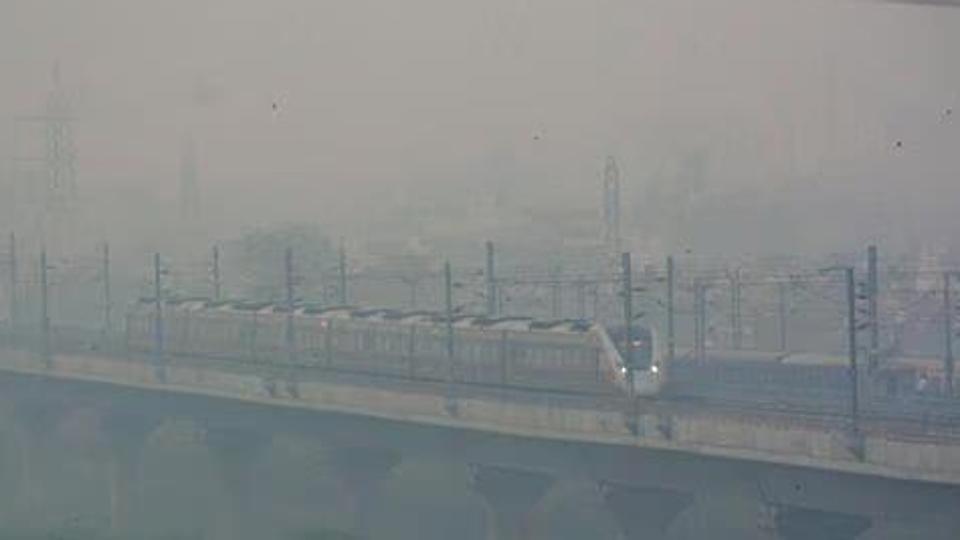
The 24-hour average AQI in the city touched 401 around noon on Saturday before dropping to 400 (in the very poor category) by 4pm. An AQI reading of 400 and above can affect healthy people and have a serious impact on those with pre-existing conditions.
Forecasts by the Centre’s Early Warning System (EWS), a forecasting model under the ministry of earth sciences, stated that conditions are set to remain unfavourable for the dispersion of pollutants over the next three days, with air quality set to worsen if firecrackers are burst on the New Year’s eve.
“Delhi’s air quality is likely to remain in the very poor category from December 31 till January 2, 2024. As weather conditions are not favourable for effective dispersion of pollutants, emissions from firecrackers if burnt on December 31, may deteriorate air quality,” EWS said in its daily bulletin.
The CPCB classifies an AQI between 0-50 as ‘good’, between 51 and 100 as ‘satisfactory’, between 101 and 200 as ‘moderate’, between 201 and 300 as ‘poor’, between 301 and 400 as ‘very poor’, and over 400 as ‘severe’.
Delhi’s average AQI on December 31, 2022, was 349 (very poor) but improved to 259 (poor) on January 1, 2023, due to strong winds.
Also Read: Moderate to dense fog in Delhi, 23 trains delayed
Fog intensity meanwhile reduced further in the last 24 hours, with the city witnessing shallow fog on Sunday. According to the India Meteorological Department, the visibility was hovering between 800-900 metres at Palam in the early hours.
No flight diversions or cancellations were reported in Delhi, with a handful of flights delayed. Northern Railways meanwhile said at least 23 trains – to and from Delhi – were running at a delay of more than one hour on Sunday morning.
In terms of temperature, there was no significant change in the minimum, which was recorded at 11.7 degrees Celsius – five notches above normal. It was 11.8 degrees a day earlier.
Delhi’s maximum temperature on Saturday was recorded at 20.3 degrees Celsius – around normal for the season. The IMD forecasts the maximum to hover around 19 degrees Celsius respectively today.