
 E-Paper



Capital’s Budget targets creating 2 million jobs
When compared to the Budget estimate of ₹69,000 crore planned for spending in the 2021-22 financial year, the government’s new allocation represents an increase of roughly 9.8%.


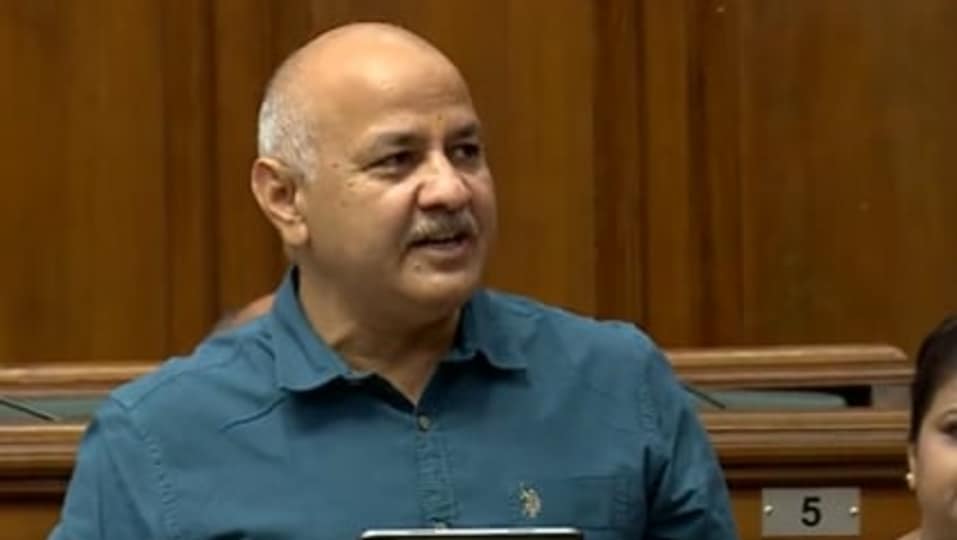
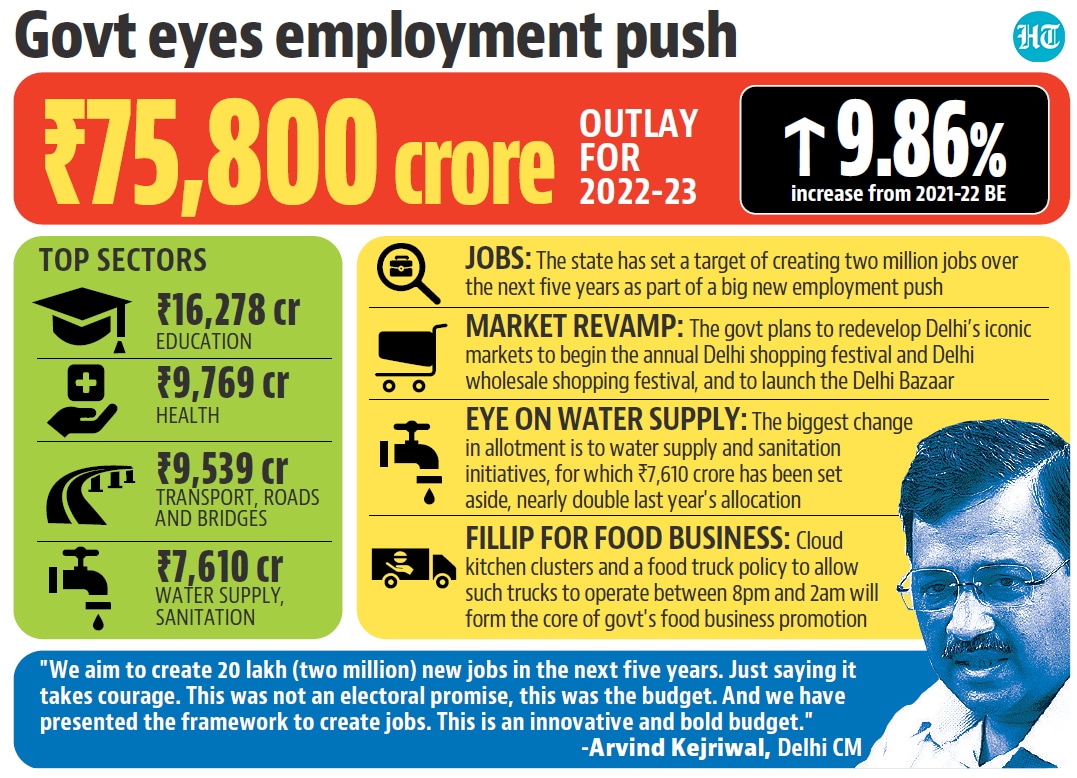
The Delhi government will target creating two million jobs over the next five years as part of a big new employment push, Delhi’s finance minister Manish Sisodia announced on Saturday while presenting the Capital’s Budget for 2022-23, which, with an allocation of ₹75,800 crore, involves plans to spend 13.13% more than expenditure during the 2021-22 fiscal year as per the revised estimates.
The thrust is based on the government’s assessments of the two most pressing issues at the time, inflation and joblessness, and the specific interventions are planned for eight sectors -- retail, food and beverages, logistic and supply chain, travel and tourism, entertainment, construction, real estate and green energy.
“I am presenting an agenda to create new jobs for the people of Delhi and to boost economic recovery from the damage caused in recent years due to Covid-19, GST, and demonetisation. This will encourage trade, industry and business, and will create a large number of employment and business opportunities for the citizens of Delhi,” Sisodia said.
“The schemes and proposals presented in this budget will not only provide new entrepreneurship opportunities to the youth of Delhi, but will also benefit the already established enterprises and businesses,” he added.
When compared to the Budget estimate of ₹69,000 crore planned for spending in the 2021-22 financial year, the government’s new allocation represents an increase of roughly 9.8%.
Sisodia said at present, roughly 33% of Delhi’s population is employed and the government plans to increase this to 45% by 2027. To do this, 16 specific interventions have been planned, he said in the assembly.
Among these is a plan to redevelop Delhi’s iconic markets -- starting with five in the first phase -- to begin annual Delhi shopping festival and Delhi wholesale shopping festival, and launch the Delhi Bazaar, an online trade platform that will help the Capital’s businesses reach global customers .
East Delhi’s Gandhi Nagar market, regarded as Asia’s largest textile market, will be redeveloped and the city’s non-conforming industrial areas will be tapped to formalise small-scale manufacturing units.
The government also plans to introduce what is described as “smart urban farming” in households, employment audits among government departments, and develop an electronic city at Baprola by setting up a plug-and-play manufacturing centre on 90-acres of land, Sisodia, who is also the city’s deputy chief minister added.
Sisodia also talked about promoting food business in Delhi by setting up cloud kitchen clusters, introducing a “food truck policy” to allow food trucks to operate between 8pm and 2am, and redevelop popular food hubs of the city. He reiterated the government’s focus on ongoing plans to release a film policy and a start-up policy, apart from promoting entrepreneurship, electric vehicles (EVs) and solar power in the city.
The government has estimated it will require about ₹4,500 crore for the programs aimed at accelerating employment during the next five years, and for 2022-23, Sisodia proposed an outlay of ₹800 crore.
In other areas, the allocation for health ( ₹16,278 crore) and education ( ₹9,769 crore) sectors have witnessed a decline for the first time since the Aam Aadmi Party (AAP) came to power in 2015. Nonetheless, these two areas were allocated the highest amount of funds.
Sisodia said the government will build a boarding school for homeless children, a plan that was reported by HT first on March 24. He also announced that a new science museum will come up in a city school, while adding that 16,000 new hospital beds and 480 mohalla clinics will be set up.
The third highest allocation was for the transport sector at ₹9,539 crore. Included in this will be what the government will spend in increasing its bus fleet to nearly 10,000 from 7,003 at present by the end of 2023, a plan that HT reported on January 26 this year.
The biggest change in allotment was to water supply and sanitation initiatives, for which ₹7,610 crore has been set aside, almost double the ₹3,274 crore as per the Budget estimate of 2021-22.
The spending plan for next year has been titled “Rozgaar (employment) budget” by the AAP government – last year’s was called the “Deshbhakti budget”. Prior to that, he presented a “Green budget”, “Health budget”, “Education budget” and “Zero Tax budget”.
Later, at a press conference with Sisodia, Delhi chief minister Arvind Kejriwal said the growth in the Budget allocations since the AAP came to power was a “miracle” when compared to other state government. “This miracle happened because AAP is staunchly honest and because the government plugged leakages in revenue sources and spending, checked corruption and stopped unnecessary government expenditure.”
However, the statements and documents released on Saturday did not speak of revenue deficit estimates.
On the overall focus of the new budget, Kejriwal said: “We aim to create 20 lakh (two million) new jobs in the next five years. Just saying it takes courage. This was not an electoral promise, this was the budget. And we have presented the framework to create jobs. This is an innovative and bold budget.”
Sisodia compared Delhi’s employment numbers with cities globally to emphasise the importance of creating jobs. “If we compare these figures of Delhi with cities like London, New York, Singapore, we find that the population of London is about 90 lakhs (9 million), out of which 51,60,000 (5.16 million) are employed. That is, about 58% of the population in London that has employment,” he said, adding that in the case of New York, the working population was 52.6% of the overall and in Singapore, this number was 67%. “To move the economy forward, and the way to move forward the per capita income will be understood from here only,” he added.
Leader of Opposition in Delhi assembly and BJP MLA Ramvir Singh Bidhuri said the budget was not an employment budget, but a “fictional budget”. “It is all just sweet dreams. No concrete programme or scheme was brought by the government to provide employment. The government could not provide any employment for the last seven years. Apart from this, failure in the fields of health, education, transport, environment, electricity, and water is also not hidden from anyone. The ground reality is nowhere to be seen in the budget,” he said.
Sabina Dewan, president and executive director, JustJobs Network, and senior visiting fellow at Centre for Policy Research (CPR), said the Delhi government’s emphasis on employment is commendable. “This is a good start, but there is a need to go beyond quantitative targets. We need deep changes that create jobs and economic mobility in the long-term. For instance, some other states have initiated concrete steps toward an urban employment scheme or guarantee. This budget makes an effort to spark urban job creation, which is good, but let’s watch for implementation. I hope there is a clear focus on the quality of jobs and not only quantity, and with a special emphasis on women’s employment,” she said.


Stay updated with all top Cities including, Bengaluru, Delhi, Mumbai and more across India. Stay informed on the latest happenings in World News along with Delhi Election 2025 and Delhi Election Result 2025 Live, New Delhi Election Result Live, Kalkaji Election Result Live at Hindustan Times.


