
 E-Paper



Delhi air may improve as wind speed picks up: IMD
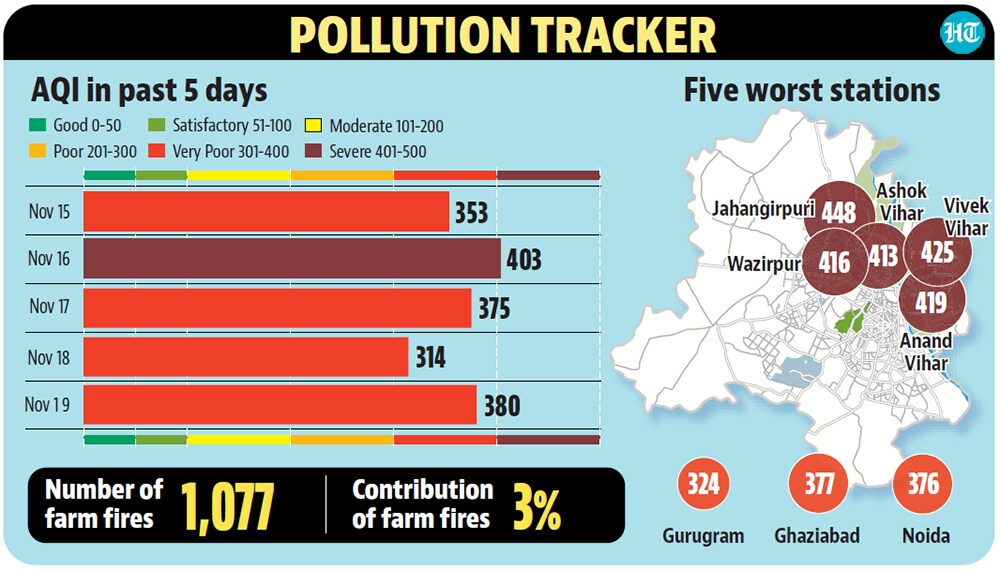
Central Pollution Control Board (CPCB) data shows that Delhi’s overall Air Quality Index (AQI) reading on Friday was 380, categorised as “very poor”.

 Prefer HTon Google


After nearly 20 days of breathing hazardous air this month, Delhi’s air quality is set to improve marginally from November 21, India Meteorological Department (IMD) scientists said Friday.
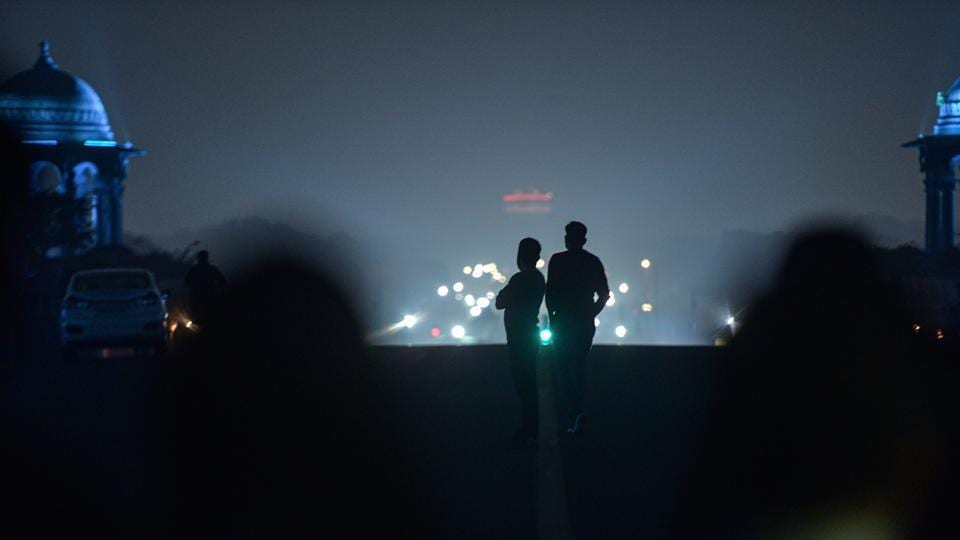
Central Pollution Control Board (CPCB) data shows that Delhi’s overall Air Quality Index (AQI) reading on Friday was 380, categorised as “very poor”. While this was a few points higher than Thursday’s 347, also considered “very poor” on CPCB’s AQI scale, forecasters said they expect wind speed to improve from Sunday, facilitating the dispersion of pollutants.
An AQI reading between 201 and 300 is considered “poor”, 301 and 400 “very poor”, and 401 and 500 “severe”.
“While the winds will continue to blow from the northwest, the speed will pick up and this will help disperse the accumulated pollutants. We are hoping that after November 21, the AQI will come down to the ‘poor’ range,” said VK Soni, head of IMD’s environment and research centre.
Soni explained that another factor for the improvement of air quality during the weekend is the reduction in the stubble fire count in the neighbouring states of Punjab and Haryana.
Union ministry of earth science’ air quality monitoring centre, System of Air Quality and Weather Forecasting and Research (Safar), said that on Friday, 1,077 fires were recorded in both the states, which contributed to 3% of the Capital’s PM2.5 (ultrafine particulate matter with diameter less than 2.5 micrometres) levels. According to experts, PM2.5 is the dominant pollutant in the region.
Meanwhile, the temperature in Delhi remained in the normal range. Forecasters said that while the city usually sees at least three or four western disturbances in the month of November, this year it has not experienced an active western disturbance since October 24.
A western disturbance refers to an area of “disturbed” or reduced air pressure, moving from the west to the east, carrying with it moisture associated with rainfall, snowfall and fog in northern India.
On Friday, the maximum temperature recorded at the Safdarjung weather station, which is the official marker for the city, was 25.9 degrees Celsius, two degrees below normal for this time of the year. The minimum temperature was 10.9 degrees Celsius, a notch below normal.
“If we experience a western disturbance, the temperature will see a drastic drop,” said Mahesh Palawat, vice-president (meteorology and climate change), Skymet Weather Services.
River of smoke
On Friday, American space agency Nasa on Friday shared several satellite images (that were taken on November 11) of farm fires-- which have led to a spike in the levels of air pollution in Delhi -- spreading all the way across the Indo-Gangetic plains as a thick plume of smoke. In the images, the Capital is almost completely shrouded by the smoke, which continues well beyond Agra, with Nasa indicating this is likely to have affected over 22 million people in a single day.
The images were taken by Visible Infrared Imaging Radiometer Suite (VIIRS) on the Suomi NPP satellite on November 11, Nasa informed on its blog.
“Looking at the size of the plume on November 11 and the population density in this area, I would say that a conservative estimate is that at least 22 million people were affected by smoke on this one day,” said Pawan Gupta, a Universities Space Research Association (USRA) scientist at Nasa’s Marshall Space Flight Center.
Delhi’s air quality was in the “severe” category on November 11, with AQI of 411, with the government forecasting body Safar pegging the share of farm fire contribution to Delhi’s PM 2.5 to be 26% that day.
According to Safar, while the contribution from farm fires has reduced, the local wind speed is calm, thereby trapping pollutants. “Local surface winds are low at the moment with moderate ventilation of near surface pollutants. From Sunday onwards, surface winds are likely to be strong resulting in effective dispersion that improves air quality,” it said.
In the blog, Nasa scientists said while lingering monsoon rain kept fire activity low for a few weeks longer than usual, elevated fire activity was observed in November. They added that fires in northern Pakistan also likely contributed to some of the smoke on November 11.
According to experts, meteorological conditions and other factors can also contribute to hazy skies, with dust from the Thar desert contributing to the haze on November 12, 2021, a separate image shared by the space agency showed.
Hiren Jethva, an USRA scientist based at Nasa’s Goddard Space Flight Center, who uses measures of “greenness,” or Normalized Difference Vegetation Index (NDVI) to anticipate fire activity each year, said this summer has seen one of the largest NDVI values in the last 20 years, based on which he had predicted this season to record a fairly high fire count. The data he uses comes from the Moderate Resolution Imaging Spectroradiometer (MODIS) on Nasa’s Aqua satellite.
“I had predicted this would be one of the most active fire seasons on record, and that is exactly what we have seen,” said Jethva. “We still have a few weeks of burning to go, but already Aqua MODIS has detected more than 17,000 hotspots in Punjab and Haryana—making this the most active fire season on record.”
Data from the last decade shows stubble burning is generally at its most active between October 15 and November 15, with a drop in activity seen from the third week of November onwards. LS Kurinji, Programme Associate at the Council on Energy, Environment and Water (CEEW), says after a late spike in the number of farm fires this year, numbers have started dropping again with less than 1,000 fire counts recorded in the last two days.
“Previously, scientific reports indicated that it takes 14-22 hours for smoke from Punjab and Haryana to reach Delhi under favourable meteorological conditions. Data from Safar indicates that on days when winds blew from the northwest, the contribution of stubble burning to Delhi’s PM2.5 level was in the range of 20-50% this year,” she explained.


